Category: Culture

  • Uniqueness of Chinese Culture

    Uniqueness of Chinese Culture

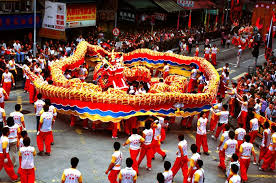
    China was known as Middle Country in ancient period and is recently one of the largest countries across the world. China follows a single time zone, even though it is spread over five geographical regions with varying time zones. Chinese culture and tradition quite, quite complex as the lifestyles of Chinese people quite differ from one region to another. One of the most important reasons for this mysterious culture is various ethnic groups followed across the country. This country comprises of different religion and it would not be surprising to commit that these religions are the pillars of Chinese society. Buddhism, Taoism and Confucianism play a vital role in making this Chinese culture, a prominent culture across the world.
    chin2

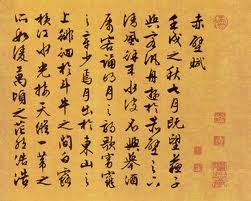
    When we talk about its art and language, then undoubtedly you will find the most innovative people in this society.  All the initiatives and invention begins from this society and in the consequences they are leading the world in many different fields. Their creativity is shown by the invention of paper, gunpowder, compass and printing technology. They have expanded their innovative and artistic ideas in pottery, painting, music and literature too. Along with so many inventive practices they are well capable of managing their tradition in today’s world. The most exclusive part you will find in this culture is its language. The Chinese language is known to be one of the oldest languages which needed only small modifications till today’s time. The unique part of this language is the use of symbols without any phonetic value. Chinese culture consists of 292 living languages with one extinct language. ‘Mandarin’ is known to be the official language in the country. During the ancient times Cinnabar ink and brushes were used for writing and drawing.
    art

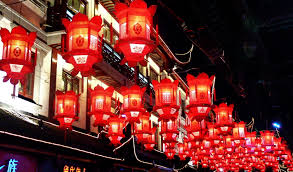
    Chinese culture is a mixture of different ethnic groups. So you will find different types of rituals and customs followed during the festivals. When we talk about the Chinese New Year which is like a Christmas in the country and is celebrated in February after the beginning of Gregorian calendar. People mark the beginning of this festive season by cleaning their houses and decorating the area with red ribbons and also give the blessing in the form of decoration. They also organize a family get together with appetizing meal. After this they all gather in their gardens or playgrounds for the fireworks which basically exorcise all the evil spirits from their soul and surroundings. It is the most adumbrative custom of Chinese people coming from the ancient time. Lantern festival shows the uniqueness of this culture. It is celebrated to mark the start of spring season. Large size lanterns are suspended on the streets and houses. Several performances like lion dances, lantern dances are organized for the people to enjoy in different areas. On this day rice dumplings and yuanxiao are the only part of their meal.
    lan

    There is a famous saying in Chinese:  ”Eating is the utmost important thing in life” so while discussing the Chinese Culture how could we forget about Chinese Cuisine. As we all know Chinese food needs no description. It is most popular and admired food all over the world. Chinese noodles, beans and rice accompanied with fish, vegetables (cabbage and peas) and meat is the most loved combination. Without Chopsticks this cuisine is incomplete. According to the geographical region the choices vary. Southern people prefer their meal being spicier and must include chili and pepper in it while northern people want ginger and vinegar to be the part of their meal.  The Chinese tea culture makes this cuisine an exclusive cuisine as tea is served there on certain special occasion and it is like a ritual which needs to be followed. There are eight families of dishes in China i.e.  Hui (Anhui), Min (Fujian), Yue (Cantonese),  Yang (Jiangsu), Xiang (Hunan), Lu (Shandong), Zhe (Zhejiang),  Chuan (Szechuan). There are four different styles in China, i.e. The Beijing, the Shanghai, the Sichuan/Szechuan and the Cantonese.
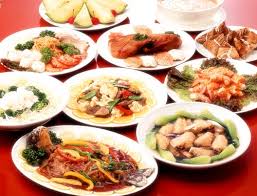
    food

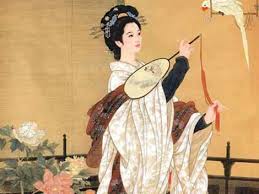
    The most essential part of any culture is how the people are dressed up. So when we go through the attire of these Chinese people, then it varies with their social ranks. Silk Clothing is put on by the royal class while another wears clothes of hemp or ramie. The traditional Chinese clothing were pien-fu which means a two piece ceremonial costume, changshan means a long dress and shen-i  means a long robe having long and loose sleeves.  Padded clothes are seen during the winter season. Their clothing is generally seen with the different embroidery designs.
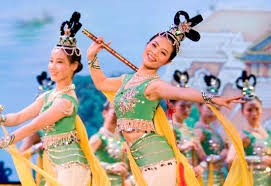
    chin1

    During the period of Zhou dynasty several national schools were established by the Chinese scholars for the training of children. A person belonging to Confucianism started encouraging people for private education. They also established various private schools which define and demarcate their own philosophy to the students. Men of this society are highly educated as compared to women as their education is only limited around the books which defines their duties towards women.
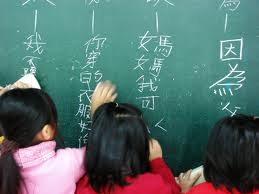
    edu

    This is all about Chinese culture which represents its uniqueness all around the world..!
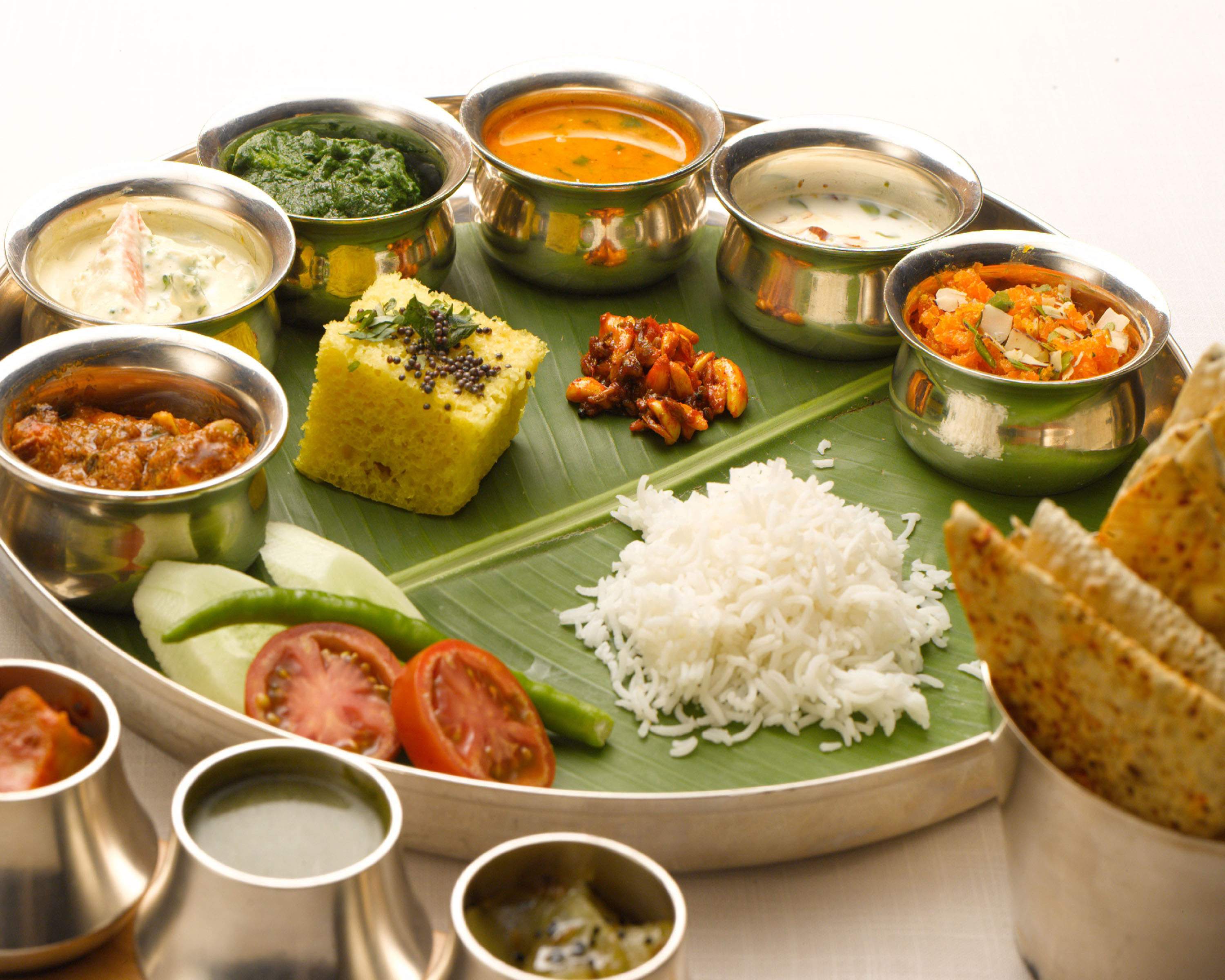


  • Hinduism and Food!
    Hinduism and Food!

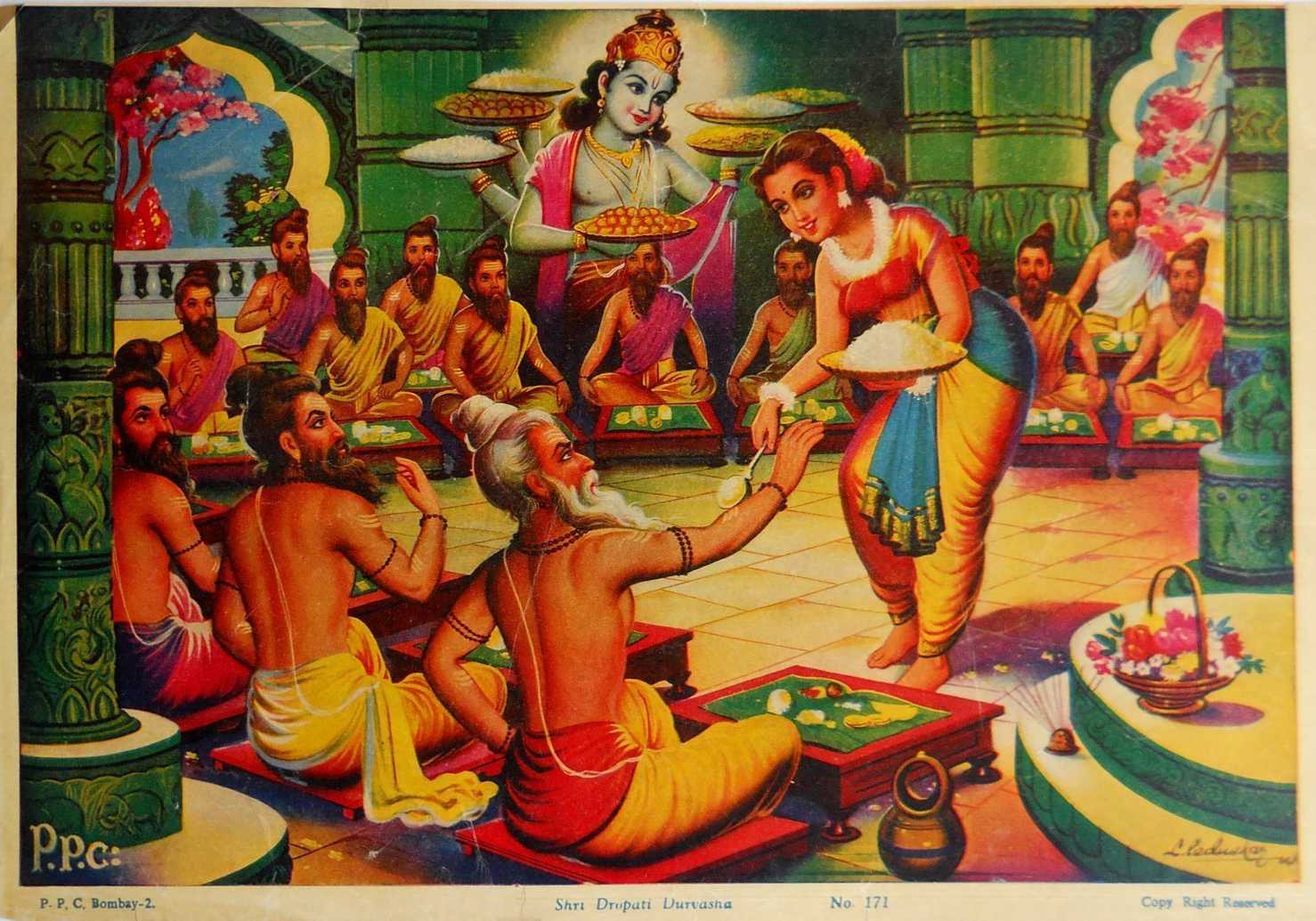
    There is a very prominent tale in Mahabharat where Draupadi had a bowl of plenty awarded to her by Sun god when she along with the Pandavas was in exile. She could take as much food from the bowl as she wanted until she herself has eaten.  One day sage Durvasa and his disciples arrived at her hut and asked Draupadi to feed them. Rishi Durvasa was known for his anger. To add insult to injury, she had already consumed food that day and knew that the pot would not yield any more eatables. She prayed to her Sakha, Lord Krishna for help. Incidentally, one grain of rice was left in the bowl. Lord Krishna took that grain and ate it up. To Draupadi’s surprise, Lord Krishna let out a belch as if just been fed with a sumptuous three-course meal. With him all the beings of the universe: the deities, yakshas , Gandharvas and also, Sage Durvasa and his disciples were satisfied.

    1

    This story indicates the importance of food in Hindu culture and mythology. In fact, food is central to almost all Hindu rituals and modes of worship. The Bhagavad Gita declares: “If one offers Me with love and devotion a leaf, a flower, a fruit, or water, I will accept it.” (9.26). The food is served in a clean place and before eating, water is sprinkled around the plate and vedic mantras are recited.  A little water is sipped before eating which is scientifically proven to be beneficial. The intension is that our mind and intellect remains inclined towards spirituality and virtues while doing everything, even, eating.

    Hindus believe that everything in the mortal world including, the five sense organs, the objects of the sense organs, elements, mind and intellect are essentially made of three qualities: Sattwa, Rajas and Tamas. Sattwa is associated with light, knowledge and purity; Rajas with activity and passion; and Tamas with ignorance, stagnancy and delusion. Consequently, different food items have different tendencies attached to them.

    3

    Foods which increase life, purity, strength, joy and cheerfulness and are savory, substantial and agreeable are Sattwic. This includes fruits, nuts, vegetables, milk and grains. The foods that are bitter, sour, saline, excessively hot, dry, pungent and burning are known as Rajasic. Onions and Garlics fall under this category and are believed to inspired passion in individuals. Tamasic food includes meat, alcohol, eggs, fish etc. Although, vegetarianism is encouraged in Hinduism, it is important to understand that these are mere guidelines that are provided to individuals to help aid the practice of meditation and there is no compulsion as far as adherence is concerned.

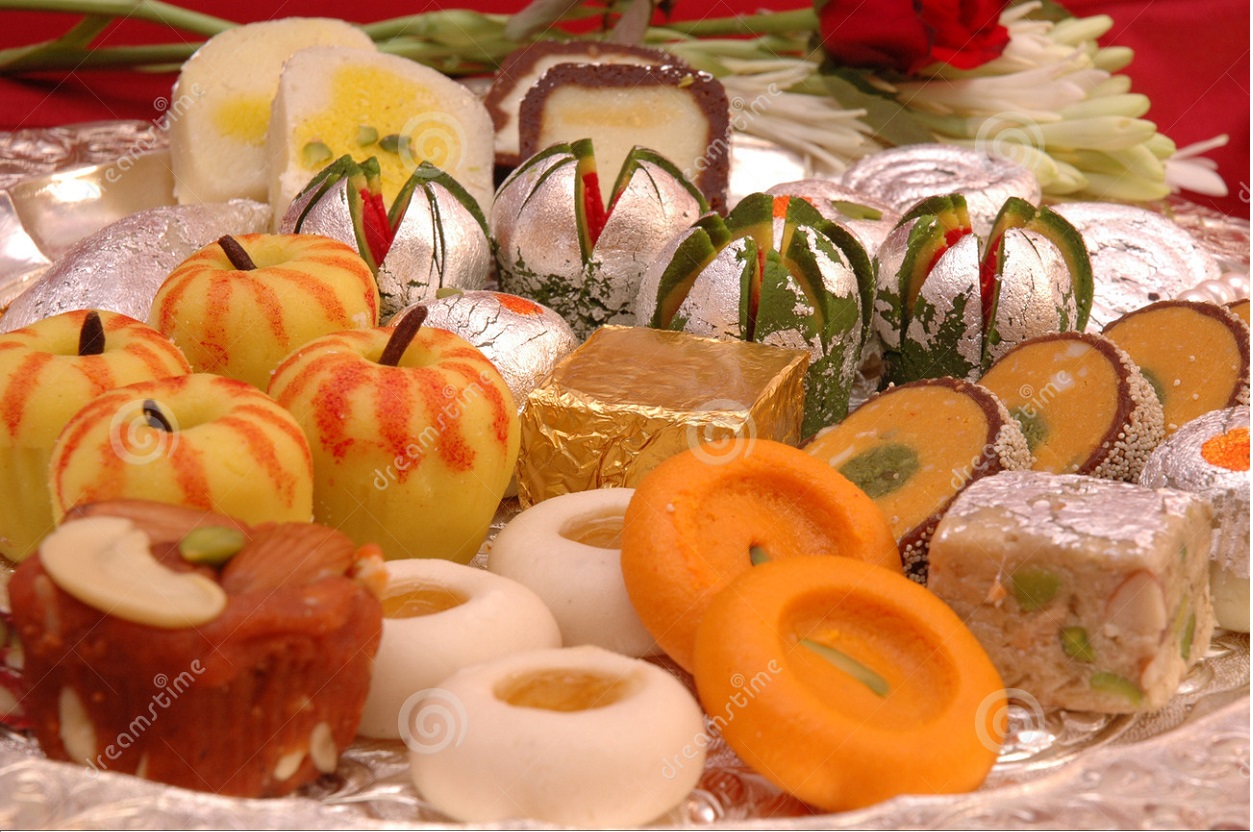
    Another important aspect of Hindu rituals is Prasad or the sacred food offering to the lord. Almost every Puja or worship is concluded by the distribution of Prasad i.e. the food that was offered to the lord during the worship. Prasad can include a variety of things such as jiggery, sweets, coconut, fruits, sweet rice, milk, tulsi leaves (Basil) etc.  The intension of the devotee is of prime importance here and not the material worth of the offering. Depending on one’s position and ability, one can offer anything with devotion. A few tulsi offered with a pure conscience will reap greater merit than gold offered with arrogance.

    4

    Growing up in a Hindu household, I have vivid memories of being restless during the entire course of my mother’s daily prayers and waiting for the Prasad at the end. During Navratras, the nine day worship of the divine mother, Bhandaras are organized.  Bhandaras are spiritual gatherings where large quantities of food are prepared by the community and then distributed to everybody who attends it. This is a form of community service where poor and ailing are fed alongside  the affluent and thus establishing their equality in the eyes of the lord.

    3

    Feast and fast, both are essential part of the Hindu experience. The festivals of Diwali, Holi, Dussehra  and Janmashtami are often associated with the preparation of delicious foods. People visit their friends and relatives and offer each other food. This helps in spreading harmony and unity in the community.  Hinduism offers a great deal of flexibility even in the case of fasting. Fasting can be complete, eating “purer” foods, adopting a completely vegetarian diet or it can be abstaining from favorite foods. It can be seen as a means of purification or as a sacrifice.

    3

    The Hindus are known to use hands to consume their food. The idea is to savor the food with as many sense organs as possible: the color and appearance of the food with eyes; its rich aroma with the nose; it’s delicious taste with the tongue and its texture with the hands. There is an interesting story regarding this. The Indian president, Dr. Radhakrishnan once met Britist Prime Minister Winston Churchill and they sat down for lunch. Before eating, Dr. Radhakrishnan washed his hands and when the food was served, took a morsel in his hands and began eating. Churchill told Dr. Radhakrishnan, “Why are you using your hands? Use spoon and fork, they are more hygienic”.

    Radhakrishnan’s repartee was, “Since nobody has used my hand to eat before, my hand is more hygienic than any spoon you can find.”

  • MANIPUR:IN THE LAND OF JEWELS

    MANIPUR:IN THE LAND OF JEWELS

    Surrounded by nine hills,the oval valley which was once a large water body,drained and unearthed by Lord Shiva himself ,the land where Lord Vishnu  is fabled to have arrived and is hence worshiped since times immemorial ,having risen up from its own ashes like the Phoenix ,behold Manipur ,the land of jewels.

    imagesimages (5)

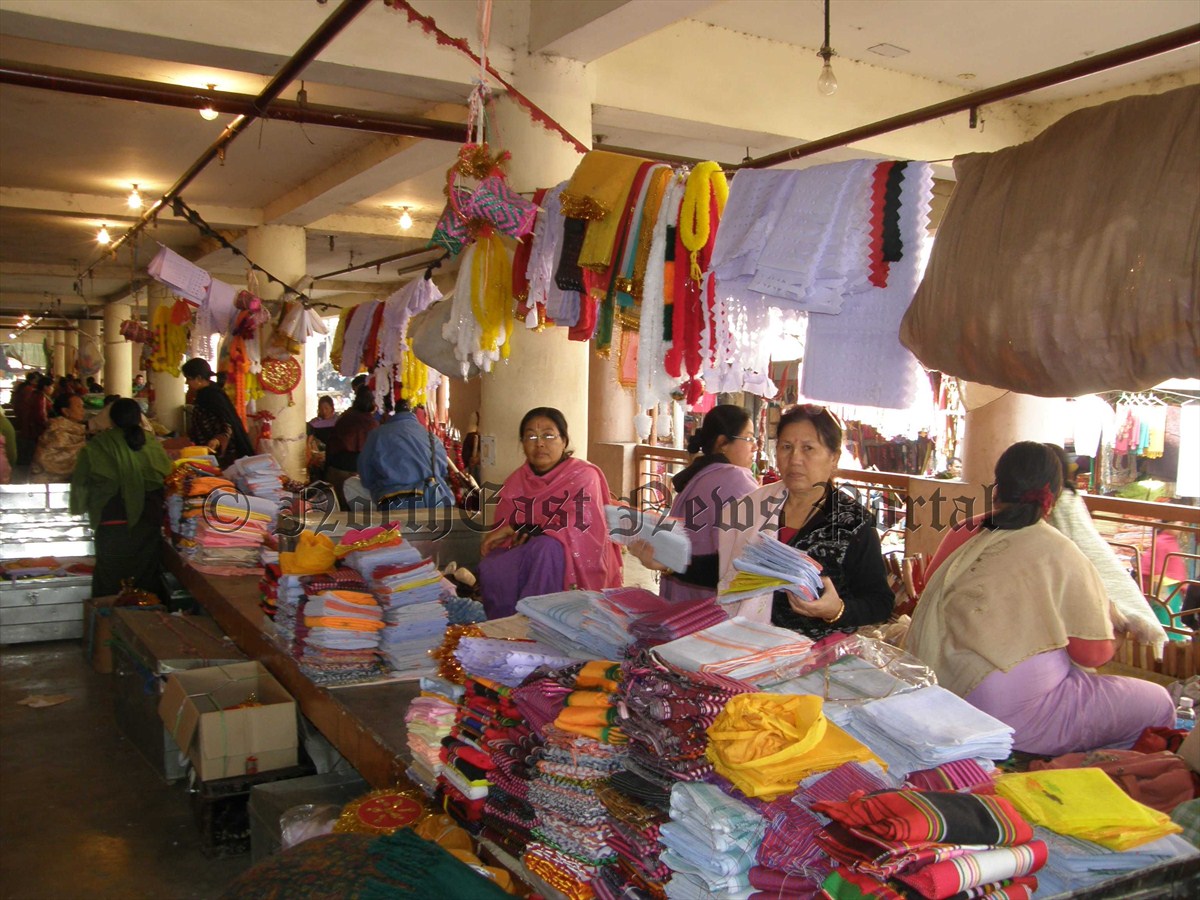
    Mentioned at least four times in the Mahabharata, the land where the children of Arjun and Chitrangada reside,where warriors and patrons rest in their graves.This place has so much more to offer than what anyone can ever imagine.Ancient yet sturdy,Manipur has created and witnessed history in the make .On the very soil of this state ,Netaji Subhash Chandra Bose furthered his march towards the nation’s self dependence and freedom .Here women and men walk shoulder to shoulder,taking up responsibilities in ways that defy patriarchy to it’s very roots.Women are respected and honored,indeed this place is a feminist heaven.Women indeed enjoy their freedom here,in fact they have an entire market run by women called the Ima market(Ima stands for mother in Manipuri) .

    P1010072

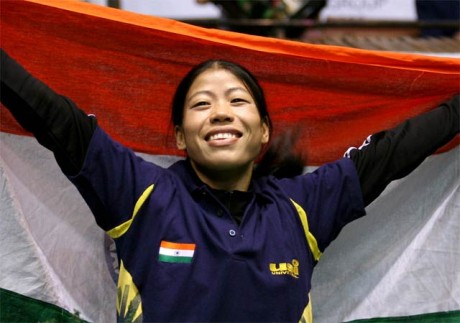
    Glorified with extremely skilled and hardworking sports person ,home to an Olympian ,Mary Kom,and many others who shall spawn .

    mary-kom_1330693060_460x460

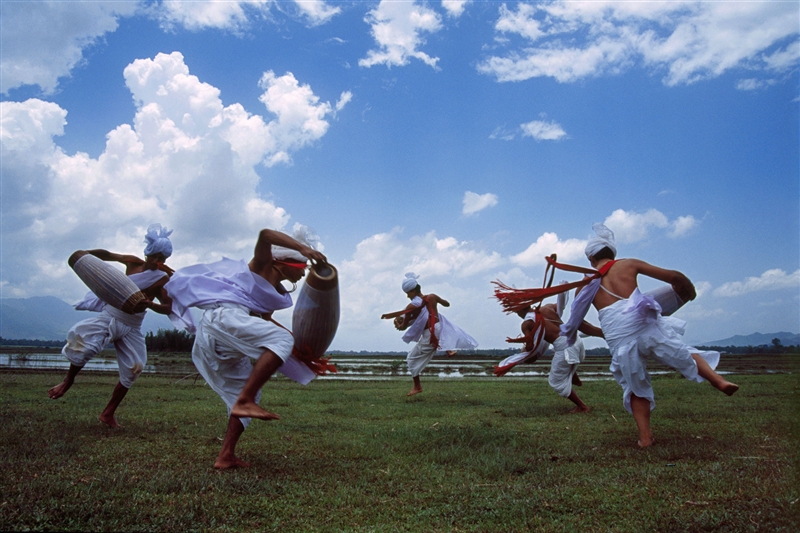
    With the Loktak lake guarding and glorifying it’s periphery,Manipur holds in its heart its rich culture ,despite having faced a two year bombardment during the second world war,and the much despised insurgent activities that has bred up an image of misunderstanding .Despite such hostilities,Manipur stands strong,and supports its culture on the pillars of belief and humanity.What you may read further are mere glimpses of its full fledged grace,though it highlights much of what many have overlooked or ignored.

    Pung-Cholam-Dance,-Manipur-JPEG
    Festivals like Yaoshang(Holi) and Rath yatra are complete projections of Manipur’s way of merry making and enthusiasm.Beginning with Yaoshang,unlike in other parts of the nation,holi is celebrated for at least a week .It is commenced with burning a miniature hut meant for Gaurang Mahaprabhu,followed by a special tradition meant for girls and boys aged thirteen and above.These youngsters participate in an energetic dance ritual called the Thabal Chongba in which girls and boys hold each other’s hand while standing in a huge circle ,hence boys and girls stand alternately in the circle.The specialty is not just the fact that one gets to hold hands,but that ,in order to do so you must first ask the girl if she wishes to hold your hand in this dance!Its like a manipuri way of asking out!Where orthodox people shun the sheer sight of a girl and a boy walking or even talking,Manipur has practiced this ritual with all it’s sincerity.When I had my first Thabal at the age of fourteen,I was pretty perplexed about the requirement of holding hands,to which my Abok(manipuri for grandmother)explained me that it was necessary for youngsters to know a right and decent manner to express likeness and accept certain changes,not just that but through this dance,they learn to speak up and even if turned down they learn o handle rejection instead of wrecking havoc in their life for being turned down. Somewhat convinced then,it is now that I fully see the potential of this ritual.Where at one hand a “no” from a girl leads to acid attack,having faced rejections in just this dance makes people better at accepting a No.The entire festival is celebrated by playing with Gulal alone,sans the nasty ingredients and colours that glue themselves on you for days.Sports being a chief interest in Manipur,they have Yaoshang games and sports events to engross and channelize people in a healthy competition.The entire week,it is but evident that  everywhere you see,the rosy colour of gulal taints the atmosphere.Beatific indeed!

    images (4)      images (3)

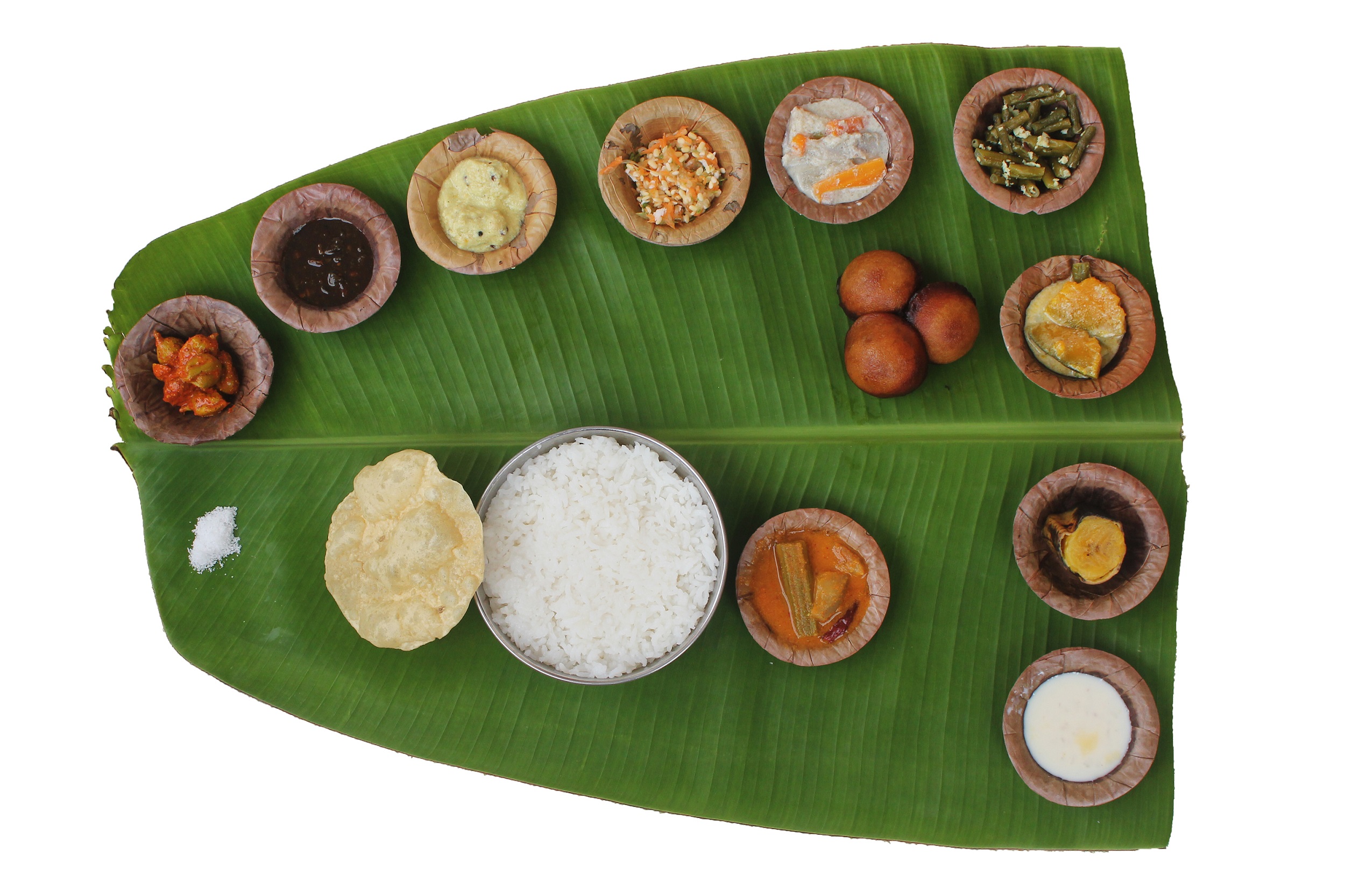
    Beginning with the food that people here eat,well they are not the one to eat almost anything and everything(so be rest assured you are not being served snake dumplings or lizard meat).The staple diet here is fish and their food is loaded with boiled vegetables sans even a single drop of oil or a pinch of  our much loved majority of spices .Amazingly spicy having being  seasoned with the hottest of chilies .To enumerate the various benefits,fish oil is extremely beneficial for the brain and maintenance of load bearing joints,and not to mention the wonders it does to the quality and growth of hair(yes that is a major secret to having such beautiful hair;ladies take note! ).The advantages of green vegetables are universally known and certified by scientists and ancestors alike since times immemorial.Super healthy and with a considerable variety of fish and prawns,this place offers you with the best of dishes that would undoubtedly boost your health and longevity.As a guest who visits Manipur at the time of such festivals and rituals ,the biggest task at hand is actually finishing this scrumptious,super healthy and variant  thali served during the celebrations.Hospitality like never before,this special treatment would pamper you and fill your tummy in ways like never before.

    manipur img

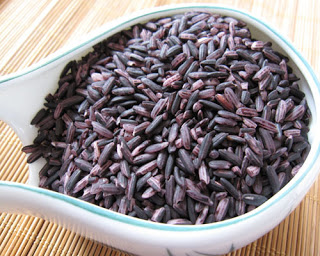
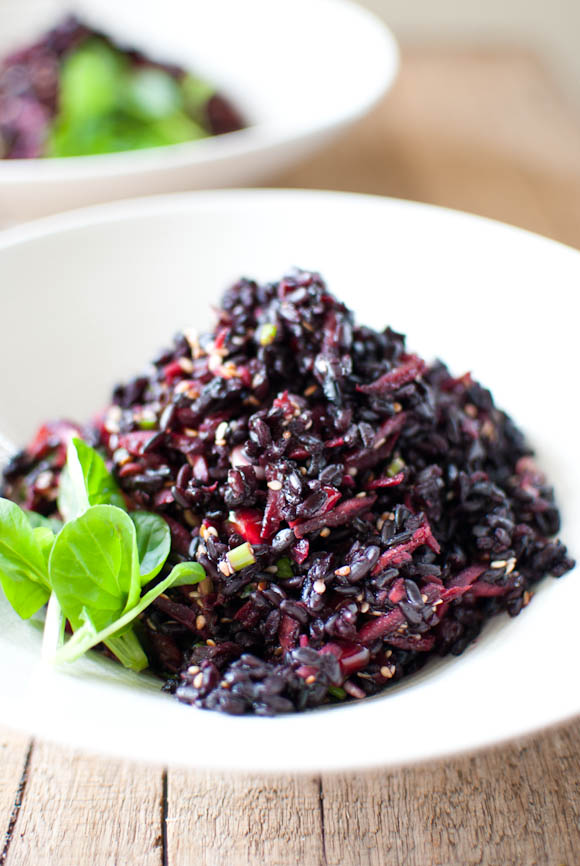
    A special variety of rice is grown here.Well mostly people would define general differences as in terms of smell and length of rice etc,but to be quite  true with an element of surprise,this rice that I speak of is actually purple in colour!It is largely used for dessert preparations and  special cuisines.

    purple riceblack rice and purple carrot salad 4

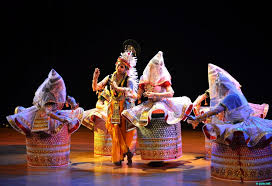
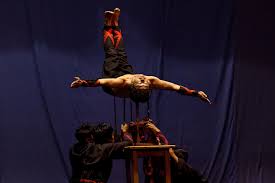
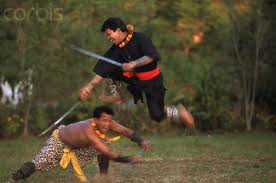
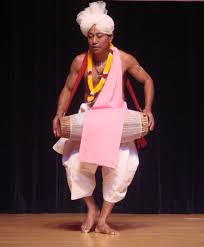
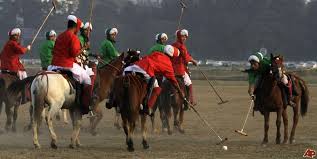
    The origin of polo,Manipuri martial arts(Thangta) ,Rasleela having been glorified by Rabindra Nath Tagore himself and Pung Chalom(the traditional dance of Manipur)are the cultural pillars on which Manipur gloriously paces ahead in time.The Switzerland of India ,this land as sacred,cryptic and lively as it is,has hence more to explore than what we see on its surface.

    images (1)        images (2)  download


  • The Culture of Convenience

    The Culture of Convenience

    The purrs of smooth engines and the coughs of not-so-smooth engines on the city streets makes for a perfect cacophony—the concrete jungle. With the hustle and bustle of modern-day living, it doesn’t take Einstein to realize that the modern youngsters are looking for convenience.

    Be it in grocery shopping, entertainment, housing, travel, relationships or even food; the one thing that would make up any rotten day is some convenience! And why not? After all the time we’ve invested in securing a future and perfecting our lifestyles, a little ‘ease-to-access’ doesn’t seem like too much of a demand. Whether we are from a bloodline of Nawabs or just another part time worker, we do quite a few things based on their convenience, or ease. How effectively it can be done seems to take a backseat on the priority bus.

    Consider a couple chit-chatting away in a quaint little coffee shop. The man, being the man and to impress the lady leans back stylishly and gestures a call with two fingers

    “Waiter!” He calls as if he owns the place.

    The waiter, in his anxious rush, trots over to the table to take their order.

    Now think about it for just a minute, what is the role of the waiter in the first place?

    It is to wait on the customers.

    Why do the customers need to be waited on when they are perfectly capable of collecting their orders themselves, using their own two hands?

    That’s right, folks; because it’s just easier that way. As long as the work doesn’t pile up on us, we’re golden! Figuratively, of course. Now certainly, it’s no crime to want for things to be convenient—it’s more of a culture; which we’ve developed over the years of evolution.

    During ancient times, it was no trouble to walk ten miles past the woods, round the mulberry bushes and beyond the wasteland to get to the river and fetch potable water. Definitely, people would call it “stupidity” if someone were to do so now, with all the plumbing and the pumps and whatnot. Certainly better this way, isn’t it? Because it’s just more convenient.

    images

    Progress and time saving are two very useful outcomes of adopting new and convenient methods. We get more work done, in lesser time, and sometimes, with a lot more efficiency. It gives us a chance to do so much more. This “convenience culture”; which every breathing being has adapted to, is helping the word move to greater heights.

    We see so many examples of day-to-day things, innovatively made easier. Moving assembly lines, digital cameras, smartphones, portable Wi-Fi, canned drinks, electricity, cars, bikes, social networking, and the list is never ending. Look to the first thing you see and think about its earlier ‘versions’. If you see a digital clock, think about when it used to be just a pendulum clock, occupying the opposite wall. If you see a suitcase with rollers, think about when it used to be a bulky wooden trunk that one had to heave around.

    See a Ducati? Those wheels used to be stone rollers.

    images (4)

    Technological advancements have played a crucial role. Work has become lesser a burden and people find more time for life.

    Another beautiful example was one that I came across a few days ago, in Chennai, near a bus stand. My father and I were starved and miles from home, when we spotted a nicely lit place with wooden-panelled walls on the inside. Past the glass doors, we saw touch-screens that clearly read “pick your order” and some queer looking conveyer belts. We looked at each other for a moment, than up at the billboard.

    It read Food Box—A convenience like never before.

    Dad and I were obviously scratching our heads, wondering why there were conveyer belts at some usual food court. Then, deciding to follow our senses and let our curiosity wander, we walked in past the glass doors and let the cool air greet us. We did as told and placed our orders by selecting them from the touch screen and waited.

    images (3)

    The conveyer moved.

    On it, came travelling a tray, sealed shut with a plastic cover, with steaming food on the inside. What was more was the fact that the order was delivered in less than ninety seconds! Now that was quick, considering we had only twenty minutes to finish up and board the next bus home.

    funded-by-mostly-friends-and-family

    It was a refreshing experience, and we had a long chat on the bus about how something like this could put the usual fast food chains out of business! The innovation had a lot of potential. People could grab their food—from a large variety—and rush out. It might not sound as exciting while reading about it but, it truly was convenient and saved us a whole lot of time.


    Taking the shortcut, however, doesn’t always make life easier. As the saying goes; too much of a good thing isn’t good. Ironically, that is very true. Despite the apparent positives that “convenience culture” brings, there is a huge load of negatives. If everyone keeps up with this want of not doing anything that’s difficult, or challenging, as spectacular it sounds, it would actually kill our mental capabilities and decrease our physical strength.

    For example, when an astronaut spends over a month in space and returns to earth, it is observed that he has lost his bone density. The explanation to this is that the lack of gravity in space makes it easier for the astronaut to move around—convenient? Seemingly so but, when you think that you’d lose your bone density, the idea of walking in zero-gravity doesn’t seem so appealing.

    The challenges we face in everyday life are like gravity. They weigh us down, yes, but only so we can grow stronger. A very disastrous side-effect of the “easy way out” is laziness. Instead of decreasing bone density, we face decreasing brain density.

    The choice is ours, really. Just because something is easy doesn’t mean that it will make us stupid, but just because something is hard doesn’t mean that it shouldn’t be done. Of course, one could argue that simplifying complexities is a key sign of intelligence, but either way, one does have to challenge the situation first.


  • Dieting or Die-Eating?

    Dieting or Die-Eating?

    Dieting_

    Oh, no. It looks as though you’ve had a row with the weighing machine. Again.

    What was it this time? The needle pointed five kilos ahead? What other options are there apart from running, yoga, swimming and various other exercises?

    Dieting, you say? Cutting down your food intake to a minimal? Are you sure you know the difference between dieting and starving?

    Unfortunately, many don’t understand what dieting truly is.

    The common misconception is that Dieting refers to controlling the amount of food or calories you ingest, in order to lose weight.

    However, the truth runs along these lines:

    Dieting is the practice of eating food in a regulated fashion to decrease, maintain, or increase body weight. That’s right, folks. Dieting doesn’t mean cutting down on your nutrition intake–it means balancing it.

    To determine a proper diet for yourself, it is suggested that you visit a dietitian and have them plan it out for you, based on your body type, weight, eating habits, height, etc.

    However, if you’re more of the future planner, it would help to know some of the long term effects of dieting

    The Long Term Effects of Dieting:

    “Success” in dieting methods has been generalized as weight loss. This implies that losing weight will lead to improved health, and yet, health outcomes are not  included in diet case studies. Do weight-loss diets lead to improved cholesterol,  systolic and diastolic blood pressure, and fasting blood glucose? 

    The question is not whether or not one should diet, but what exactly is it that dieting achieves.

    In most case studies dieting persons show minimal improvements in the above mentioned health criteria, while none correlate with weight change.

    Shocking, but true. Though weight-loss dieting might help shed those extra pounds, it only does so temporarily. In the long run, however, case studies reported that, the majority of individuals had gained almost all of the weight that was lost after dieting, if not more, regardless of continuity in their diet or exercise program. It was also revealed that after two years of dieting, up to two-thirds of dieters were even heavier than they were, prior to beginning their program!

    The “Taboo” Foods

    Certainly, when you are put under a weight loss dietary program, there are certain foods you would be required to give up or cut down on. These include, but are not limited to:

    drinksSoft_Drinks_in_Glass_with_Bottles_926f0c15-b214-4abb-9bea-2dfe2f519478-prv

    • Salad Dressings
    • Beverages like alcohol, smoothies, coffee with cream and sugar, sweetened juices, teas, and sodas
    • Certain meats like Bacon, grilled Chicken
    • Cheese
    • Croutons
    • Burgers
    • Chocolates
    • Doughnuts
    • Cookies
    • Tortillas
    • French fries
    • Potato chips

    The list could go o forever, but to sum it up, anything with carbohydrates or fats becomes a taboo. Though it is true that not all dietitians advise that you ban these foods, or tell you to cut down on their quantity, could you really live with feeling guilty every time you pass a packet of Lays, in a shop?

    Think about what we saw earlier, about how dieting isn’t really all rainbows and ponies in the long run, and ask yourself: is all the effort really worth it? Is it honestly worth it to drown in shame every time you take a bite out of something sweet, only to find out that you’ll gain the same weight, or probably more, two years down the lane, despite your efforts?

    Doesn’t seem smart.

    chips 2processed meat

    The Ignored Side Effects

    Every day, it seems there’s a new “it” diet. But now, it seems as though there’s a whole new reason not to try them all: It turns out, switching diets can drastically affect your intestinal health.

    While there are studies that show the health and medical benefits of weight loss, a study in 2005 of around 3000 Finns over an 18-year period showed that weight loss from dieting can result in increased mortality, while those who maintained their weight got the best. It has also been found that in most cases, a low fat diet causes constipation. Is that something you want to deal with? I think not. In adolescents, it is noted that along with physical ones, dieting can inflict psychological and emotional harms. The stress of being thinner usually leads to eating disorders like Anorexia and low self esteem in teenagers. Sadly though, these ill effects are shadowed by the supposedly ‘fantastic’ results of dieting, that last no more than six months after the completion of your regime.

    images (2)

    The Consequences

    In many cases, normal dieting doesn’t seem to be satisfactory. Not because you’re not doing it right, but just because it isn’t normal and your body is not ready to accept such changes as you inflict on it during the course of your diet. Sadly, these simple signs are misunderstood and dieters are lead to believe that their diet lacks severity.

    As a result, they monitor their eating habits even more strictly than they did before and needless to say, this only leads to more harm.


    1. Binge Eating: Binge eating is sometimes the outcome of having gone too long without necessary nutrition and calories. If you consistently skip meals when on a diet, it is possible to feel deprived and eat many more calories late at night, especially if you’re unable to fall asleep from intense hunger.                                                                                                                                                             download (2)
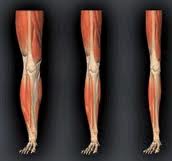
    2. Muscle Loss: Unhealthy dieting practices that don’t produce enough protein can lead to unwanted muscle loss. Your body needs protein to build and repair tissues, and carry out a large number of processes. When you don’t consume enough protein in your diet, your body will consume its own muscle mass. Ouch!                                                                                                                        muscle-loss-in-legs
    3. Fatigue and Nausea: Some unhealthy dieting practices include extreme calorie reduction. Juice fasts where you go for weeks without consuming solid foods often result in horrible side effects. Fatigue, nausea, dizziness and headaches are common consequences of these unhealthy diets.
    4. Challenge to mental Health: Unhealthy dieting is challenging for your mental health. Many people feel grumpy and irritable when they are hungry. Not getting enough calories, not having enough energy to carry out daily tasks, feeling dizzy and nauseous can all combine to push some extreme dieters into feelings of deep sadness or even depression.                                

     download (3)

    The Final Conclusion

    After having thoroughly read about dieting and it’s true colours, can you really say that it is the most natural way to lose unwanted weight?

    The challenge with weight loss diets is that they usually cannot be maintained in the long term. You may be able to survive on a short term basis on an extremely low-calorie diet, but eventually you will have to resume eating regular meals.

    The ball is in your court then. Do you prefer dieting? Or happily Die-Eating?

  • The art of Chikankari!

    The art of Chikankari!

    Gorgeous Terracotta pots, the ‘tehzib’ (polite mannerisms), the famous ‘Zari Zardosi’, the Nawabs, the eloquent Urdu poetry and the lip smacking Kebabs…Do these ring a bell in your mind? For many of us, it takes us to this one place located in Uttar Pradesh around the Gomti River, which is known as Lucknow to the world! Arts and crafts form the heart of this city. Handicrafts account for a major chunk of its economy and this place is a must-visit for everyone who has a liking for indigenous arts.  Lucknow has given another fine art form to the world, called the ‘Chikankari’.

    images

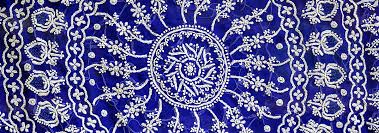
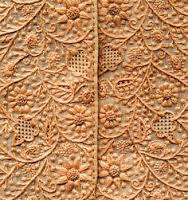
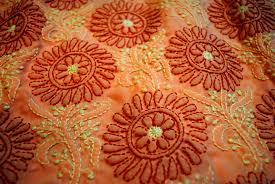
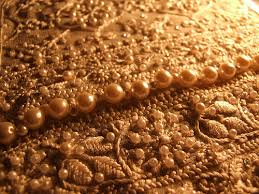
    Chikankari is a unique traditional embroidery style also known as ‘shadow work’. It is a very delicate hand embroidery done originally on soft muslin cloth using a white thread and occasionally a yellowish silk fibre. With the modernization of this old art-form, artisans have started producing these elegant marvels on a multitude of bases like semi-georgette, pure georgette, silk, chiffon and other light and thin fabrics. It is made sure that the fabric is not hard or very thick to make sewing with the needle easier. The intricacy and the exquisite gossamer characteristics of this art form lends it a very subtle elegance and a fine quality that is appreciated by designers all over the world. The art of Chikan embroidery is not just a mere craft anymore. It accounts for a large amount of income of the state through exports and is thus one of the most important economic activities practiced in Lucknow and the neighbouring areas. It provides employment to over 3 lakh people ranging from artisans, dealers, entrepreneurs and exporters.

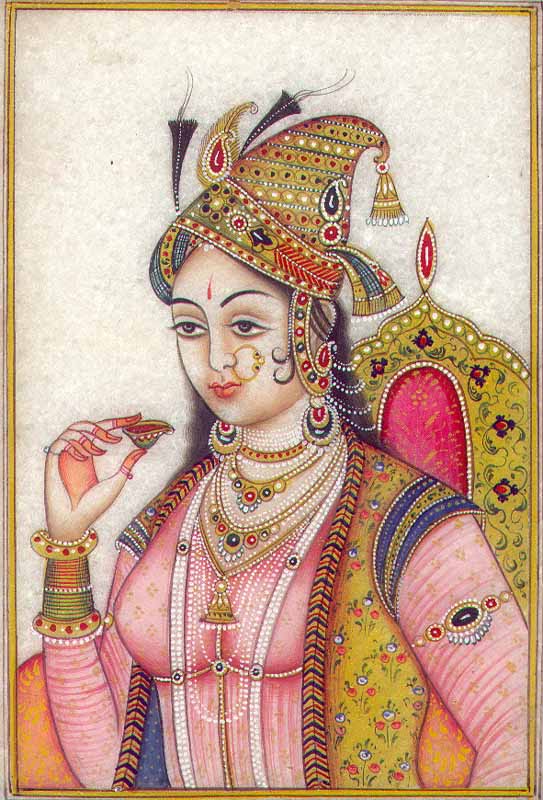
    6.-Noor-Jehan-eating-paan

    The word ‘Chikan’ has Persian roots and finds its lexical origin in the word ‘Chikh’ or ‘Chakin’ which refers to a cloth adorned with needlework. The origin of Chikan has several tales associated to it. The earliest reference to it was in the 3rd century BC when a Greek traveler, Megasthenes mentioned the use of flowered muslins by Indians. Some famous folklore suggest that a traveler passing through a village near Lucknow is accountable for the popularity of the craft. They say that the tired traveler while crossing this little village asked for water from a poor peasant who offered it graciously to him. As a token of appreciation, he taught the skill of Chikankari to the farmer so that he would never fall short of money ever again. Though it is said that Chikankari became an integral part of Indian Culture when the art form was revived by the Mughal Empress Noor Jehan. Despite being a part of the Indian heritage for centuries before this, the origin of chikan is believed to be in the town of Awadh due to the impetus given to the work by Noor Jahan.

    images (5)

    The art has a huge Mughal inclination. The inspiration from Mughal designs can be widely seen in the motifs sewn onto the fabric. Generally floral designs with plants, leaves or creepers (bel) are the most common designs used. Individual motifs and bhutis of animals and birds are also a common sight in this exquisite needlework. Fish, the emblem of Oudh is also widely used.

    images (3)

    Arabesque versions of soft roses, gorgeous lilies, intricate butterflies and other animals lend this couture a mesmerizing expression of indigenous style of the Mughal Era. Chikankari has adopted additional adornments like sequin, bead and mirror work, Mukaish, Kamdani and Badla to lend it a heavier and richer appeal. Also, apart from the original use of white thread, one can find a fine collection of threads of different materials and varied colours. Integrating this needle work with stones, embellishments or jail work gives it an eclectic appeal.

    download

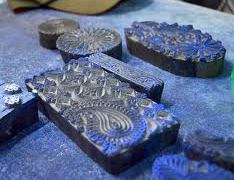
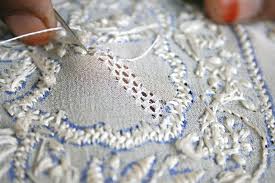
    The process of Chikankari has five different stages: Designing; Engraving; Block printing; Embroidery; and finally washing and finishing. The desired patters are sketched and then engraved on one or more dye blocks which are collectively used to put together a beautiful pattern on the ground fabric. The embroider then stitches on the pattern using different stitching patterns depending on the design and the shape required. There are around 36 different stitches that are done here. They are broadly classified into three types: flat stitches, open trellis like ‘Jali’ work and raised or embossed stitches. Some of these intricate stitching patterns are described here.

    images (2)

    Bakhya: Also called the shadow work, it has two types, Ulti and Sidhi. Normmally done from the wrong side of the fabric, Bakhya is also known as the double back style.

    Tepchi: It is a long running stitch which is employed for simple straight designs. It is usually used for outlines.

    Hool: It is a detatched eyelet stitch wherein a hole is punched into the fabric and the threads are teased apart which are then held back by small straight stitches all around. It generally forms the centre of a flower.

    Jali: Here the thread is never drawn through the fabric making sure that the back side looks as perfect as the front. The fibres of the cloth are torn apart slightly and tiny buttonhole stitches are inserted into the cloth.

    Zanzeera is a small intricate fine chain stitch generally used to outline leaves or petals.

    While Phanda is a millet-shaped stitch and Murri is a rice shaped minute stitch, both of these are used to embroider the centre of flowers in ordinary Chikankari motifs.

    images (6)

    There are various other stitches like Turpai, Darzdari, Rahet, Banarsi, Khatau and many more which lend the art work a unique look altogether. The style of stitching is chosen according to the pattern to be followed as in this embroidery style, strict rules are followed. It is obeyed that a stitch assigned for a particular purpose has no other alternative and cannot be replaced by any other stitch. Though, frames are used these days by the chikan-karigars, it was not used originally. Originally, the fingers and the thumb of the left hand were used to hold the cloth in place and then the stitching was done by the right hand. Once the stitching is over, the fabric is checked for any flaws and is then washed before it is starched and ironed. The whole procedure can take up to six to seven months.

    images (1)

    Though the art form has reached out to the world and has seen a number of variations under the impact of Globalization, it still retains its authenticity and glamour. It is widely worn by people all across the world in various forms. Be it scarves, sarees, kurtis or even gowns, this indigenous art form has spread all over the fashion industry.

    So, next time you visit the Nawabi city of Lucknow, make sure you get your collection of this prized art form!

  • The Mesmerizing Museums!

    The Mesmerizing Museums!

    Human Civilization, across the vast area of the globe has been a seat of diverse cultural evolutions. The societies all across the world have evolved culturally, economically, socially, politically and spiritually. The change in values, principles, ethics and customs is reflected in the fact that all of us had been subjected to constant change through the processes of Urbanization, Industrialization and Modernization. From the Stone Age to the Modern Machine Age, man has traversed a long course in time!

    download (1)

    The change in the cultural and social practices is well reflected in many institutions and material evidences. One of them is a Museum. A museum, as an Oxford Dictionary defines it is an institution or a building that houses objects of interest to display to the public. Wikipedia calls a museum as an institution that conserves a collection of artifacts and other objects of scientific, artistic, cultural, or historical importance and makes them available for public viewing through exhibits that may be permanent or temporary. To many, a museum is the primary source of information about the evolution of man in a multitude of aspects. To many, visiting museums is a recreational activity. To some of us, a museum is a mirror into our true origin and a way to connect to our roots. Thus, a museum is a reflection of our ideologies that date back to millions of years and yet build our present identity.

    download

    The word ‘museum’ has possibly been derived from the Greek word ‘monseion’ that meant ‘seat of the Muses’. It then referred to a philosophical institution or a place for contemplation. The Latin derivation ‘museum’ appears to have restricted to places of philosophical discussions. Thus the great Museum in Alexandria which was founded by Ptolemy I Soter in the early 3rd century BC., with a college of scholars and a library of its own, was more of a prototype university to preserve and interpret material aspects of the heritage. By the 17th century, museum was a term used in Europe to refer to describe collections of curiosities. By the 18th century, the idea of an institution called a museum established to preserve and display a collection to the public was accepted. 19th and 20th centuries have witnessed establishment of many such museums all across the world in various countries. Though continued digitization of information and increasing capacity of digital information storage along with technological advancements has caused the traditional model of a museum to become less popular, but the virtual exhibits so developed still remain dependent on the preservation and interpretation of material things by the traditional concept of the model.

    download (2)

    Visiting a museum has been a household- recreation for many. Go to a place that has a decent historical lineage and it is bound to have a museum. And if there is a museum, visiting is a good option. What we should observe here is that a museum is not just to be visited for spectating the galore of our forefathers. It a place to connect to our history, gain information, promote our national and cultural identity and hence make it a memorable experience. These cultural institutions foster intercultural awareness and restore a sense of dignity and identity to many communities. They could also resolve conflicts. People and communities in areas infected with unrest and conflict could appreciate each other’s ancient history and thus co-exist in harmony if they were made aware of it through such institutions. UNESCO suggests making entries to museums free to promote the culture among various people irrespective of their caste, creed, social and economic status. The value of ancient arts and culture chimes in sync with the modern ethics of our society in the concept of museums. Quoting the exact words of NDMC that says:

    “The museum sector believes that it makes a real difference to people’s lives. It is a line that is frequently used to advocate and promote our work to stakeholders; but what does it mean and how might we investigate it? What is the nature of the impact that museums have on the individual and how does this play out in communities, societies and even nations?”

    images

    Museums are fundamentally driven by the human desire to delve evidence for secure meaningful information and to dig deeper for accounts of experiences. What a museum intends to do is make a cultural impact, by stimulating knowledge transfer, deliver life-enhancing skills, development of basic virtues and skills of patience, observation, reasoning out and hence the overall development of a human mind. It strives to establish an emotional connect and development of ideas or an increase in the capacity to learn.

    Given the significance of museums in our fast modern lives, it is a definite fact that the galore of these institutions is not to be given a miss. There are various museums in the world in different continents that are not just objects of cultural significance but reach out to the masses to etch a permanent impact on their minds. Having said that, let us have look at some of the famous museums of the world.

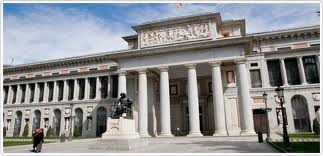
    1.)    The Prado, Madrid, Spain

    images (1)

    The Royal family of Spain curated and commissioned art with utmost passion. In addition to their fine taste and interest, their huge collection of the best Spanish paintings and works of the best artists from across the globe made them establish this museum. It was open to public in 1819 by Fernando VII in the neoclassic building designed by Juan de Villanueva.

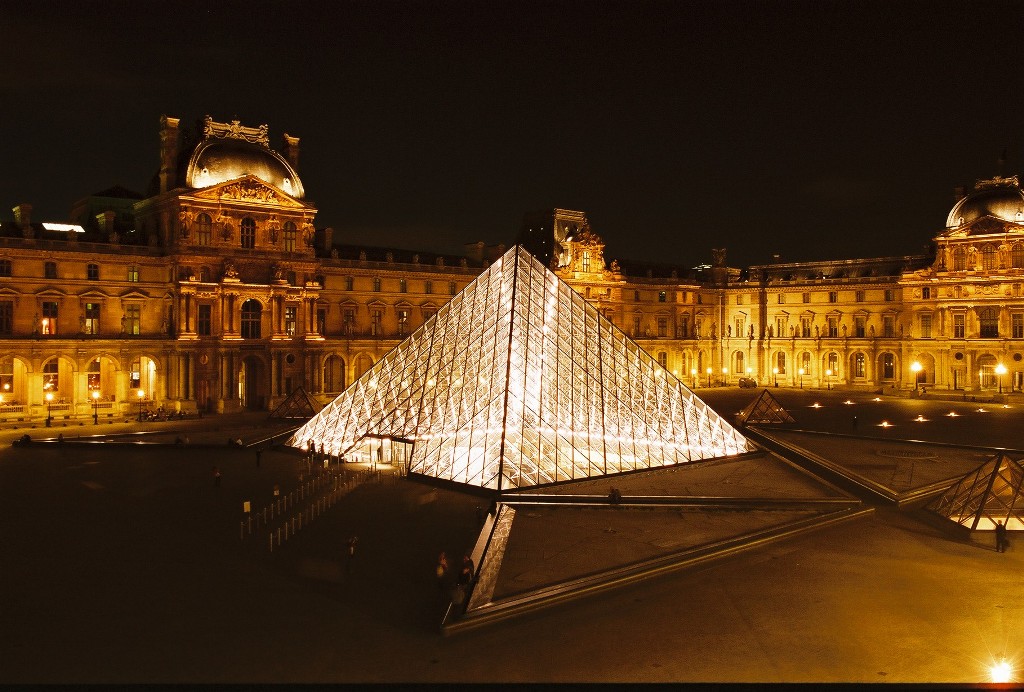
    2.)    Le Louvre, Paris, Spain

    Le-Louvre

    One of the largest and the most visited museums in the world, with over 9.3 million visitors in 2013, this museum is popular enough to make people swoon over it just by its name. Housed in the Louvre Palace, a former Royal Palace, it was opened in 1793. The famous glass pyramid added in 1989 is one the major attractions. The most famous exhibit being the classic painting of the Mona Lisa by Leonardo da Vinci.

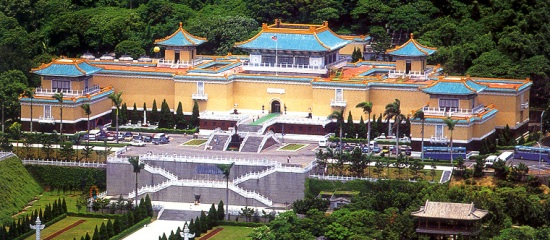
    3.)    National Palace Museum, Taipei

    W020090108346006316518

    The National Palace Museum boasts of the largest collection of ancient Chinese artifacts. The museum was originally established Beijing’s Forbidden City in 1925, after the expulsion of the last king of China. In the final years of the Chinese Civil War, the most precious items of the collection were transported to Taiwan.

    4.)    State Hermitage Museum , Saint Petersburg, Russia

    Winter_Palace_facade_large

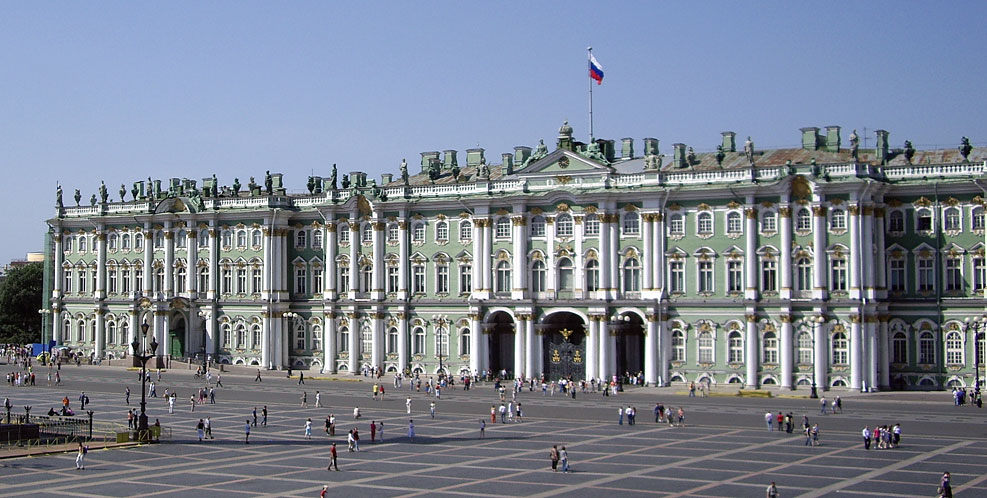
    The Hermitage has acquired a mesmerizing collection of arts from all over the world varying from the times of the Stone Era to the early 20th century. The glorious blue- and-white structure consisting of 6 buildings, was completed in 1764 and had served as the main residence of the Czars for several centuries. Founded by Catherine the Great, this massive museum houses some of the best works of famous artists like Michealangelo, Leonardo Da Vinci and more.

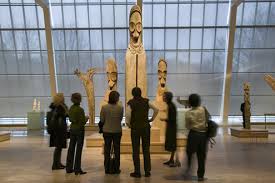
    5.)    The Metropolitan Museum of Art, New York City

    met

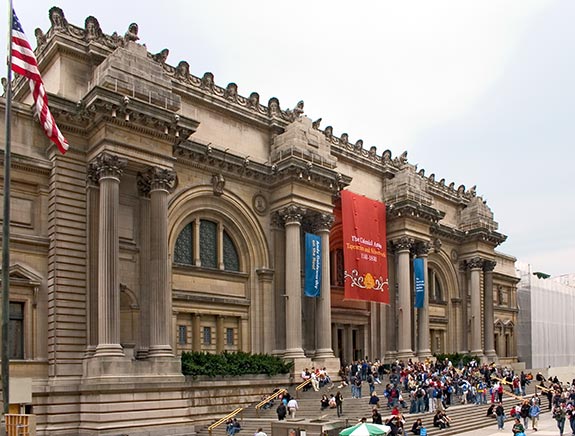
    Also known as the Met, This is an art museum located on the eastern edge of Central Park in the New York City. The vast gothic-style building was opened to public in the year 1872 and had been subjected to various add-ons after that. It has on exhibit, some of the finest works of art from across the human history depicting almost every field of craft in existence. It also organizes travelling shows throughout the year.

    6.)    Smithsonian Institution, Washington D.C.

    smithsonian

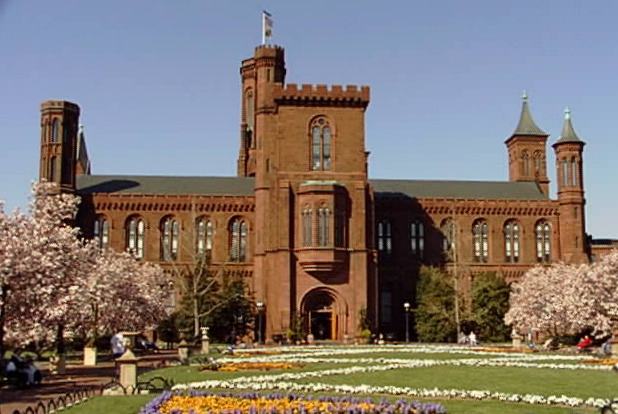
    This is the world’s largest research and museum complex. It includes 19 museums and galleries, the National Zoological Park and many research stations. Dorothy’s ruby red slippers, the dresses of the First Ladies, the Gem Hall and the Wright brothers’ 1903 flyer are some of the major attractions here.

    7.)    The British Museum, London, England

    download (4)

    This museum boasts of being the national collection of archaeology and ethnography ranging from pre-historic bones to pieces of Athens’ Parthenon. It houses the Rosetta Stone that was carved in 196 B.C. It was established in 1753 and has the largest collection of mummies outside of Egypt.

    8.)    Vatican museums, Vatican city, Rome

    download (3)

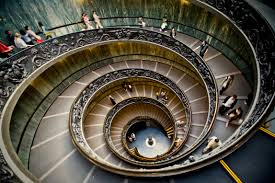
    It was founded by Pope Julius II in the 6th Century and are the most famous for the spiral staircase. The exquisitely decorated Sistine Chapel is another proud acquisition of the museum. The chapel ceiling was painted by Michelangelo between 1508 and 1512.

    9.)    The Egyptian Museum, Cairo

    download (5)

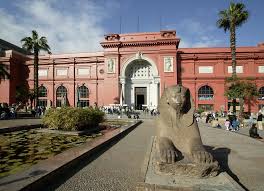
    It is counted as one of the worlds’ best museums. It has a huge collection of papyrus and coins used by ancient Egyptians. Also, it houses many artifacts from the final two Egyptian Dynasties and from the Valley of Kings. Main attractions are the Royal Mummy Room containing 27 mummies from the pharaonic times.

    10.)Museo Nacional de Antropologia, Mexico City

    download (6)

    The Museo Nacional de Antropología or National Museum of Anthropology was opened in 1964. It contains archaeological artifacts from the pre-Columbian heritage of Mexico. The most famous object of attraction is the Stone of the Sun which was not used as a calender actually but contains 20 day signs and the four eras of suns that preceded the present 5th sun.

  • The Lebanese Trail

    The Lebanese Trail

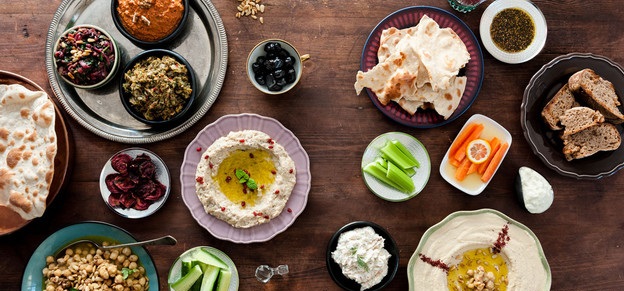
    Since my affection for Lebanese cuisine transformed into an obsession, and I started to empty my pockets at every other Lebanese joint in the city, which though made me popular and loved among their owners, but my savings began to race to the descending point. I was worried, and about to become penniless, but my obsession was experiencing its ascending waves and ridges, that didn’t seem to end. And, so I had this (brilliant) idea of saving myself, all that expense, with only a little bit of research and lots of effort. I started to cook, bake and indulge in the Lebanese delicacies on my own, and here’s the itinerary of my palate-pampering venture!
    FALAFEL

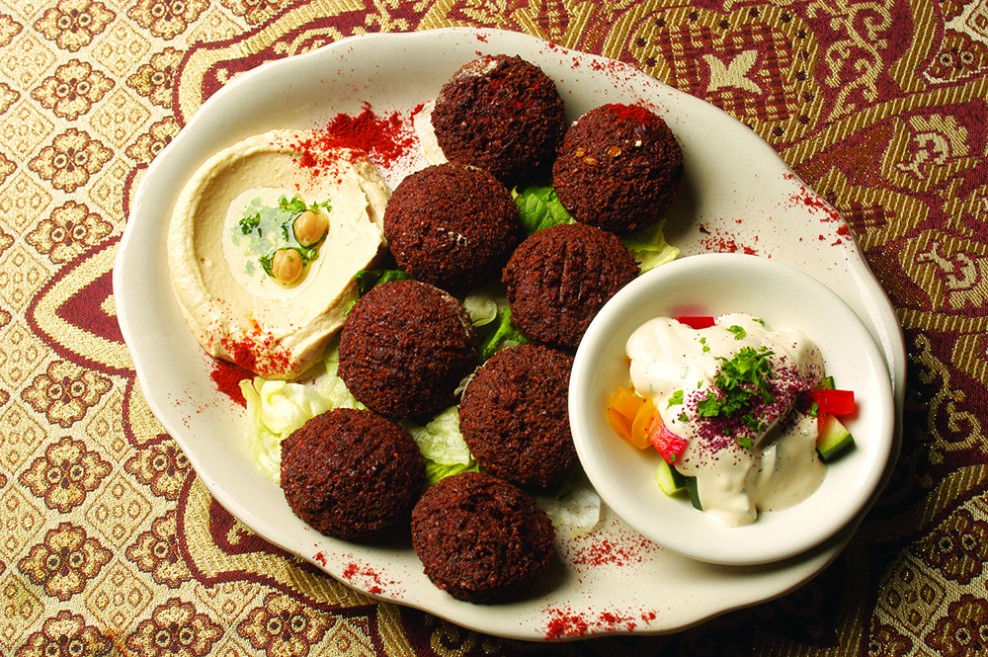
    FALAFEL-PLATE-988x657

    A traditional Middle East delight, this dish takes only two hours of dedication, and delivers you with varied options of consumption of its heavenly taste. This can be enjoyed with pocket-mouth pita bread, or wrapped around with lafa, which is a flatbread. Top it up with some fresh salad, spicy hot sauce, pickled vegetables, or the traditional drizzle of tahini-based sauces would do the magic!

    INGREDIENTS

    • Dried chickpeas or garbanzo beans – 1 cup
    • Chopped onion(large) – 1
    • Chopped garlic – 2 cloves
    • Chopped fresh parsley – 3 tablespoons
    • Coriander – 1 teaspoon
    • Cumin – 1 teaspoon
    • Essentials according to taste – Salt, oil and pepper.

    METHOD

    • This step isn’t really required if you’re using canned beans. But otherwise, place the dried beans in a bowl and fill the bowl up with cold water. Allow them to soak overnight.
    • Next morning, drain the chickpeas and pour them into a pan of fresh water and bring to boil.
    • Let it boil for some 5 minutes and then allow to simmer on low flame, for about an hour. Then, drain and cool for 15minutes
    • Assemble chickpeas, onion, coriander, garlic, cumin, salt and pepper in a bowl and add flour to it.
    • Mash the chickpeas along with all the other ingredients (this can be done in a food processor) to make a thick paste out of it.
    • Make small balls out of the mixture, and slightly flatten them.
    • Deep fry until golden brown.
    • Serve hot, with humus, tahini or pita bread and salad!

    TARATOR SAUCE

    taratour-sauce-01

    My personal favourite! This heavenly sauce goes with almost everything edible under the sun. Try it with veggies, seafood, beef, chicken, or lamb, and discover the extra edge.

    INGREDIENTS

    • Sesame seeds (for Tahini paste) – 2 cups
    • Olive oil- 4 tablespoons
    • Lemon juice – ¾ cup
    • Water- 2 tablespoons
    • Crushed garlic- 2 cloves
    • Salt- ½ teaspoon
    • Finely chopped parsley – ½ teaspoon
    • A dash of cumin

    METHOD

    • To make the Tahini paste, roast the sesame seeds gently over low heat while stirring continuously for about 10 minutes. The colour is not needed to change, so when done, remove flame and keep it aside to cool.
    • Add the roasted sesame seeds to a food processor bowl along with 4 tablespoons of olive oil and make a thick paste out of it. Add more oil if needed. Your tahini paste is ready, so let it cool and then refrigerate.
    • Again, in a food processor, assemble tahini paste, garlic, lemon juice, salt, and cumin together and mix well. Keep adding water while mixing, but maintain its thickness.
    • Remove from the processor into a bowl and stir in parsley. Refrigerate it in jars and indulge!

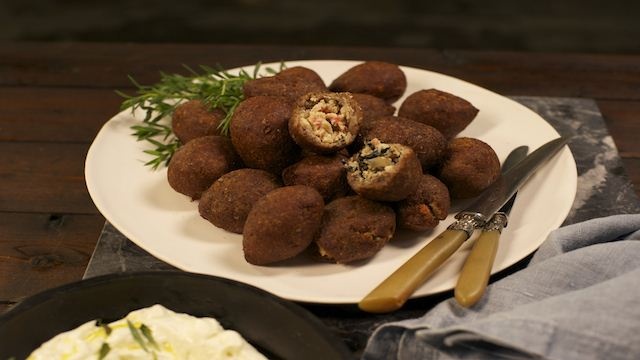
    LAMB AND KISHK KIBBEH

    6c2b5108fcfd3432a494083b560b5f3c

    INGREDIENTS

    • Olive oil( to deep fry)
    • Greek-style yoghurt
    • Tarator sauce for garnishing

    Kibbeh shell

    • Fine Burghul( cracked wheat) – 300g
    • Hot water – 675ml
    • Sabaht baharat (Lebanese seven spice: a combination of ¼ tsp. cloves, ¼ tsp. cardamom,2 tsps. cumin, ½ tsp. nutmeg, 1 tsp. coriander, ½ tsp. cinnamon and 1 tsp. pepper with 2 tsps. smoked paprika. Ready-made is available in stores)
    • Lamb leg(all sinew removed and cut into small pieces)- 360g
    • Salt and black pepper

    Kibbeh farce

    • Olive oil- 1 tablespoon
    • Finely chopped garlic- 1 clove
    • Finely chopped small brown onion- ½
    • Finely chopped silverbeet leaves and stems- 2
    • Cooked and mashed chickpeas- ½ cup
    • Sabaht baharat- 1 tablespoon
    • Peeled and chopped tomatoes- 2-3 cups
    • Dried mint- 3teaspoon
    • Kishk powder – 50g
    • Labna- 30g
    • Salt and pepper, to taste

    METHOD

    • For the kibbeh shell, soak the burghul in hot water until they turn soft. Drain the excess water after it’s done.
    • Combine the softened burghul, sabaht baharat and lamb in a bowl, and season it with salt and pepper. Mix and then mince the mixture along with the meat.
    • In a food processer then process the entire mixture until a thick and sticky consistency is formed. Cover and refrigerate.
    • For the kishk farce, in a frying pan, add oil and garlic and sauté for 1- 2 minutes on medium flame, until its fragrance fills the air. Toss in the onion and silverbeet stems and cook for 2-3 minutes, until the onion softens.
    • Add the silverbeet leaves, chickpeas, sabaht baharat and sprinkle a pinch of salt and let it cook until the leaves are wilted.
    • Add the tomatoes and dried mint into it and cook for a minute, just to soften. Remove it from the flame and add the kishk powder and labna and mix. Transfer in a bowl and refrigerate.
    • To assemble, take an egg sixe amount of kibbeh shell mixture and shape it into a ball. Poke a hole in it, using the thumb and keep digging deeper to make space for the filling. Stuff a tablespoon of kishk farce in it and seal the ball. Repeat it with the others. Once done, refrigerate them for half an hour to set and firm up
    • Then, deep fry the kibbeh in a saucepan for 4-5 minutes until dark golden. Drain on a tissue to get rid of the every oil.
    • Serve hot with the heavenly tarator sauce, or yogurt and salad.


    LAMB SHAWARMA

    chicken-shawarma-8-4-11

    INGREDIENTS

    • Plain yogurt- 2 cups
    • Distilled white vinegar – ¼ cup
    • Olive oil – ¼ cup
    • Lemon juice – 3 tablespoons
    • Garlic, minced – 3 cloves
    • Ground cinnamon – ½ teaspoon
    • Ground nutmeg – ½ teaspoon
    • Dried oregano – ½ teaspoon
    • Bay leaves- 2
    • Boneless lamb legs(cut into strips) – 3 ½ pounds
    • Olive oil – 2 tablespoons
    • Pita bread rounds (8-inch) – 8 pieces
    • Tomatoes (thinly sliced) – 2
    • Onion( thinly sliced) – 2
    • Fresh mint or coriander leaves – ½ bunch

    METHOD

    • Whisk in yogurt, vinegar, ¼ cup of olive oil, garlic, cinnamon, nutmeg, lemon juice, oregano and bay leaves, in a bowl, and then pour the mixture into a re-sealable plastic bag.
    • Put the thinly sliced meat into the bag to coat them with the marinade and seal the bag while squeezing out the excess air. Marinate the lamb, in a refrigerator, overnight.
    • Next day, in a heated non-stick pan add 2 tablespoons of olive oil and pour in the lamb and marinade. Cook until the lamb has lost its pinkish hue and is tender (for about 15-20 minutes).
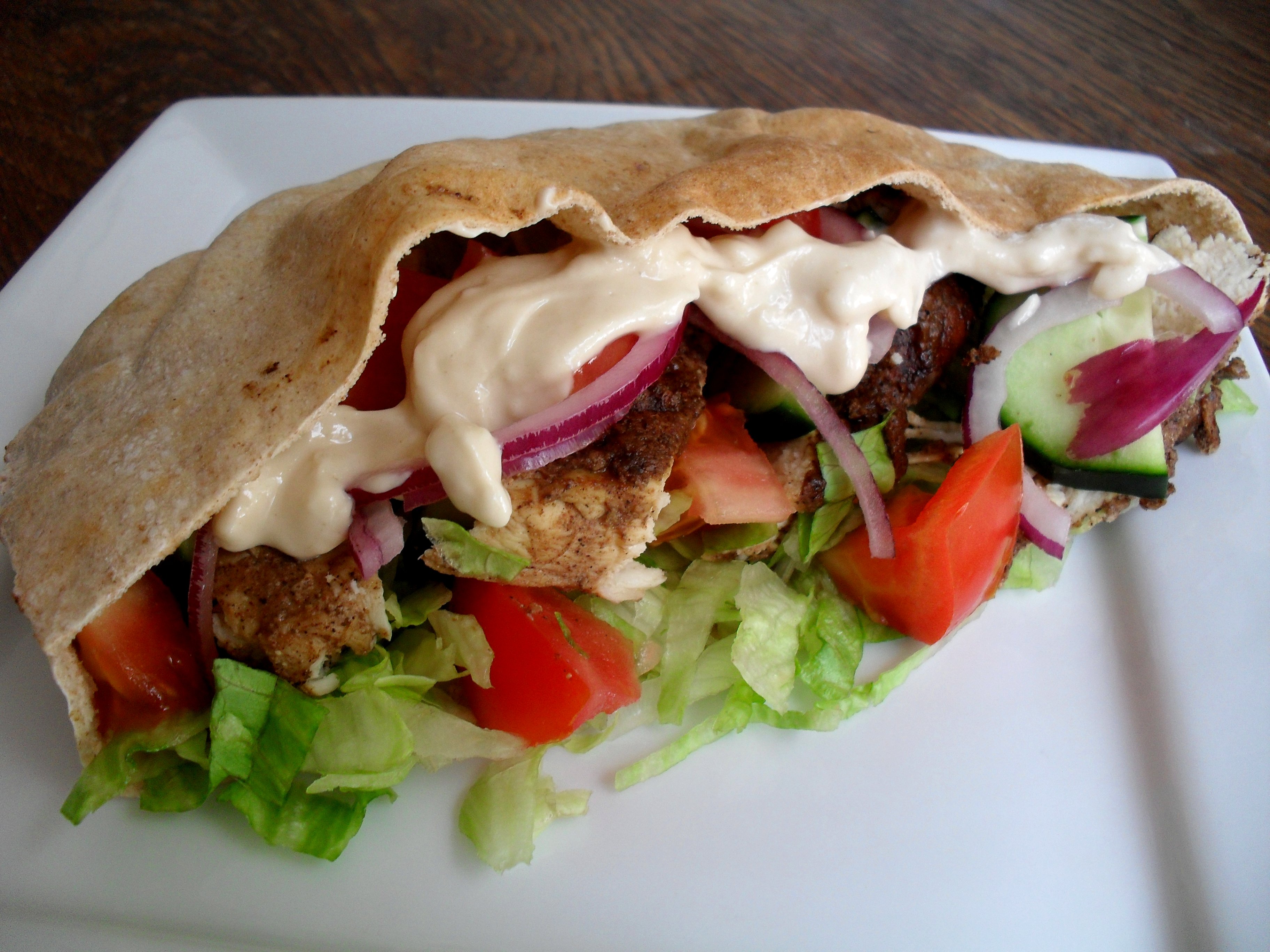
    • Continue stirring while the meat cooks. Once done, divide the cooked lamb among the warmed pita breads, and garnish with tomatoes, onions, fresh mint or coriander leaves. Serve with Tarator sauce at the side (you can also sauté the onions and tomatoes, for a spicier texture, but I like them fresh because it’s healthier that way!)


    Tada!

  • Diwali-A festival of lights

    Diwali-A festival of lights

    Diwali is celebrated by Indians all over the world with great happiness.This is the reason it is most popular and is also most likely festival in the country as well as abroad.Diwali is also known as festival of lights.Diwali is different from other festivals it doesn’t comes with one day celebrations, it brings a series of holidays along with it.On the day of Diwali goddess Lakshmi is worshiped with most devotion and peace of mind.During the Diwali season lights, crackers, sweets are shopped frequently everywhere in India and abroad.This festival generally falls in the month of September-November.The festival is generally celebrated as the victory of good over evil.It can also be said that the victory of  light over darkness and knowledge over ignorance.The festival gets its name from lamps ( known as deepa ) that are arranged in a row ( known as avali ).As Indians on the day of Diwali arrange lamps outside the house in a row, it is known as Deepavali.By doing so they feel that  that it is a symbol for the inner light that protects us from spiritual darkness.

    Diwali a festival of flowers
    Diwali a festival of flowers

    Five day festival:

    First day ( Dhanteras ) :

    According to Hindu month diwali starts with Dhanwantari Trayodashi, it is the thirteenth lunar day of Krishna Paksha.This Trayodashi is popularly known as Dhanteras.According to few beliefs, on this day lord Dhanwantari came out of ocean with ayurvedic to look after the welfare of mankind.On this special occasion people worship god of death Yama by lightening a yama diya.There is a tradition from many years that buying a utensil on this day will bring good luck.

    First day of Diwali celebrations
    First day of Diwali celebrations

    Second day( Choti Diwali ):

    The second day of Diwali is Narak Chaturdashi.Ancestors say that lord Krishna has killed the demon Narakasura on this day to make people free from fear.On this special people have oil massage to body and they take bath on this day.There is also a belief that people who don’t take bath on this day will go to Narak.

    Narak chaturdi celebration
    Narak chaturdi celebration

    Third day ( Lakshmi Puja ):

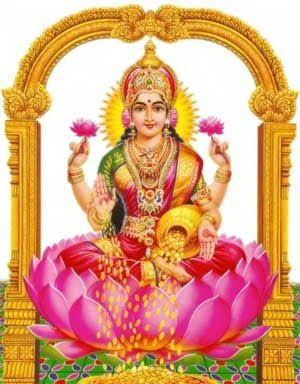
    The third day of Diwali is the main day of Diwali and is known as Badi Diwali.On this day people worship Goddess Lakshmi with divine and peace of mind to bless them with wealth and prosperity.Many of the business people do this puja every year to seek blessings from goddess lakshmi.All the women at home do this puja asking goddess Lakshmi to look after their family.On this day people clean their homes and decorate it with various colorful lights and fire crackers to express their joy.

    Lakshmi puja on third day
    Lakshmi puja on third day

    Fourth day ( Govardhan Puja ):

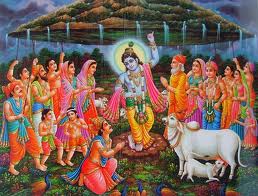
    The fourth day of Diwali is celebrated as Gowardhan puja.The name itself specifies that on this day we must worship gowardhan parvat.Legends say that on this day lord Krishna offered pooja to gowardhan parvat to protect people from heavy rains.Since then it became a tradition for Hindus to worship Govardhan Parvat.

    Govardhan puja on fourth day
    Govardhan puja on fourth day

    Fifth day ( Bhai Duj ):

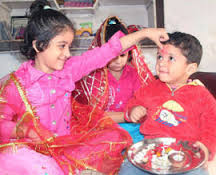
    The fifth day of Diwali is celebrated as Bhai Doj.The name itself says that it is the time to honor brother and sister relationship.Legends say that on this day when brothers visit their sisters they will get rid of all their sins.Thus on this day brothers visit sisters and and sisters sweeten their mouth with sweets.This day ends the festival Diwali.

    Brothers visit sisters on fifth day
    Brothers visit sisters on fifth day

    Lights and fireworks:

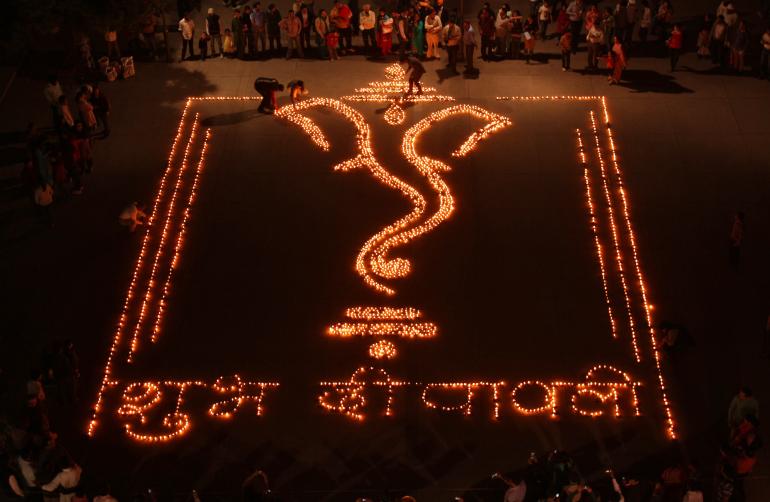
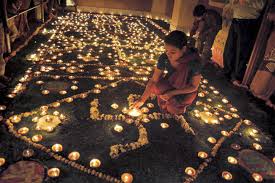
    As the name specifies that it is a festival of lights arranges in a row.On this special occasion houses, shops, public places are decorated with oil lamps in a attractive manner.Few people replace oil lamps with candles.The lamps are lightened using mustard oil and mostly placed in a row in windows, doors and outside buildings.These lamps are lightened to welcome goddess Lakshmi into home’s.The main reason for the celebration of the festival is that the return of Lord Rama and Sita to Rama’s kingdom after fourteen years of exile.On this day oil lamps are often seen floating on the rivers especially Ganges.

    Diwali lights
    Diwali lights

    Fireworks:

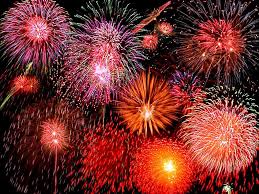
     The illumination of fire crackers is mainly for the better maintenance of health, wealth, knowledge, peace and prosperity.People living on earth enjoy firing crackers.There is a reason that during the month of the festival as winter falls, few types of bacteria will rice up due to the atmospheric changes.To kill those bacteria and insects people fire crackers and the fumes produced by the crackers kill a lot of insects and mosquitoes, found in plenty after the rains.Fireworks are a big part of the Diwali celebrations.But since many years there are some movements against it as it is causing air pollution and as it also leads to some dreadful accidents.Diwali is officially considered as holiday in many countries like India, Nepal, Srilanka, Singapore, Myanmar, Mauritius, Guyana, Suriname, Malaysia, Fiji.

    Diwali fireworks
    Diwali fireworks

    This festival is considered as festival of peace.On this occasion Hindu, Jain and Sikh communities also mark charitable causes, kindness, and for peace.As it is festival of peace on the this day the at thee International border, Indian forces approach Pakistani forces and offer traditional Indian sweets.In response to this the Pakistani forces offer Pakistani sweets.

  • Dussehra – A festival celebrated all over India

    Dussehra – A festival celebrated all over India

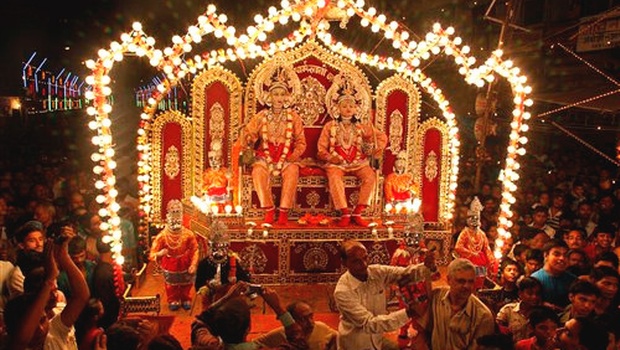
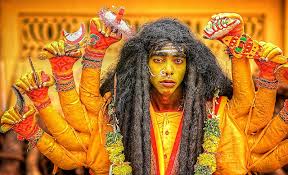
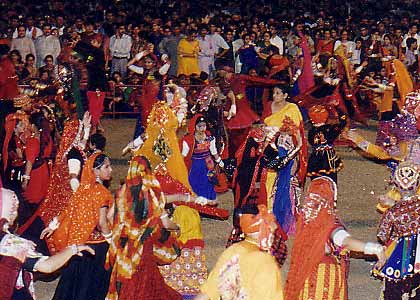
    As we all know that India is a land of festivals and celebrations.Dussehra is one of the most celebrated festival in all the parts of the country.It is a annual festival and is celebrated for seven consecutive days.There are two important stories behind the celebration of dussehra in India.One story related to Lord Ram and the other relates to goddess Durga.The main reason for the celebration of this festival is due to victory of good against evil.Many of the festivals in India are related to the epics like Ramayana and Mahabharata and Dussehra is one among them.

    Dussehra celebrations in India
    Dussehra celebrations in India

    History:

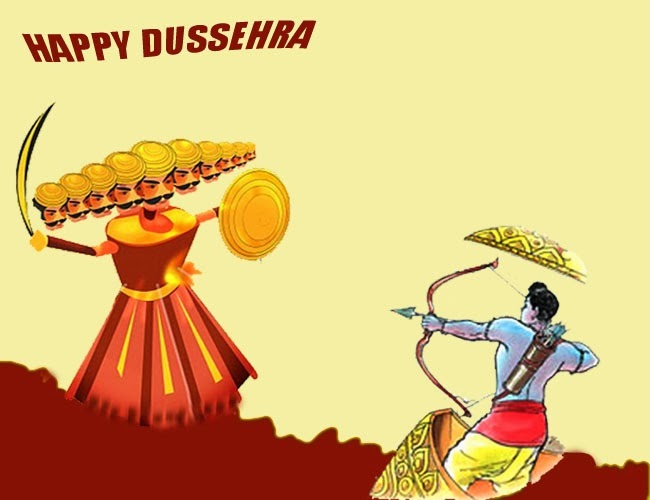
    According to north India, history of dussehra began when Lord Rama declared war on Ravana, who took away Rama’s wife Sita.Lord Rama took blessings from goddess Durga and he succeeded in the war that took place between Lord Ram and Ravana.This war lasted for ten days.Thus people started celebrating dussehra to seek blessings from the goddess of power and courage.

    Lord Rama assasinating Ravana
    Lord Rama assassinating Ravana

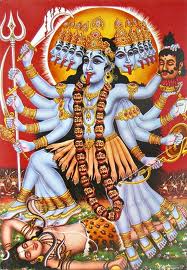
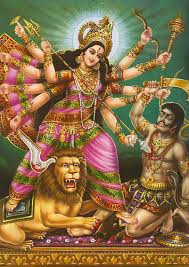
                    Coming to south India, the history behind the celebration of dussehra festival as follows.When Mahishasura was undefeatable even by Lord Brahma ( the creator ), Lord Vishnu ( the protector ) and Lord Shiva ( the destroyer ).At that time goddess Durga was powered to destroy the demon Mahishasura.This victory against the demon is celebrated as Vijayadashami or Dussehra.During Vijayadashami for nine nights people worship goddess Durga.Generally this festival falls in the month of September or October.

    Goddess Durga assasinating Mahishasura
    Goddess Durga assassinating Mahishasura

    Dussehra celebrations in different parts:

    Northern India:

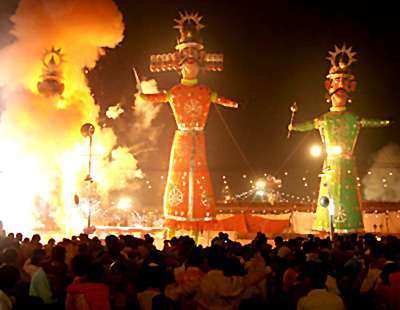
    On the first day of navaratri, many of the northern states like Himachal Pradesh, Kashmir, Uttar Pradesh, Uttarakhand and west Bihar have a tradition to plant barley seeds in earthen pots.On the ninth day i.e., Dussehra the sprouts are kept in men’s cap or ears.They believe that it is a symbol of luck.In some parts of Maharashtra during the ten days of this festival, many plays and dramas based on Ramayana are performed.While in the evenings,there are outdoor plays and large parades with sculptures of Ravana, Kumbhakarna and Meghanad.These sculptures are burnt in the open place.Generally dussehra starts with the end of hot summer.At this time it is believed to spread infections.To avoid those infections they burn these large sculptures which are made out of phosphorous in air.By doing so it certainly purifies the atmosphere.Where as in temples they perform chandi homa with same cause.

    Dussehra-The-Triumph-of-Good-over-Evil
    Dussehra-The-Triumph-of-Good-over-Evil

    Southern India:

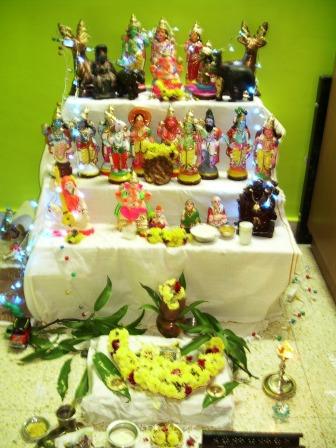
    Vijayadashami is celebrated in south India in various ways.Most of the south Indians believe that it is a best day to start anything to achieve in life.This festival is celebrated as Golu in Andhra Pradesh, Karnataka, Tami Nadu,Kerala from navarathri onwards.The exhibition of toys in various places undertake various names.It is known as “Bombe habba” in Karnataka, “Bommala Koluvu” in Andhra Pradesh,”Bomma Gollu”in Kerala and Golu or Kolu in Tamil Nadu.As the goddess Durga needed lots of power at the time of assassination of Mahisahasura.Many of the gods and goddesses transferred their power to her and they all stood still as statues.So to respect their sacrifice, people prepare small statues in the shape of gods and goddesses.People think that it is a favorable day for starting their child’s formal education.Also people keep their books, tools, materials for puja and take back those things on the ninth day of navaratri.

    Dussehra celebrations in South India
    Dussehra celebrations in South India

    Andhra Pradesh:

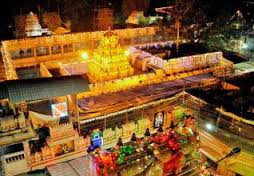
    According to Telugu people, Vijayadashami is a auspicious day for starting a new business, education, selling or buying of things.In the city of Hyderabad, Durga Puja is being celebrated for more than 60 years till now.During navaratri goddess Durga is decorated in different avatars like Bala Tripura Sundari, Mahishasura Mardhini, Annapoorna, Kali, Raja Rajeswari, Kanaka Durga, Lakshmi, Saraswati and Gayatri Devi.In Andhra especially the festival is celebrated grandly in Vijayawada.Every year it is celebrated grandly in this place. are celebrated every year with great pomp & show and tens of thousands of people visit this temple during the navaratri’s.

    Vijayadashami celebrations in Andhra Pradesh
    Vijayadashami celebrations in Andhra Pradesh

    Karnataka:

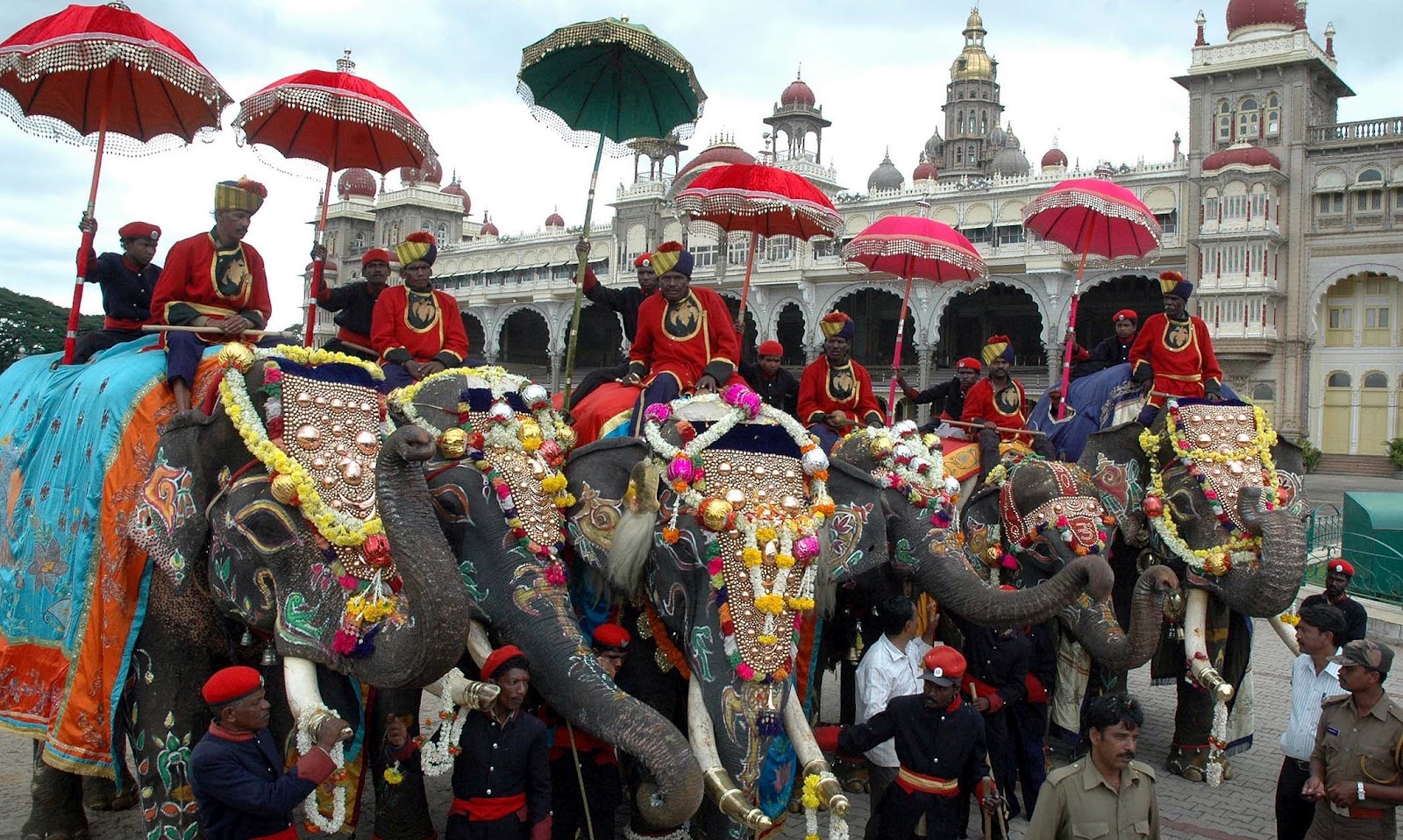
    In karnataka people celebrate ayudha puja on the ninth day of navaratri.They celebrate it by worshiping the commonly used tools like pens, books, kitchen tools, vehicle tools and many more.They believe whatever may be the work that is started on this day will lead to success with the help of goddess Durga blessings.

    Dussehra celebrations in Karnataka
    Dussehra celebrations in Karnataka

    Kerala:

    In Kerala the last three days of navaratri is celebrated as Saraswati puja.People of Kerala keep their books for puja on the first day of navaratri and take them back on third day i.e., Vijayadashami.Ayudha puja is also conducted during this period.

    Dussehra celebrations in Kerala
    Dussehra celebrations in Kerala

    Tamil Nadu:

    In Tamil Nadu they celebrate the worship of goddess Lakshmi, Saraswati and Shakti.People fast on all 9 days of navaratri and tie a holy thread on fist.People of Tamil Nadu dress up in various avatar’s of goddess and collect money.All the money that is collected is offered to temple on the ninth day of navaratri.

    Dussehra celebrations in Tamil Nadu
    Dussehra celebrations in Tamil Nadu

    Western India:

    In Maharashtra, the festival is celebrated on the tenth day in the month of Ashwin.On the first day people visit each other and exchange sweets.On this occasion people worship Apta tree and decorate their home or work place using those leaves.They believe it brings them luck.They also start new things on this occasion believing it brings success and will have blessings of goddess Durga.

    Dussehra celebrations in Western India
    Dussehra celebrations in Western India

    Eastern India:

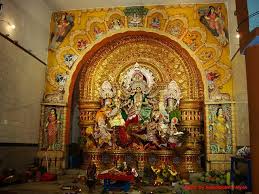
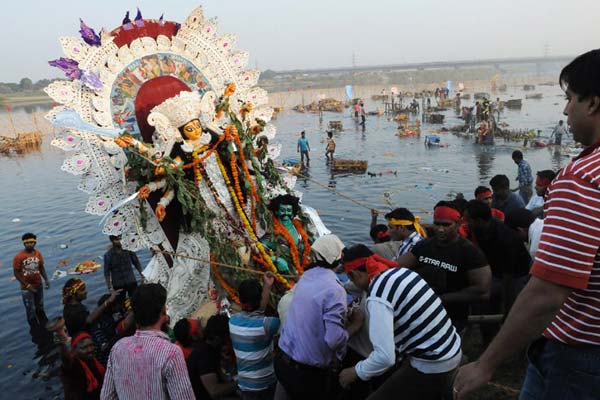
    In Bengal, Orissa and Assam, Dussehra is celebrated in the form of Durga Puja.It is celebrated for five days in Bengal, whereas in Orrisa and Assam it is celebrated for four days.As a part of their celebration on the fifth day, they place a statue of goddess Durga and is beautifully established in the form of Pandals.They perform Durga puja on sashti, sapthami, ashtami, navami followed by a great puja on tenth day.Women take sindhoor on their foreheads each other.In this way they play sindhoor holi against each other.

    Dussehra-and-Durga-Puja-Celebrations
    Dussehra-and-Durga-Puja-Celebrations