Tag: sweet

  • Winter Delights: Gajar Ka Halwa and Gujarati Meethi Kadhi

    Winter Delights: Gajar Ka Halwa and Gujarati Meethi Kadhi

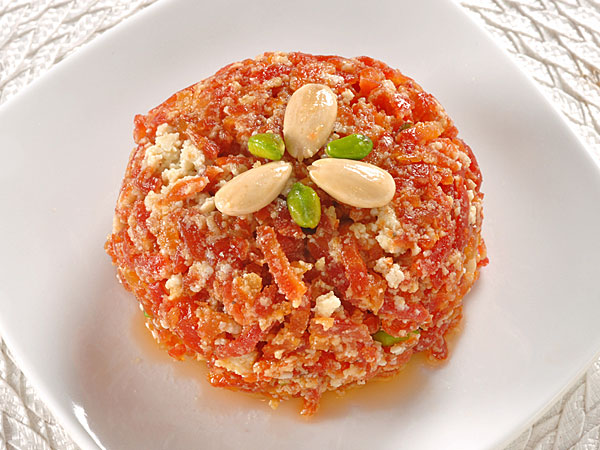
    The frigid winter months of December and January are bearing down upon us, and all anyone wants to do right now is to curl up cosily in their heavy blankets and eat tons of hot, rich food. The harsh weather right now makes the human body crave even more for nutrition, and it is not surprising that some of the best dishes that we know of taste the best in these freezing days. Compared to the year long summer heat in most parts of India, we have a greater appetite for food in the winters. It is in these few weeks that we look with great curiosity towards our kitchens, and wait impatiently for our mothers to emerge out of the area with some aromatic and delicious gastronomic work. Be it sarson ka saag and makke di roti, gulab jamuns, hot coffee, or ginger tea, all of these dishes and more never fail to tickle our tastebuds during the cold season. Here are two easy to cook recipes, one for gajar ka halwa, and the other for Gujarati meethi kadhi, in case you ever need a hot fix for your winter woes.


    Gajar ka Halwa
    Also known as gajrela, gajar ka gajrela, and carrot halwa, gajar ka halwa is a South Asian dessert pudding and a winter delicacy in north Indian states. Made by cooking grated carrots, milk, ghee (clarified butter), and nuts together, this dessert is eaten on many festive occasions in both India and Pakistan apart from being available round the year in most sweetmeat shops of the subcontinent. A completely vegetarian preparation, gajar ka halwa is a dish enjoyed by all people, and has been subject to a number of culinary innovations, some of which are a vegan version, red velvet gajar ka halwa, similarly flavoured doughnuts topped with the same, a cream cheese and halwa combination which is the desi counterpart to the carrot cheesecake.

    The dish dates back to the ancient Mughal times, and the word “halwa”, meaning sweet, is itself derived from the Arabic language. Gajar translates to carrot from the Hindi language. While gajar ka halwa may seem like a particularly difficult preparation to pull off in the kitchen, it is actually not. Although the ingredients do take a considerable amount of time to cook fully, gajar ka halwa is a very easy recipe to make provided you have all the cooking materials you need ready at your disposal.

    Recipe (serves three-four)

    Ingredients required:

    • 1 kg of grated carrots, cleaned and peeled beforehand
    • 100 ml of condensed milk
    • Cleaned, preferably roasted, dried fruits and nuts (cashews, almonds, raisins, pistachios)
    • ½ kg of khoya
    • 4 big tablespoons of desi ghee (clarified butter)
    • 1 cup of castor sugar
    • 4 cups of milk
    • Cardamom seeds. Alternatively, you can use one-third of a teaspoon of cardamom powder.

    The steps needed:

    • Put the shredded carrots and milk in a heavy-bottomed pan or a wok on medium flame.
    • Let the carrots soak in the milk to a considerable amount. Let the mixture turn a rich golden-orange colour.
    • Add condensed milk and cardamom and stir for some time.
    • When it is cooked halfway, add khoya, after putting aside some for garnishing. Also add ghee.
    • Once everything is properly mixed, add sugar on a low flame. Take note of the flame and ensure that the sugar does not caramelize in the halwa.
    • Add dried fruits from above, garnish with a little khoya, and serve in bowls. You can also add varakh (the silver food foil) for an aesthetic look.


    Gujarati Meethi Kadhi
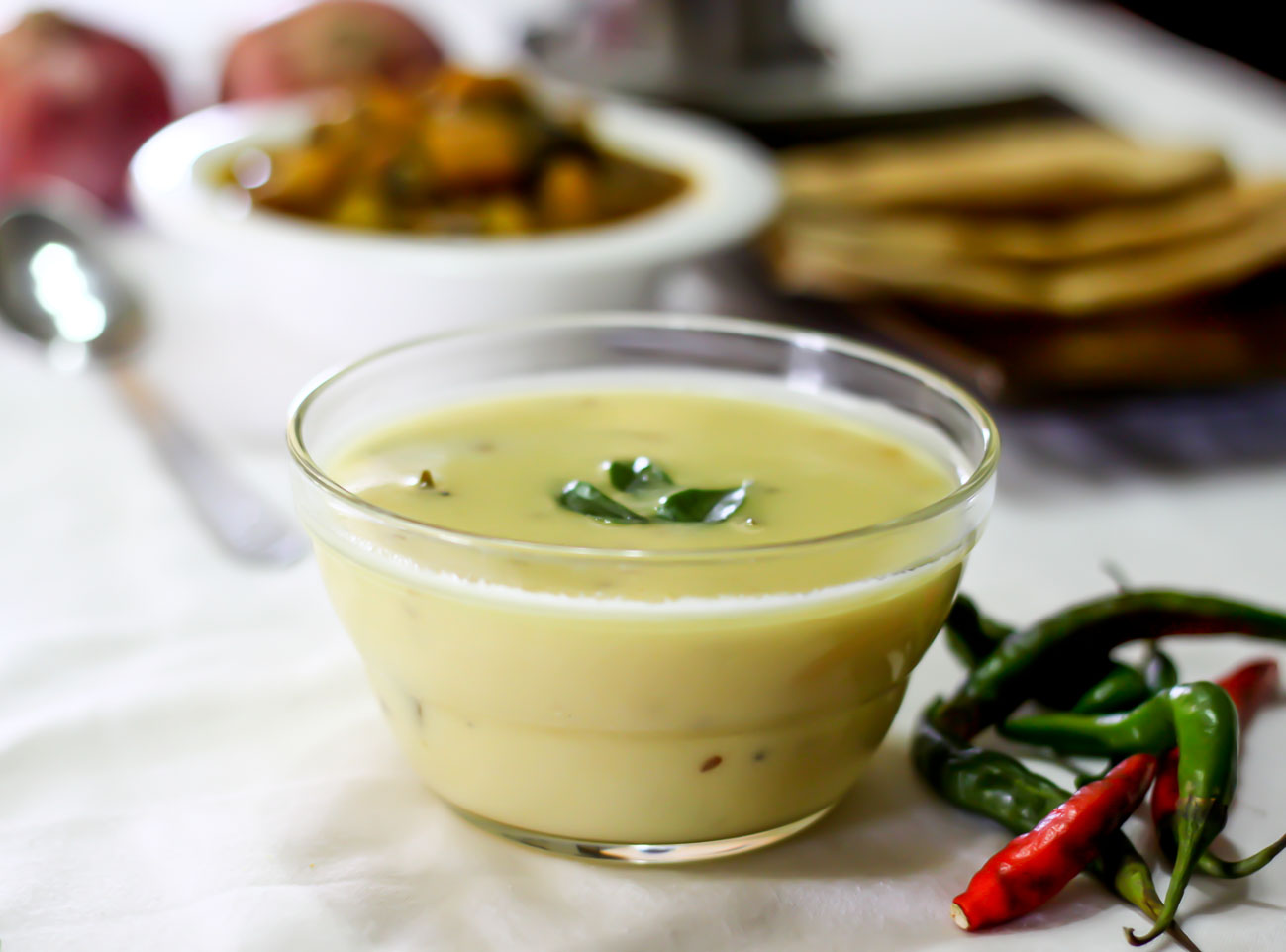
    Kadhi is an Indian main course dish of desert origins, and was first made in Rajasthan. However, it quickly grew popular with people from other regions of India, and now has different variants according to different states, belonging to Punjab, the Sindh area of Pakistan, Gujarat, Uttar Pradesh, and Maharashtra. While it is a dish best served hot, kadhi itself is derived from curd and yoghurt, which ironically taste best when cold.

    Gujarati cuisine is known for its sweetness, and its kadhi carries the same quality. In our household, Gujarati meethi (Hindi for “sweet”) kadhi is a winter favourite, and its recipe has passed on from one generation to the next, with a few modifications by each. This dish can be had as a drink, and since we already have the salty kadhi of Uttar Pradesh, complimented with besan pakodas (fillets), Gujarati meethi kadhi is served as a hot and sweet beverage mostly in the evenings. It hardly takes much time and effort to prepare, and is the perfect heavy snack that will fill your stomach in between meals. All you need is a bowl, a saucepan, and some easily accessible cooking materials, and a time period of fifteen minutes to spare.

    Recipe (serves two)

    Ingredients required:

    • 2 big tablespoons of besan (gram flour)
    • 1½ glasses of curd
    • Half a cup of water
    • Turmeric
    • Curry leaves
    • Asafoetida
    • A teaspoon of rai (mustard seeds)
    • Two teaspoons of sugar
    • Salt
    • Whole, dried red chillies
    • 2 teaspoons of oil

    The steps needed:

    • Add the besan and curd slowly in a big bowl, stirring slowly so that no lumps are formed.
    • Put a pinch of turmeric in this mixture. Also, add salt according to taste.
    • In a separate pan, put oil and let it heat on a slow flame.
    • To the hot oil, add rai, a little hint of asafoetida, and some curry leaves. Be careful to not let the curry leaves blacken completely because of excessive heat.
    • On a low flame, add red chillies to the pan.
    • Take the besan and curd paste, and pour it in the pan.
    • Stir continuously so that no lumps are formed while keeping the pan on a medium flame.
    • Let the mixture boil, and then pour it in glasses.
    • Top with a few curry leaves and serve hot.
  • Mangoes: Shout out to all the Mango Maniacs

    Mangoes: Shout out to all the Mango Maniacs

    Summer is at full stretch and the scorching heat and frequent power cuts don’t make it easy to fancy this season. There are still stuffs that we do root for throughout the year. Yes! I’m talking about long vacations, hometown visits or vacationing in the hill stations! But for all the “Foodaholics”, out there awaits the king of all fruits. Yes! MANGOES!! Though age is no category for a mango maniac, still I believe that kids are best examples of the same as to them apart from joining exciting summer camps or watching TV for endless hours, mangoes do hold a special place. Have to admit watching kids eat mangoes with pulp all over hands is an off-putting yet adorable sight. They are ones who won’t count calories but would feast upon them and contest with their siblings of who had the most like a true Mango maniac! As a kid when we used to head for our hometown, the sight of mango laden trees and lots of them used to get us frantic! Even in the cities at that time the quality of mangoes available in the market used to be fine and more feasible for the “Feast contests”.             Nowadays, we find it difficult to make a difference between which one is naturally and which are artificially ripened mangoes as both of them look almost alike. Well, to be honest artificially ripened looks more alluring. There are many features that set them apart like artificially ripened ones will have distinct patches of green color and their taste gives slight burning sensation in the mouth.  It is said that to get the taste of natural mango one should wait for the season to set in like after April. Now to list up all the mouth watering delicacies made from mangoes, though note that this wouldn’t include any sophisticated recipes but more like a list of the best homemade “Beat the heat” and other refreshments  from mango. Just to be sure Do Google the recipes for them!

    1. AAM PANNA!

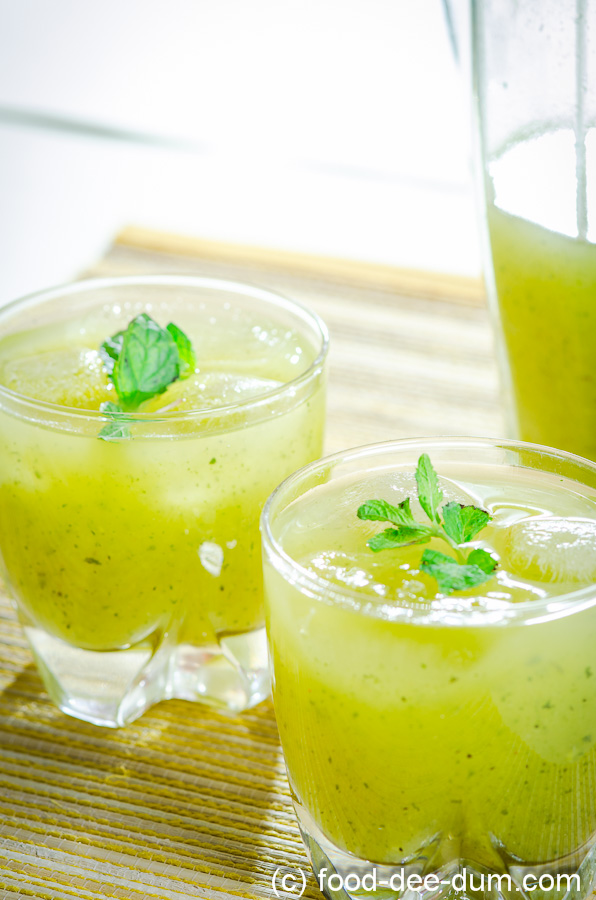
    Refreshing drink made from raw mangoes, Aam panna is made by taking the pulp out of boiled raw mangoes and then mixing the pulp with water adding sugar or jaggery. Of course not forget, Ice! Having a chilled glass of Aam panna after an exhausting day in office or playing all day in the scorching heat surely refreshes the senses. Aam_Panna

    1. AAMRAS!

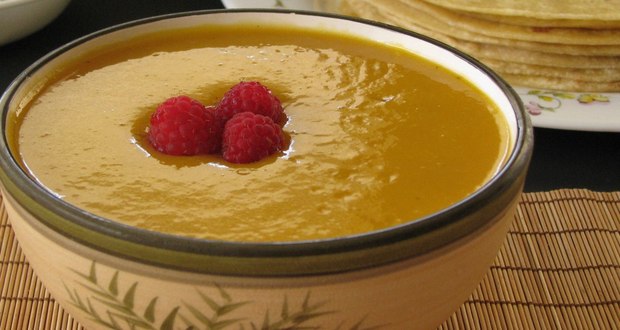
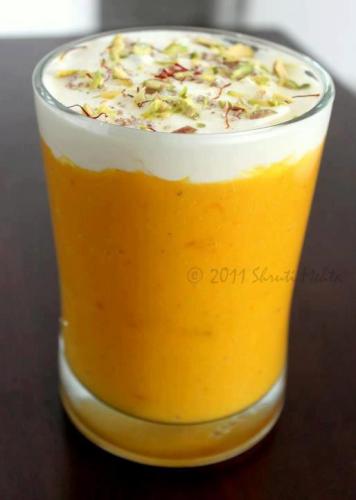
    Aamras is nothing but mango puree flavored with cardamom and saffron. This refreshment goes well with Puris, Paranthas or can relished solo. Sweetened naturally doesn’t have added sugars and one can enjoy this with limited calorie intake. aamras

    1. MANGO SMOOTHIE!

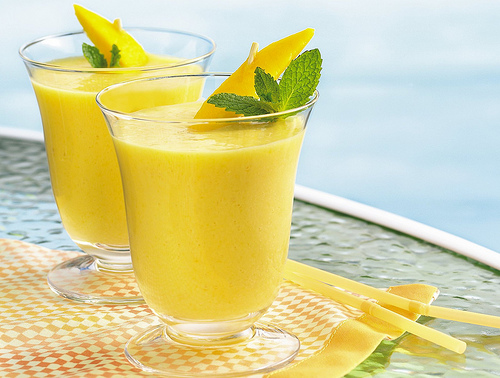
    Delicious summer drink prepared by blending mango pulp with almost equal amount of water and lime juice (as per preference). Sugar or sugarcane juice can be added to sweeten it more.Smoothie should be served chilled. Mango-Smoothies

    1. KHATTI MEETHI CHUTNEY!

    As it is not so much popular than the above refreshments, so I don’t know what its market name is. Regardless in our household it has been given that name.So, it’s basically prepared by frying raw mango pieces with mustard and cumin seeds. The fried mango pieces are the poured into hot sugar or jaggery syrup and cooked for few minutes.This mouth watering chutney tastes tangy-sweet and goes well with the meals or can be enjoyed as it is. Khatti meethi chutney

    1. MANGO MOUSSE!

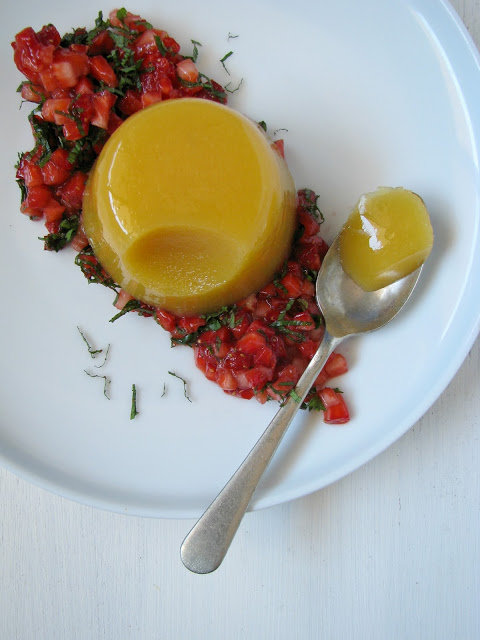
    One of the favorite deserts ever! Mango mousse is a light and creamy sweet dish prepared by both using egg or egg less. Prepared by blending the mango pulp with honey and cream and refrigerated for 30 minutes or so. This can be served with your favorite toppings like blueberry, tooti fruity e.t.c.  In the egg version while blending, egg whites pre- cooked in caramel is added. Mango mousse

    1. MANGO UPSIDE-DOWN CAKE!

    Fan of baking? If not too, this flavorsome cake is worth every bite.  Prepared like any other cake with a twisted layer of mangoes at the bottom. Top the cake with whipped cream and there you have a perfect piece of delight. Mango upside down cake   Okay, so the point made Mangoes are “Kings of Fruit”. Apart of being awesomely delicious let’s see if they carry more value.

     SKIN

    Having acne problems? Boil a raw mango, take the juice and apply as an acne remover. Mangoes are believe it or not great cleansers and exfoliate your skin too. Add wheat flour to mango pulp and apply this mixture to clean pores in the skin from deep within. For exfoliation purpose blend peeled mango with milk and crushed cashews or oat. People with sensitive skin can use mango-milk pack for refreshing their skin without worrying about reactions. Mangoes are also known to remove blemishes and enhance the skin color because of the presence of vitamin A, C and Beta carotene.

    Mango health benefits

    HEALTH

    4000 Years and older this fruit contains abundant levels of anti-oxidants  which is said to beneficial for preventing diseases like cancer, leukemia e.t.c.  It helps improving the eyesight due to presence of vitamin A. Additionally, the presence of fiber and Vitamin C helps in bringing down cholesterol and it increases metabolism.Mangoes are said to be rich in folic acid which helps in improving fertility.    So, a Mango maniac yet? There is around a month more for the mango season to get over, make sure you grab a bite of delectable must haves from safe to say now an “All rounder” fruit!

  • Cupcakes

    Cupcakes

    Cupcakes are small sized cakes suitable to be served to one person. These cakes are baked in small aluminum cups or thin paper and decorated similar to how normal sized cakes are decorated. Therefore one can see cupcakes as a miniature form of the normal sized cakes. In old times cakes used to me made in pottery cups or coffee mugs until the discovery of muffin tins which was a metal pan with or without a non sticky surface and had depressions or cups made in them. The number of such depressions ranged between 6 to 12 depending upon the length of the pan and the size of these depressions. Other than metal, such pans were made using materials such as silicone and stoneware. If we notice a cupcake, we find that the lower portion of the cake is covered with a thin sheet of paper. These are patty cases or cupcake liners which are used for bakes these cakes. This paper or cupcake liners are made up of paper or very thin aluminum foil or silicone rubber. These liners are placed in the packets of the muffin tin wherein the batter is put before it goes for baking. The main purpose or use of such liners is that they keep the cupcakes moist and makes it easy to remove the cakes from the tin once baking is over. It also saves time and efforts which would be otherwise put in cleaning the tin after baking is over. For people who could not afford a muffin tin, aluminum foils or silicone liners became handy can they could balance on their own. The paper used here are not the normal paper we find but are thicker yet lighter in nature. Some bakers use 2-3 paper liners joint together to make its stability similar to a single aluminum foil. Such liners also like muffin tin come in different shapes and sizes depending upon the size of the cupcake to be baked.

    cpcake 1

      According to food historians, cupcakes originated in the United States around the 19th century. The creation of cupcakes is considered to be a revolution in the field of baking due to the amount of time it saves in the kitchen however the origin of the name is still unknown. Historians have come up with two sets of theory which details out how the name could have come into existence. According to one theory the name “cupcakes” was devised from the fact that these cakes were made in cups or coffee mugs and the second theory states that the name was introduced because the ingredients used to make this cake was measured in cups like 1 cup of butter, 3 cups of flour etc. However nobody knows which of these theories explains the truth.

    cupcake 1

    “Sprinkles cupcakes” established in Beverly Hills is considered to be the first cupcake bakery to be started by two investment bankers who had started this business at the time when the market of cakes and bakery products was falling. Though a very risky venture, the two partners believed that the survival of the industry now rested on their shoulders. The partners finally felt relieved that their decision to run the business was correct when the first set of cakes which was produced was sold out in no time and they had to bake more in order to meet the demand for the day. Around 2500 cakes were sold that very day and this was the start of cupcake fever. Cupcakes always proved convenient when compared to the normal sized cakes because they took less time to bake and secondly because of the use of muffin tins, the base of these cakes also did not burn. Since its creation they have been a boom in the culinary world with dozens of bakeries, cookbooks, blogs specially dedicated to them. The market for cupcakes saw a 52% increase in sales during the year 2010-2011 with market speculators predicting a rise in this percent in the future.

    cupcake 3

    Cupcakes are easy to make and can be made at home as well on special occasions such a parties and family gatherings. With different recipes available to us, we have so much to choose from depending upon our taste and preferences.

    Since chocolate is a favourite of many the recipe for a dark chocolate cupcake is given below which I would say is worth a try

    Dark Chocolate Cupcake

    cup 5

    Directions:

    • Preheat the oven to about 350F and adjust the rack to the lower middle position in the oven.
    • Take a muffin pan and line it with the baking cups and keep it aside.
    • Now in a bowl add butter cocoa and chocolate and place it on a saucepan filled with water and heat until the chocolate and the butter starts to melt. Once the melting starts mix them both till they combine with each other nicely. Then keep it aside for cooling.
    • Now in a medium sized bowl add flour, baking soda and baking powder and in another bowl add eggs, sugar, vanilla and salt and mix well.
    • Now add everything together and mix well till they combine to become thick and homogeneous in nature.
    • Divide the batter evenly inside the muffin cups and place them inside the oven. Baking takes about 18-20 minutes after which the cakes are ready to come out.
    • Once out keep them aside for cooling
    • Now in a separate bowl add peanut butter, sugar, vanilla and salt and mix well till they become creamy. Then add cream to the mix and continue to stir till we get a light and smooth batter.
    • By the time this creamy batter is made the cakes would have cooled down. Now make small holes on the cupcakes and fill them with this peanut butter frosting

    Your dark chocolate cupcakes is ready to be served

     The popularity of this sweet dish has increased so much that according to Google, cupcake recipes are the most searched recipes in the world. So go forward and enjoy your sweet treat in the cup whether you are a child or an adult.

  • The King of Fruits

    The King of Fruits

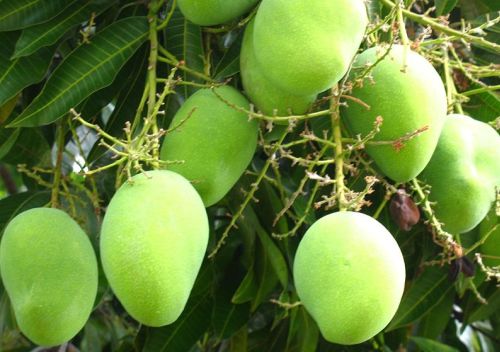
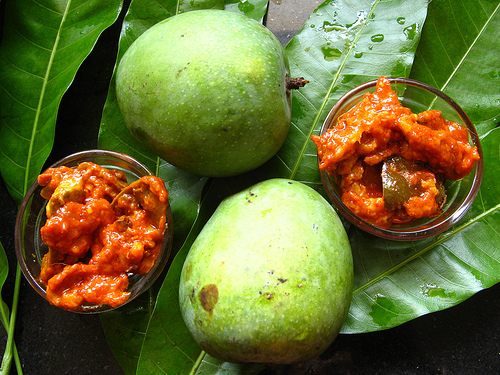
    Mango is a fruit which belongs to the plant family Anacardiaceae. They are tropical fruiting trees which are mostly cultivated for edible fruits. The mangoes originated in South and Southeast Asia and were later adopted by the neighboring regions. With time it became one of the most cultivated fruits in the tropical regions.Major contributions to the production of mangoes are given by regions like Sumatra, Borneo and counties like Burma and India. Other than being the king of fruits, mango is the national fruit of Indian and the Philippines and the national tree of Bangladesh. Mangoes come in different varieties depends upon the method in which it is cultivated plus the weather conditions. In some cultures the fruit and leaves of this plant is used as decorations for wedding and other public and religious ceremonies.

    green-mangoes

    Cultivation of mangoes have been taking place in Southeast Asia for thousands of years but the knowledge regarding its cultivation reached East Asia by the 5th century only. In East Africa mangoes were introduced after the 10th century. Mangoes later travelled to regions like West Indies Brazil and Mexico where appropriate climate contributed to its growth. Cultivation of mangoes can only be possible in a frost free tropical climate. Today almost half of the production in the world market is done by India with china being the second largest producer. Other regions such as Australia, Pakistan, north and Central America also account for the production of this fruit. Such as the Canary Islands in Spain is also a notable producer of this fruit. Though India is the largest producer, study sates that it accounts for only 1 percent in the international trade market for mangoes as it most of its produce is consumed domestically.

    5108f0481b71310e17d099a47425b94d_500

    Over the years so many different ways have been introduced for consumption of mangoes in the form of chutneys, pickles and milkshakes. In many households, mango pulp is used to make jellies and a special jam called mangada. The pulp is also is cooked with red gram and served with rice. In Andhra Pradesh mangoes are used to prepare dal while in Gujarati cuisines, mangoes are used to make chunda which is a grated mango dish. In many countries mangoes are used to prepare smoothies and ice creams where the mango nectar is used as a major flavouring and colouring agent. In Central America people consume green mangoes with salt, lime and black pepper along with a hot sauce. Traditionally roasted pumpkin seed along with chilli or soya sauce is eaten together with green mangoes. In Southeast Asia slices of mangoes are put over ice creams. It is also served as a desert with a special kind of rice cooked with coconut. Green mangoes are used as salads and served with fish sauce, rice vinegar and dried shrimp.

    025edit

    Mangoes are considered to be very beneficial for health as they are full of anti-oxidants which help in fighting different types of cancer such as breast, prostate and colon cancer. These anti oxidants also help in preventing leukemia and help in cell rejuvenation and repair. Acne is reduces as it helps in detoxifying the skin from inside. Mangoes are huge storehouses of vitamin A and C. vitamin A as we all know helps protect the eyesight and is responsible for endowing a glowing skin and maintaining a great complexion while vitamin C is responsible for boosting immunity.  The acidic content of vitamin C is further accompanied with acids like malic and tartaric acid which helps in maintaining the alkaline balance of the body. The thread like texture of the fruit is because of its high fibre content. Fibre further helps in lowering cholesterol levels in the body thereby playing a huge role in preventing diabetes. The skin of this fruit is a popular de-tanner and is extensively used as a part of many beauty regimes, including reduction of dark spots, acne, cleansing, exfoliation etc. The best part is, being a natural product it is safe to use across all skin types and is foolproof solution for fair smooth skin. Mangoes are also beneficial for the hair being an oasis of vitamins and minerals that nourish and encourage hair growth. As a part of many home remedies, mangoes are used as conditioners, for treating dandruff and reducing hair loss and graying of hair.

    mango-pickle-receipe

    To avail all these benefits, it is important that we, as consumers, select and store the fruit judiciously. Ofcource, the rules for selection remain the same; clean no marks on the external body and so on. But more importantly, mangoes with good aroma should be selected. Unripe mangoes are green in colour while ripe mangoes may have different colour like yellow, orange or red but one thing should be noted that the colour must not be seen as a basis for deciding the maturity of the fruit because there are some varieties of mangoes which retain their green colour even when they ripe. Once the mangoes are purchased care should be taken regarding the storage of this fruit which varies depending upon the variety of the mango. In order to ensure that mangoes remain fresh we can store them in the refrigerator. Freezing them may result in the blackening of their outer skin but the inside remains fresh. In case they are green in colour then they should be stored in a brown paper bag away from sunlight for a few days till they ripen.

  • Zulbia

    Zulbia

    jalebi 1

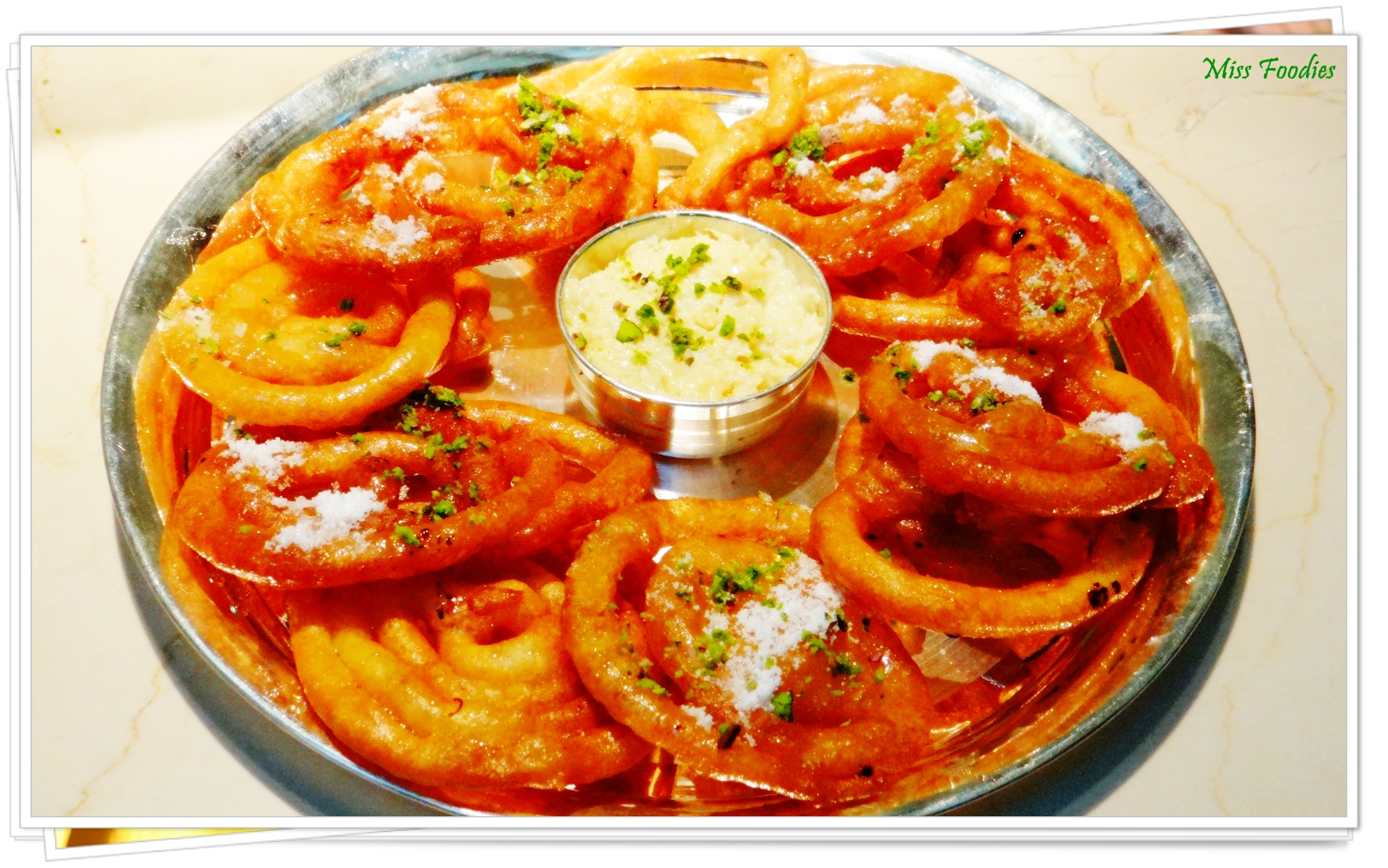
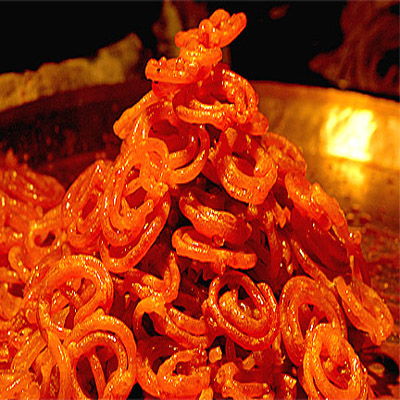
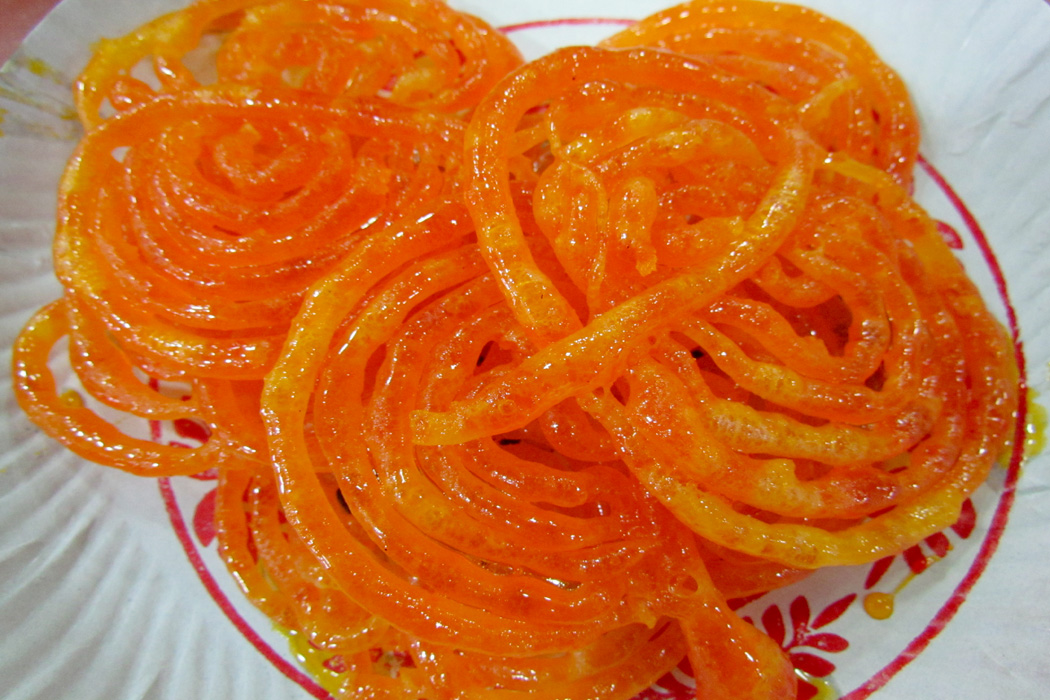
    Jalebi or Zulbia is a popular sweet in our country and surprisingly not only in India but is also found to entertain the taste buds of people of Middle East and North African countries like Jordan, Syria, Egypt and Algeria. The creation of these sweets is simple and mainly requires a deep frying of wheat flour also called maida in India, in whirl shapes which is then soaked in the sugar solution. A sweet that finds its way in every household especially during festive seasons like Ramadan and Diwali.

    jalebi
    Back in India, Jalebi is also served as a ‘Celebration sweet’ during national holidays like Independence Day and Republic Day, on which its offered in government institutions, defence facilities and other organizations. The sweet is served either warm or cold and has a somewhat chewy texture with a sugary exterior coating. Rose water or other flavors are sometimes added to the dish.
    The origins of Jalebi can be traced to ancient India. History says that it was earlier produced from fermented wheat and yoghurt batter. It is believed that the diffusion of this dish to other countries occurred during the Muslim Rule when the economy was opened up for trade and exchanges with various other countries of the world. The sweet is also known as Zalabia in Comoros Islands, where its believed that it had been introduced by Middle Eastern settlers and merchants. The references about this particular sweet can also be seen in the 13th century writing of various rulers who enjoyed this delicacy only during very special occasions. In Iran, the tradition was to offer this sweet, called Zulbia, to the poor during the festival of Ramadan. It’s been followed till date without fail. During the 1900s, it was a treat for the common American family where Jalebi was used to hold ice cream till the invention of cones.

    jalebi 3
    Currently the sweet has found fame and a strong base especially in north part of India. Over the years it’s surprising to see that the dish has had various versions and twists bought in by the modern chefs of the time and still sees advancements. My first experience was when I was small, my father had purchased this sweet from the local Halwaii, freshly made nice and hot, which melted in no time as it entered my mouth and left me wanting for more of this delight. Seen as a sweet dish in every marriage, it’s difficult for it to not be in the menu card, thanks to the huge public demand it has created over the years.

    jalebi 4
    Ahmedabad, a place where Jalebi is not treated as just a sweet, is mostly consumed together with fafda, finds a place in the demand list not only during occasions but is also pushed in with breakfast lunch and dinner as a yummy combination of sweet and salty. Market watchers in Ahmedabad say that localities’ consume fafda jalebis worth at least minimum of Rs.25 crores. This previous year heavy sales was witnessed not only on Dussehra morning but also in the last night of Navratri where people made a point to stop and add more sweetness to the festival by eating jalebis with fafda and then going home after days of uninterrupted dance and worship. This year however the sellers are curious to see the market reaction with the rise in the prices of the commodity, as they believe that prices would rise by 20%, reason being the rise in the prices of inputs that goes in the preparation of this particular dish such as refined flour, gram flour, ghee, spices and also labour. Estimates suggest that if its assumed that 50lakh Amdavadis will treat over 100 grams of fafda Jalebi, then this will generate a rough figure of Rs. 30 crores in a single day. The sellers feel that an increase in the prices will surely have its effect on the consumers however they believe that the craze for this dish will not die. The quantity consumed may surely come down like a person consuming 2kg may now consume just 1 or half a kilo, but business due to this might not be affected much due to the rise in prices. According to Murlidhar Agarwal, a member of the Ahmedabad Mithai Farshan and Milk-Mawa sellers association in the city says that 65kg gram of flour earlier cost them around Rs.1300 but now has seen an increase to about Rs.2000. Similar rise has also been seen in the price of oil and labour which has risen from Rs.1400 to Rs.2200 and labour charges being Rs.5000 per person respectively. With quantities expected to fall and cost of production expected to rise, sellers are thinking of taking various measures to keep with and sustain their profit margin. Many sellers are thinking of opening up shop early than their usual timings in order to increase their sales per day while others are simply deciding to bring down their profit margin. Many, in order to meet the excess demand during festive days have decided to take pre-bookings and orders in advance and also keep packets of 250-500grams ready so that people can pick easily. With all important decision and measures taken its now time which will design the way.

    jalebi 2
    According to me, when it comes to joy and satisfaction given by this dish, price cannot affect much however the sad part is although North Indian are well aware of this dish the same does not go for the South. Many states down south have not had the privilege to enjoy mainly due to lack of knowledge regarding its preparation. Therefore we can hope that it’s not long enough that the dish will soon find its way to South Indian households as well.

  • Step-By-Step Guide on How To Eat Well

    Step-By-Step Guide on How To Eat Well

    1. Eat at regular intervals and make sure that you have three meals a day. This should help your blood glucose level to remain steady throughout the day. Also, having three proper meals at regular intervals will prevent you from feeling hungry.


    1.  Watch the amount of fat you eat. Fried and fatty foods are loaded with calories (they are obviously not good for you if you are trying to shed a few inches off your waist). Intake of saturated fats may lead to rise in one’s cholesterol level. However, you can switch to healthier unsaturated fats which will not harm you in any way.

    Food to avoid: Butter, Ghee, Paneer, Pastries, Crisps, Samosas, etc

    How to eat healthy fats? Instead of cooking with butter or ghee (saturated fat), use olive oil or cornflower oil (unsaturated fat). Avoid using too much coconut in your cooking. Creamy coconut and coconut milk are high in saturated fat. Choose skimmed milk and low fat yogurt over cream and full- fat yogurt. Replace Paneer with Tofu.


    A helpful recipe-


    vegan-chinese-salt-and-pepper-tofu-recipe-2

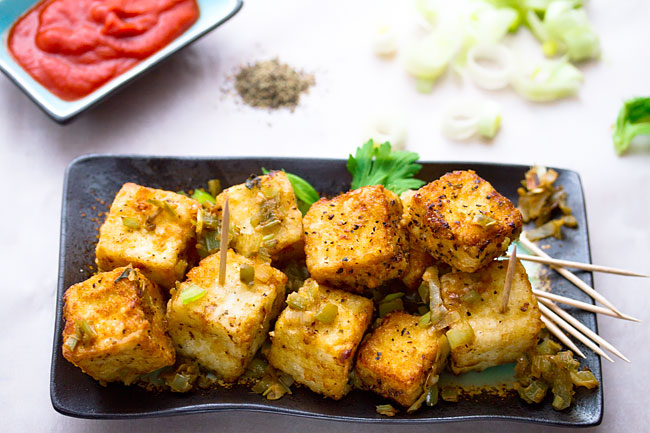
    Grilled Salt and Pepper Tofu


    Ingredients: 1 tbsp olive oil, 2 springs onions ( chopped, plus the finely chopped green parts of 4-6 spring onion), 5 cm piece root ginger (chopped), 6 garlic cloves (chopped), 5 cm stalk celery (chopped), 2 green chillies (sliced), 200g tofu (cut into 2 cm cubes), 1/8 tsp salt, 7-8 black peppercorns ( crushed), 1 tbsp lemon juice

    Method: Heat the oil in a pan. Add the spring onions, ginger and garlic, and sauté for 2 minutes. Add the celery and green chillies, and sauté for 30 minutes. Stir in the tofu, salt and crushed peppercorns and sauté until tofu gets some brown flecks. Add the spring onion greens and sauté for 1 minute. Add the lemon juice, toss and serve.


    1. Fruits and vegetables are rich in antioxidants. Antioxidants help prevent damage to one’s arteries. So, eat as much fruits and vegetables as regularly as possible. These foods are nutritious, low- GI, low in calories and fat and quite filling. Dried fruits can be had as snacks in between meals. Have fruits in dessert instead of sweet meats. Incorporate the habit of having some salad with yours meals. For example –


    Bulgur Wheat and Fruit Salad


    Ingredients: 200g bulgur wheat, 2 medium size red peppers, 1 medium size yellow pepper, 1 medium size onion ( sliced),  4 garlic cloves ( thinly sliced), 2 medium size tomatoes (seeded and diced), 1 tbsp chopped fresh parsley, ½ tsp salt, ground white pepper to taste, pinch of sugar, 1 tbsp lemon juice, 1 medium size apple ( diced), 4 tbsp finely chopped fresh mint leaves, a few leaves of Iceberg lettuce, 1 tbsp olive oil

    Method: Soak the cracked wheat in water for 15 minutes, then strain. Push each pepper on to a fork and, one at a time, roast directly on a flame. (If you prefer, you can char the peppers under the grill or roast them in the oven) Put the soaked wheat into a salad bowl, and stir in the onion and garlic. Run water on the charred peppers and then remove the burnt skin. Cut the flesh into small pieces and add to the salad bowl. Stir in the tomatoes and parsley, then add the salt, white pepper and sugar. Mix. Add the lemon juice, apple and mint leaves. Tear up the Iceberg lettuce and add. Toss well. Add the olive oil, toss again. Serve immediately.


    1. Consume less sugar. Replace fizzy drinks with diet ones, water or unsweetened fruit juice. Limit sweet meats such as Rosogolla, Barfi, Ladoo, Gulab ajmun, Khir Malai to special occasions. Cut back on sugar in your tea and coffee. Switch to artificial sweeteners such as Splenda or Sweetex.

    sweetex


    1. Eat food low in salt such as plain popcorn, unsalted nuts or fresh fruits instead of savory biscuits, salted crisps, etc. Use unsalted butter instead of salted butter. Dried fish is very high in salt; soak it thrice and throw away the water before cooking. There is no need to add extra salt in cooking. Instead of salt, try experimenting with paprika, pepper, spices and fresh herbs.

    download

    1. Have more high- fibre food. Choose brown basmati rice over white rice, dal with whole lentils over dal with pureed lentils. As recommended earlier, eat your vegetables and fruits regularly.


    A vegetable dish for you to try –


    Mushrooms with fresh Coriander


    Ingredients – 600g button mushrooms (trimmed), 1 tbsp olive oil, 5 green cardamom pods, 1 black cardamom pod, 5 cloves, 2.5cm stick cinnamon, 1 bay leaf, pinch of ground mace, 175g boiled onion paste, 4 tsp minced ginger, 4 tsp minced garlic, 4 green chillies (chopped), 1 tsp red chilli powder, ½ tsp ground coriander, 375g natural low-fat yogurt (whisked), ½ tsp salt, 3 tbsp cashew nut paste, 25g fresh coriander leaves (chopped), 3.5cm piece root ginger (cut into thin strips)

    Method – Blanch the mushrooms in hot water for 2 minutes. Drain and set aside. Heat the oil in a non stick pan. Add the cardamom pods, clove, cinnamon, bay leaf and mace, and sauté over a medium heat until fragrant. Add the onion paste and sauté for 2 – 3 minutes. Stir in the minced ginger and continue to sauté until the oil surfaces. Add the chillies and sauté for 30 seconds more, before adding the chilli powder and ground coriander. Stir for another 30 seconds. Remove the pan from the heat and stir in the yogurt and salt. Mix well, then return the pan to the heat. Add 150ml of water and let it come to the boil. Reduce the heat and simmer until the fat rises to the surface. Stir in the cashew nut paste and simmer for 2 – 3 minutes. Add the mushrooms and ¾ of the chopped coriander and simmer for 2 – 3 minutes. Transfer the mushrooms to a serving dish and garnish with the remaining coriander and the ginger strips.


    Follow these steps attentively and you will soon discover a healthier better YOU.


    Recipe courtesy – sanjeevkapoor.com

    Picture courtesy – vegiebelly.com, weldricks.co.uk, spicesherbscentre.com