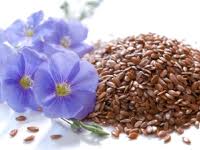
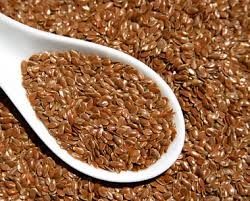
 Flaxseeds are obtained from flax which is also known as linseed, and botanically is known as Linum usitatissimum, which is a member of genus Linum of the family Linaceae. It is a food and a fiber crop grown in cooler regions of the world. The species are native to Western Asia and Middle East, including India.
Category: Food
-
All About Flax Seeds
-
Love For Salads
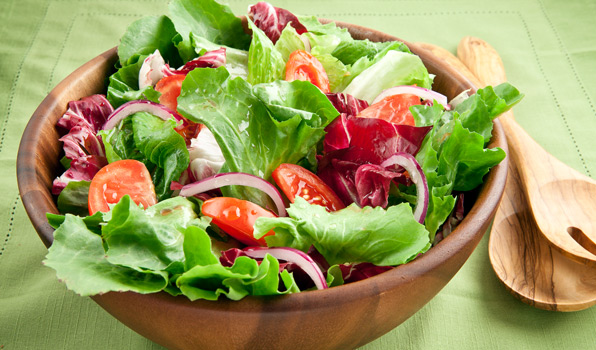
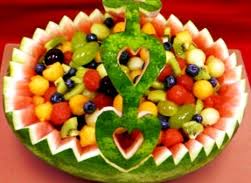
For the ultimate in healthy and satisfying fare, there’s nothing better than a refreshing salad. Whether you yearn for a cool, crisp lettuce, sweet fruit salad or a savory potato salad, there is something for everyone on the list of salad recipes.

Salad, a popular ready- to eat dish often contains leafy vegetables or fruits, often served with dressings usually served at a chilled or at a moderate
temperature. Salads may sometimes additionally contain grain, meat, tuna or other seafood.Leafy vegetables are generally served with dressings, as well as with garnishes, and sometimes with meat, pasta, cheese, eggs, fish or whole grains.
(more…) -
Street Food Made Easy Part-2
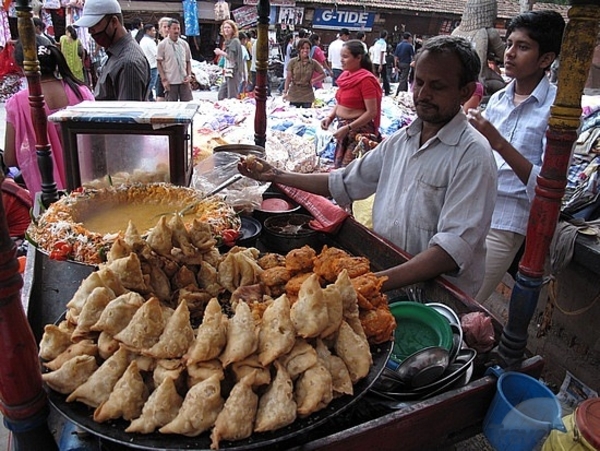
Okay, for those of you who have read the previous edition to this article, I am not going to bother with an explanation regarding what street food is, how it tastes, what are its benefits and the like. However, for those who are reading about street food for the first time, this article will surely prove to be a pleasant surprise. And dare I say both for the tummy and the mind!
Street food can be of various types. It can include heavy or light food items as per your hunger pangs. Well, in this article, I would like to satisfy those among you who prefer the former category.
Often while returning from work or from school or from college, you find your stomach rumbling. Really loudly! Well, what to do? You know that having food from the street is not really the safest bet for your health. But what is the alternative then? It is really simple actually. Just make those street food items which you have been craving for God know how many days at your own home! Follow the recipes given below to get the most satisfying and sumptuous results with the utmost amount of ease on your part. I assure you that you will not be disappointed in the least. Simply read on to find out more!
(1) Dahi Papdi Chaat:
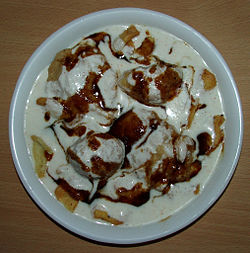
Dahi Papdi Chaat is a very popular north Indian (Maharashtrian) street food item. Chaat essentially means a Hindi word which literally means ‘to lick’. It is now used to describe a whole range of savoury snacks and fast food items across Indian and in some places abroad as well. Papdi refers to the special crisp fried dough wafers which are made in a special way by using refined white flour and oil (mustard usually) as the main ingredients.
Ingredients:
•Crisp Papdis: 24.
•Whisked Yoghurt: 1 ½ cups.
•Salt: According to taste.
•Sugar: 1 tbsp.
•Boiled and Chopped Potatoes: 2 medium sized.
•Blanched Sprouted Green Gram: ½ cup.
•Red Chilli-Garlic Chutney: ¼ cup.
•Green Chutney: ½ cup.
•Sweet Tamarind Chutney: ¼ cup.
•Roasted Cumin Powder: 1 tsp.
•Chaat Masala: ½ tsp.
•Red Chilli Powder: ½ tsp.
•Fresh Coriander Leaves: According to use.
•Sev: As required.
•Peeled Pomegranate (Anar): 2 tbsp.Preparation:
•Add salt and sugar to the yogurt and whisk further till it has arrived at a smooth consistency. Keep the mixture in the refrigerator till use. In the meantime, arrange the Papdis on a medium-sized plate.
•Place some of the chopped potatoes over each Papdi. Over that, put some boiled sprouted moong. Drizzle a little Red Chilli-Garlic Chutney, Green Chutney and Sweet Tamarind Chutney over those.
•Sprinkle cumin powder, chaat masala, a little red chilli powder and salt. Top it all up with the chilled yogurt mixture.
•Drizzle some more of the Sweet Tamarind Chutney and the Red Chilli-Garlic Chutney. Then add the coriander leaves, Sev and the pomegranate pearls on top at the end.
•Serve immediately.Preparation Time: 15-20 minutes.
Serves 4.
(2) Pav Bhaji:
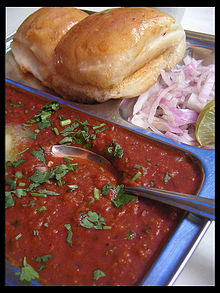
Pav Bhaji is an exceedingly popular Maharashtrian street food item that traditionally originated in the Mumbai cuisine. While the Bhaji part of the dish is a traditional Indian name for a vegetable dish, the Pav or Pau or Pao was the Portuguese word for bread (small rolls). Pav Bhaji is native to Mumbai and has now become popular in almost all the metropolitan areas in India especially in those of central and western Indian states such as Gujarat and Karnataka.
Ingredients:
•Turmeric Powder: ¼ tsp.
•Pav Bhaji Masala Powder: 1 ½ tbsp.
•Ginger Garlic Paste: 1 ½ tbsp.
•Finely Chopped Tomatoes: 3 medium sized.
•Tomato Sauce (Optional): 4 tbsp.
•Lemon Juice (Optional): 1-2 tsp.
•Finely Chopped Onion for Garnishing (Optional): 1 small sized.
•Coriander Leaves for Garnishing: According to requirement.
•Butter/Oil for Bhaji: 1 tbsp.
•Additional Butter for Pav: According to requirement.
•Pav (Buns): 6 to 8.Preparation:
•Add the butter or oil in a pan and heat it up. Add the chopped onions and fry till they turn translucent. Then, add the ginger garlic paste and fry till it gets fragrant.
•Add the chopped tomatoes, the turmeric powder and then sprinkle salt. Continue to fry till the tomatoes turn soft and mushy.
•Add the chilli powder, extra salt and Pav Bhaji Masala powder. Mix well and fry for another 2 minutes.
•Pour water so that it is just enough to cover the vegetables.
•Add the coriander leaves. Mix well and mash the curry if you desire a smooth Bhaji.
•Cook till the consistency of the gravy becomes thick.
•Slit the Pav buns horizontally leaving one edge intact.
•Heat the butter on a pan. Open the buns and toast it for a minute or two. If you like to make it spicier, sprinkle some Pav Bhaji Masala Powder on the inner side.
•Garnish with onions and serve either hot or warm.Preparation Time: 25-30 minutes.
Serves 3-4.
So, there you are. I am sure that you must be salivating by now if you have read through the recipes and seen the pictures. Especially if you are on an empty stomach! Well, then. Why the wait up? Go to the kitchen and start cooking. Nobody is going to stop you from devouring these delicious food items once you are done!
Happy snacking folks!
-

Mangoes: Shout out to all the Mango Maniacs
Summer is at full stretch and the scorching heat and frequent power cuts don’t make it easy to fancy this season. There are still stuffs that we do root for throughout the year. Yes! I’m talking about long vacations, hometown visits or vacationing in the hill stations! But for all the “Foodaholics”, out there awaits the king of all fruits. Yes! MANGOES!! Though age is no category for a mango maniac, still I believe that kids are best examples of the same as to them apart from joining exciting summer camps or watching TV for endless hours, mangoes do hold a special place. Have to admit watching kids eat mangoes with pulp all over hands is an off-putting yet adorable sight. They are ones who won’t count calories but would feast upon them and contest with their siblings of who had the most like a true Mango maniac! As a kid when we used to head for our hometown, the sight of mango laden trees and lots of them used to get us frantic! Even in the cities at that time the quality of mangoes available in the market used to be fine and more feasible for the “Feast contests”. Nowadays, we find it difficult to make a difference between which one is naturally and which are artificially ripened mangoes as both of them look almost alike. Well, to be honest artificially ripened looks more alluring. There are many features that set them apart like artificially ripened ones will have distinct patches of green color and their taste gives slight burning sensation in the mouth. It is said that to get the taste of natural mango one should wait for the season to set in like after April. Now to list up all the mouth watering delicacies made from mangoes, though note that this wouldn’t include any sophisticated recipes but more like a list of the best homemade “Beat the heat” and other refreshments from mango. Just to be sure Do Google the recipes for them!
-
AAM PANNA!
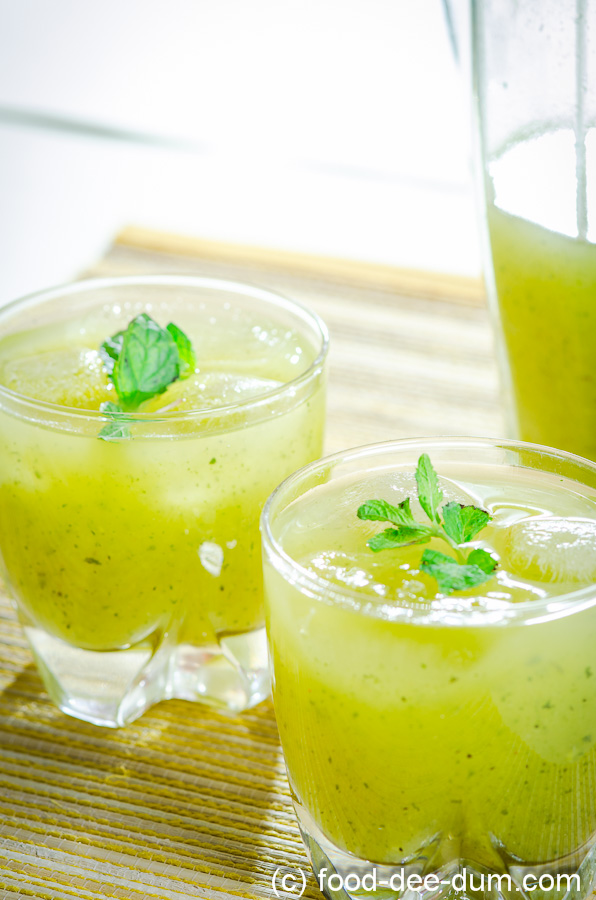
Refreshing drink made from raw mangoes, Aam panna is made by taking the pulp out of boiled raw mangoes and then mixing the pulp with water adding sugar or jaggery. Of course not forget, Ice! Having a chilled glass of Aam panna after an exhausting day in office or playing all day in the scorching heat surely refreshes the senses.

-
AAMRAS!
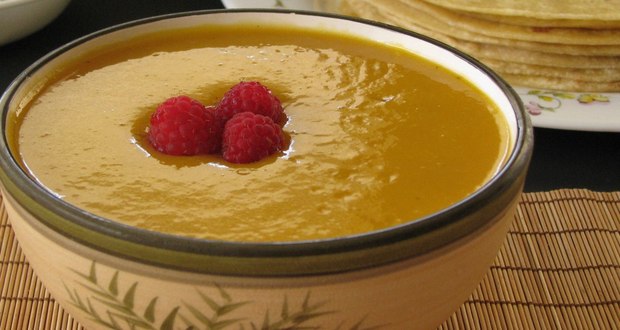
Aamras is nothing but mango puree flavored with cardamom and saffron. This refreshment goes well with Puris, Paranthas or can relished solo. Sweetened naturally doesn’t have added sugars and one can enjoy this with limited calorie intake.

-
MANGO SMOOTHIE!
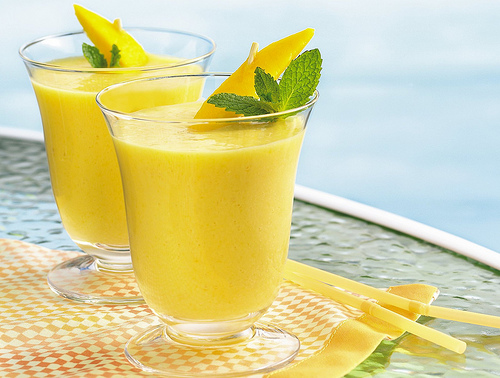
Delicious summer drink prepared by blending mango pulp with almost equal amount of water and lime juice (as per preference). Sugar or sugarcane juice can be added to sweeten it more.Smoothie should be served chilled.

-
KHATTI MEETHI CHUTNEY!
As it is not so much popular than the above refreshments, so I don’t know what its market name is. Regardless in our household it has been given that name.So, it’s basically prepared by frying raw mango pieces with mustard and cumin seeds. The fried mango pieces are the poured into hot sugar or jaggery syrup and cooked for few minutes.This mouth watering chutney tastes tangy-sweet and goes well with the meals or can be enjoyed as it is.

-
MANGO MOUSSE!
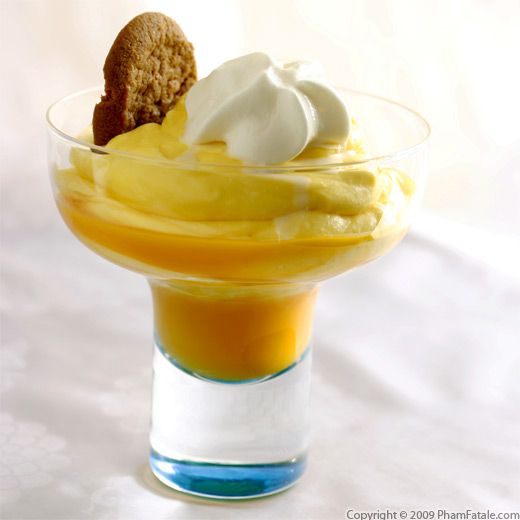
One of the favorite deserts ever! Mango mousse is a light and creamy sweet dish prepared by both using egg or egg less. Prepared by blending the mango pulp with honey and cream and refrigerated for 30 minutes or so. This can be served with your favorite toppings like blueberry, tooti fruity e.t.c. In the egg version while blending, egg whites pre- cooked in caramel is added.

-
MANGO UPSIDE-DOWN CAKE!
Fan of baking? If not too, this flavorsome cake is worth every bite. Prepared like any other cake with a twisted layer of mangoes at the bottom. Top the cake with whipped cream and there you have a perfect piece of delight.
 Okay, so the point made Mangoes are “Kings of Fruit”. Apart of being awesomely delicious let’s see if they carry more value.
SKIN
Having acne problems? Boil a raw mango, take the juice and apply as an acne remover. Mangoes are believe it or not great cleansers and exfoliate your skin too. Add wheat flour to mango pulp and apply this mixture to clean pores in the skin from deep within. For exfoliation purpose blend peeled mango with milk and crushed cashews or oat. People with sensitive skin can use mango-milk pack for refreshing their skin without worrying about reactions. Mangoes are also known to remove blemishes and enhance the skin color because of the presence of vitamin A, C and Beta carotene.

HEALTH
4000 Years and older this fruit contains abundant levels of anti-oxidants which is said to beneficial for preventing diseases like cancer, leukemia e.t.c. It helps improving the eyesight due to presence of vitamin A. Additionally, the presence of fiber and Vitamin C helps in bringing down cholesterol and it increases metabolism.Mangoes are said to be rich in folic acid which helps in improving fertility. So, a Mango maniac yet? There is around a month more for the mango season to get over, make sure you grab a bite of delectable must haves from safe to say now an “All rounder” fruit!
-
-
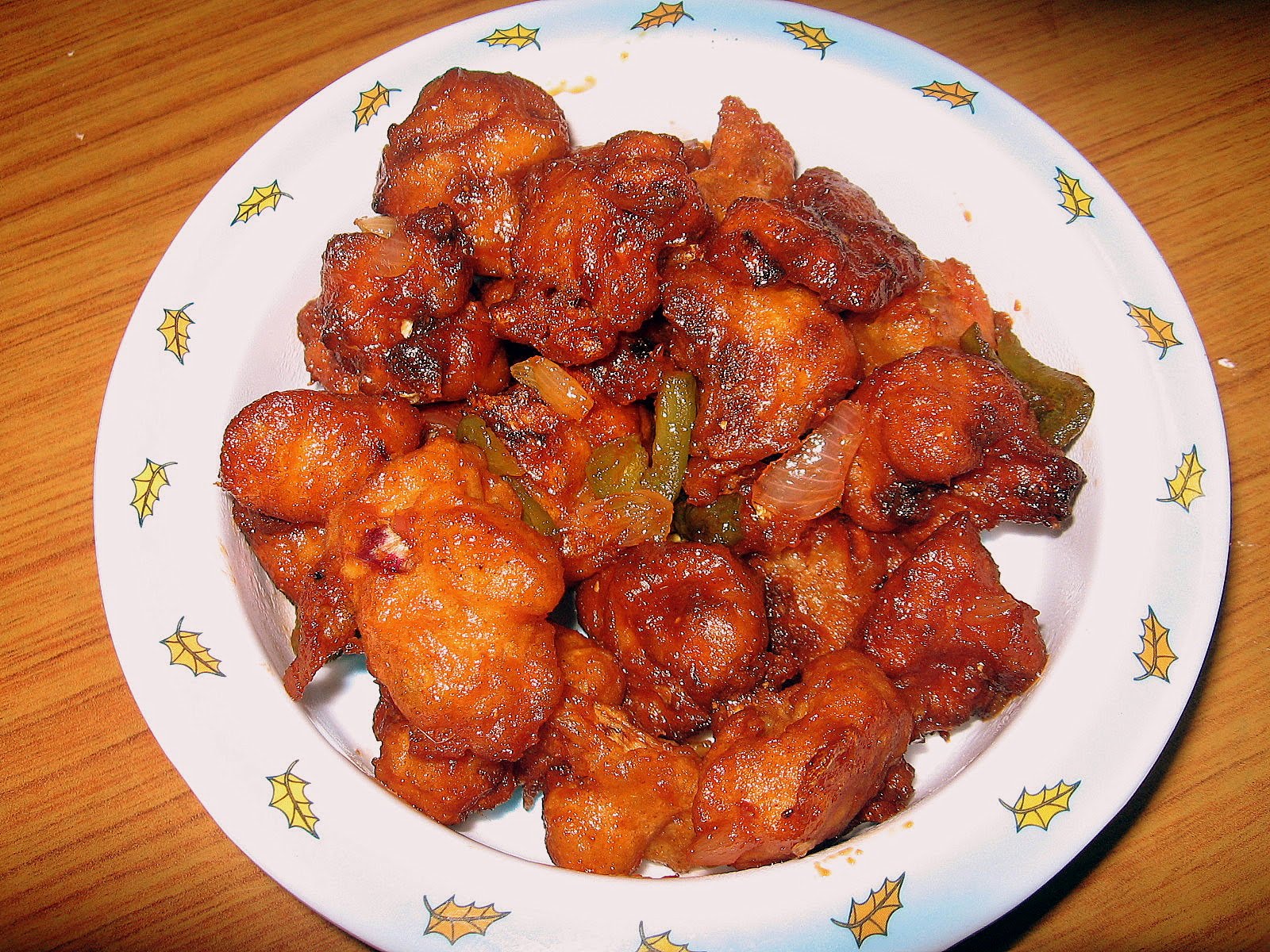
Gobi Manchurian Recipe
Gobi Manchurian is a Indochinese item which is made out of fried cauliflower and this dish is popular all over India.We can find it in all the restaurants and occupies a respective place in the menu card. This Chinese dish became in India because it had a adaptive taste that is suited for many of the Indians.It is believed that the origination of this dish has came through a small Chinese community in that lived in Kolkata for a century. We can find two varieties of this dish, one is dry and the other is gravy.Both of these varieties can be prepared by using cauliflower, corn flour, maida flour, spring onion, capsicum, soy sauce, minced garlic, ground pepper, etc.generally spring onion is used for garnish purpose.It has mild spicy to hot taste this can be varied depending on one’s requirements.
This popular Indo Chinese recipe is very delicious and tasty.This can be prepared by using florets of cauliflower known as Gobi. This will be more delicious when we make a serve with steamed rice, rotis, naans, plain noodles.We can make dry and gravy version of this Gobi Manchurian by following some steps.
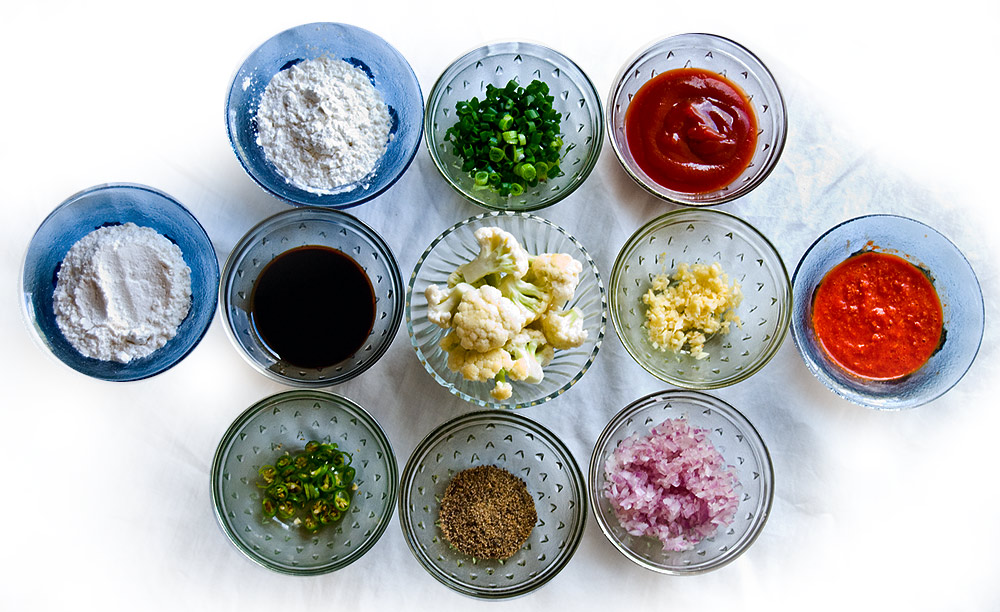
Gobi Manchurian recipe Ingredients:
For making sauce:
1) Take a bunch of finely chopped spring onions approximately half the cup
2) Take two table spoons of finely chopped ginger
3) Take two table spoons of finely chopped garlic
4) Take half the table spoon of chopped celery
5) Take 1/4 or half table spoon of black pepper powder
6) Take one to two finely chopped green chillies
7) Take one table spoon of soy sauce
8) Take two to three table spoons of oil
9) Take one and half cup of fresh water
10) Take salt that is suitable for taste
For making batter:
1) Take medium sized Gobi or Cauliflower
2) Take one cup of maida or all purpose flour
3) Take three table spoon of corn flour
4) Take one table spoon of minced ginger garlic paste
5) Take one table spoon of soy sauce
6) Take half table spoon of black pepper powder
7) Take 3/4 cup of veg stock
8) Take oil that is required for making a deep fry
9) salt required amount
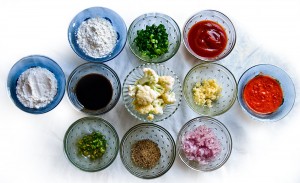
Ingredients required for making Gobi Manchurian Preparation of Florets:
Gobi Manchurian which is one of the best starters that one can have in any party, occasion.Most of the people like this item and no one likes to ignore it.As there are two varieties of this type most of the people like to have dry item rather than gravy one as dry item is convenient to have as a snack item before dinner. The preparation of dry Gobi Manchurian involves two parts 1) making of florets, 2) make spicy saute.
Step 1:
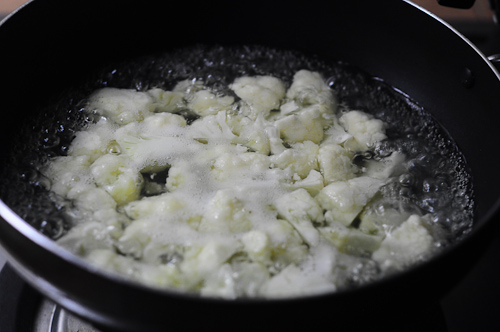
At first take a fresh cauliflower and wash it thoroughly to see that it is dust free, care should be taken that the florets should not get damaged.Take a bowl of water and add salt, cauliflower florets to it,allow it to boil in salted water for three to four minutes on a medium flame.After boiling, excess water is drained and spread these cauliflower florets on a tissue paper.
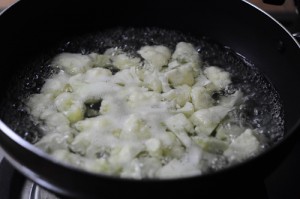
Boiling the florets in salt water Step 2:
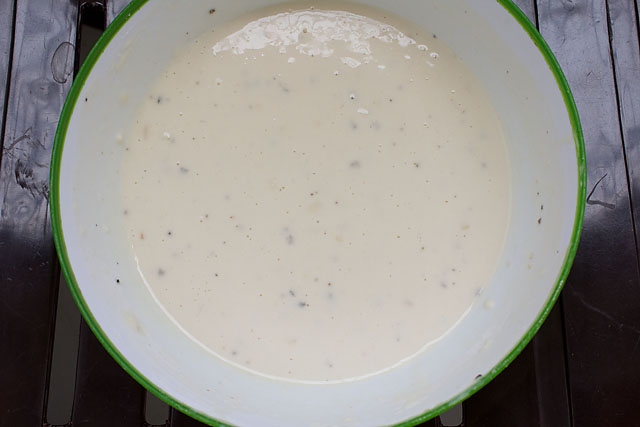
Take a bowl and mix maida,corn flour,ginger paste,garlic paste,water and salt to form a batter.Care should be taken that this batter is not so thick or thin.Make sure that this batter must have thickness similar to dosa batter.Now add all the florets to this batter and mix them well.For better taste of this Manchurian batter must be evenly mixed to these florets.
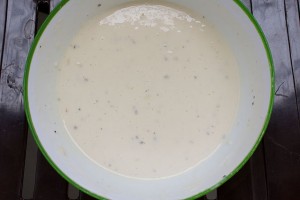
Batter preparation for making gobi Manchurian recipe Step 3:
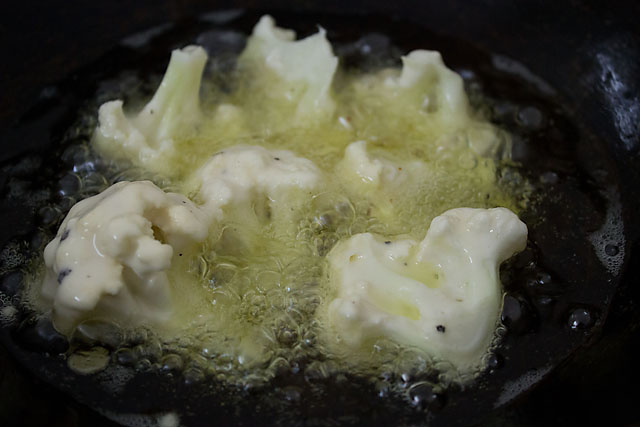
At first take a pan and add oil to it that is required for deep fry of these florets.Heat the oil on a medium flame and slowly add the florets to it that are mixed with batter.Fry these florets on a medium flame and care should be taken that they should not turn the oil may not spill.Frying process is done till their color changes to brown.After they are fried transfer these fried florets to a plate.
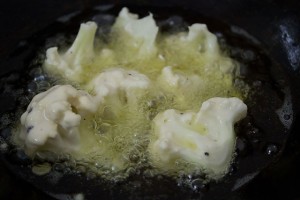
Deep frying of florets in oil Preparation of saute:
Step 1:
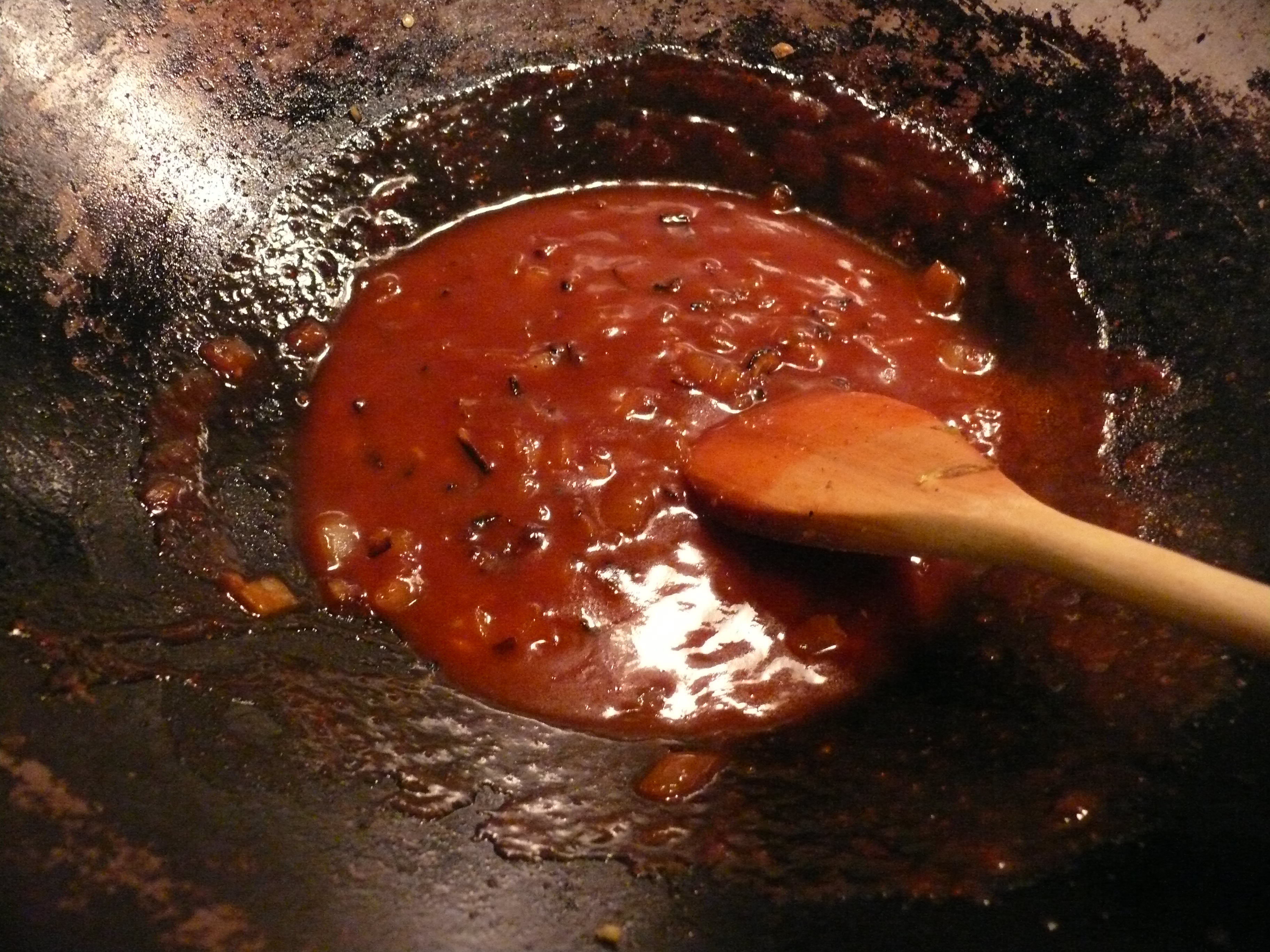
Take a deep pan or kadai and add two table spoons of oil.Heat it on a medium flame and add ginger paste, garlic paste, finely chopped green chillies, chopped capsicum, finely chopped onion to it and saute them well on a high flame for about three to four minutes.
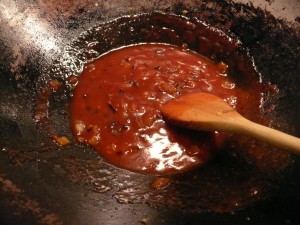
Gobi-Manchurian-saute making process step 2:
To the mixture add soy sauce,tomato ketchup, chilli sauce and salt that is required for taste,now saute this mixture well until all the ingredients are well mixed.It must be stirred continuously for about one minute and add deep fried florets to this mixture.
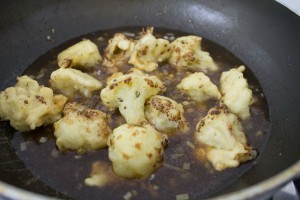
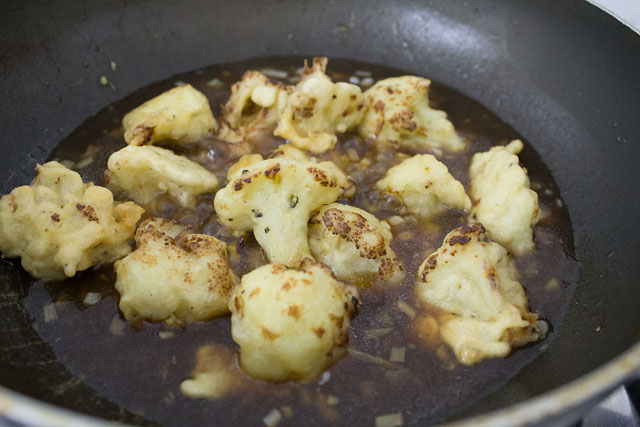
Adding florets to the sauce mixtures and saute it step 3:
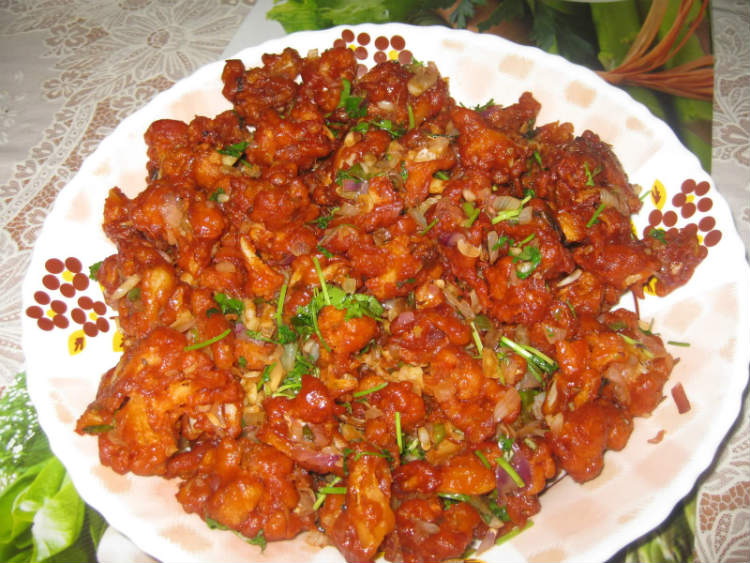
Add deep fried florets to the pan and continuously toss the pan so that all the ingredients are well attached to each of the florets.This process of mixing must be continued for about two to three minutes on a high flame. Care should be taken while tossing the items on pan as spilling may happen.That’s it very tasty and spicy hot Gobi Manchurian is ready, take it to a serving place and enjoy the Indo Chinese recipe.
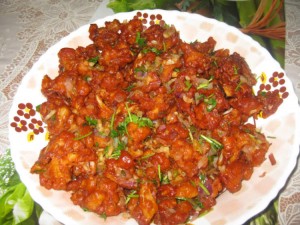
Serve the Gobi Manchurian in a plate -

Sweets – Yummy treats for You!!
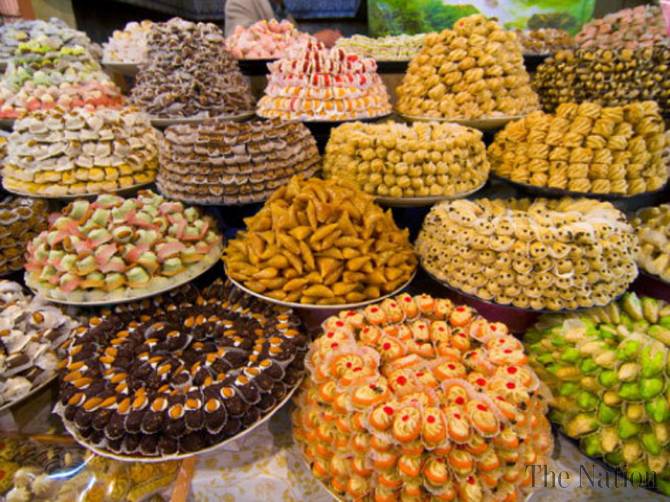
My college is situated at this awesome place. Remember, I told you about all the lip-smacking biriyani food joints near my college? Well, Park Circus also has its neat share of ‘misti r dokan’, i.e., sweet shops.
To name a few – Jugols’ , Mithai and a tiny sweet shop near Mahadevi Birla Girl’s School which serves soft hot white rasgullas that melt in the mouth. I remember walking to Jugols’ in the sultry heat in my first year (back then I was a regular customer) of college just to satisfy my taste buds.

Kolkata or Calcutta, as I still prefer to call it, is home to century old sweet shops. The ownerships may have changed hands but the love of sweets of the customers never ceased (and might I add, it never will).
Putiram’s ‘Rosomadhuri ‘, Mithai’s ‘Misti Doi’, Ganguram’s ‘Chomchom ‘, Balaram Mullick and Radharam Mullik’s ‘Mango Chanar Brulee ‘, Bancharam’s ‘Raj Bhog‘, Bhim Chandra Nag’s ‘Pranhara‘, are by far the popular choices of the ‘misti-loving’ denizens.
How to make your own sweets and woo your loved ones?
Plain and simple – follow these super easy recipes and you will be good to go.
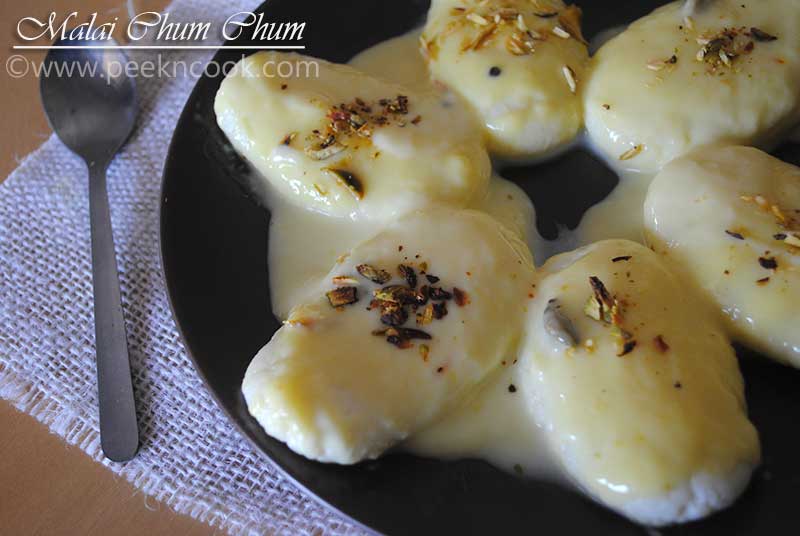
Malai Chomchom

Ingredients: 1 cheese cloth
For channa – ½ gallon whole milk, 1 large fresh lemon squeezed and filtered to make juice (use more if lemons are small size)
For syrup- 5 cups drinking water,2 cups sugar
For malai – ½ gallon whole milk, 1 tsp cardamom powder
For garnish- Sliced pistachios
Directions: Heat ½ gallon of whole milk in a heavy bottomed nonstick container in medium high heat. Stir occasionally to make sure milk does not burn at bottom or spill. When milk starts to boil put lemon juice (freshly squeezed) slowly into the boiling milk with constant gentle stirring. As milk starts to cuddle and gets separated from the whey (greenish transparent water) in about 2-3 minutes remove the vessel from heat and pour it in a cheese cloth spread over a strainer. Note: if the whey is not transparent then add a little more lemon juice and stir gently until whey is clear and transparent. Wash the chhana under cold water nicely to remove lemon flavor. As the chhana cools down bring the edges of the cloth up and tie it together. Squeeze out as much water as possible. In order to dry the chhana even further hang this chhana in cloth above the sink or keep a plate over it with some heavy object on top. Keep it this way for about 30 minutes. Then knead the dry chhana using the heel of your palm on a flat clean surface for about 7-8 minutes until it becomes a soft smooth dough and your palm becomes oily. Divide the dough into 12-14 equal parts. Take each part and roll it with both palms gently to make a smooth ball and then roll one way to give it a cylindrical shape – and voila a chomchom! Likewise do all the chom-choms. Place all the rolls on a plate and cover them with a damp cloth on top or with another plate so that they don’t dry out.
For the syrup, take 5 cups of water and boil it in a wide vessel. Add 2 cups of sugar to it when water starts boiling. Wait until sugar dissolves completely. Add about 7-8 chomchoms one by one into the boiling water. Don’t put too many at the same time as the chom-choms need room to expand. Keep the heat in medium high and cover the vessel tightly. Let it cook for 25 minutes. Do not open the lid in between. After 25 minutes switch off the heat and let it cool (covered) for another 10-15 minutes. Repeat the steps to make next batch of chom-choms. For preparing the Malai, boil ½ gallon of whole milk in medium flame, stirring occasionally to prevent it from getting burnt at the bottom, until it thickens and becomes creamy. This will take some 20-30 mins. Add cardamom powder to it and mix well. Switch off the heat. Take the chom-choms out of the syrup and drop them into the warm malai one at a time. Kepp them in the syrup for 20 minutes. Take out the malai wrapped chom-choms carefully and lay them into a plate. Garnish with pistachio.
Pranhara

Ingredients: 4 Cups whole milk, 4 tablespoons white vinegar or strained lemon juice, ½ Cup sugar, 1 Cup dry powdered milk, 3-4 tablespoons butter, 3-4 drops of rose water
Directions: Line a colander or sieve with a large piece of cheesecloth that has been folded 3-4 times. Place the lined colander or sieve over a large bowl or sink. Boil milk in a large thick-bottomed saucepan over medium high heat. Stir occasionally, scraping the pan bottom, to avoid scorching. Mix vinegar with 4 tablespoon of water and add to boiling milk. Look out for curd-mass to separate from greenish water. As curds rise and come to the surface stop the stove. Run a spatula along the bottom of the pan occasionally to free up any stuck curds. Gently begin to ladle curds into the prepared sieve or colander. Wrap the cloth around the cheese and rinse under a running water without pressing the cheese. Gather the edges of the cloth, tie or fasten into a knot and allow to cool and drain for 2 hour minimum.
Heat butter in a nonstick pan over medium low heat. Once butter melts, add the dry powdered milk. Stir constantly to form a coarse dust and until slightly golden and aromatic. Set aside. Knead the cheese on a clean surface with your heel of the hand by pressing it across the surface until smooth and fluffy and no trace of grains. Knead about 5-6 minutes. Collect all the cheese and divide them into two parts. Mix sugar and cheese dust(Set aside some for garnish) with one part cheese and cook in low heat stirring constantly, scrapping the pan bottom. Use a thick bottomed or non-stick pan. Cook until the mixture is very sticky and a mass pulls away from the bottom and sides of the pan. Remove from heat. Let cool. Mix the rose water, second portion of the cheese and knead till smooth. Divide into smaller bite size balls. Garnish with cheese dust.
Recipe Courtesy – withaspin.com, bengaligourmet.com
Image Courtesy – peekncook.com, withaspin.com, hungryangmo.com
-

Going Places: A Street Food Junkie’s Survival Guide
Holiday season is here and bags are packed. Every year some travel bug feasts on my family members and we end up in some random town. So when travel bug bite my brother this year, we ended up in Kota (Have you heard about it? It is a beautiful town in Rajasthan).
Traveling to a place where you have never eaten before is a Food Junkie’s dream destination. To tell you the truth, it is every Indian’s delight. How can you NOT like trying new food items, tell me? Though there might be some exceptions like my brother who has no appreciation for food and thus always judges me on the account of unhealthy street food I eat.
Out on street, the first thing my cousin, who is a resident of Kota, told me was, ‘As long as your taste buds are not used to this city, you shouldn’t take any risk with the street food’. Well, that’s true to every word, I swear. Else there might be some bad consequences.
Coming back to the point, every Indian city has its own street delight. Let me be sure you know exactly what I am talking about when I talk about street food. When somebody mentions street food, you might think about chaat without wasting a moment. Yes, chaat is street food but it is a small portion of the bigger universe.
Street food, as one can understand by the name itself, is food which is sold (but may or may not be made) in streets. It ranges from the light chaats to hearty meals like Daal-baati choorma, Rajma-Chawal, Pulao and Curry. Just anything and everything. The only thing that stands out between a Dhaaba and Street vendors is that these street sellers are too poor to start a dhaaba. But at the same time, due to their easy availability and reasonable prices, they are always a hit among lower to middle class and college going people. Also, the quality of celebrated street food is that it might not be the mainstream found in restaurant menus but it stands as the heartbeat of the city, adored by common people.
In other words, as historic monuments are a must visit in order to study the culture of a city, same way, eating street food and exploring regional arts is also a must to indulge in the culture of a city. It gives a new flavor to life. These things are only known by Street Food Junkies who go out in the streets to rejuvenate their taste buds.
Now, if you are a Street Food Addict or aspiring to be a Street Food analyst (if there is any such thing), you can follow some of these tips in order to enjoy Street Food without mulling over consequences.
- Give your taste bud a little time to get along with the local taste.
Especially if you are not used to local spicy food. Proceed with small amounts at first and build up tolerance to the taste.
- Have you ever played the game ‘Follow the Leader’?
You have to do the same. Follow the crowd and have faith on the locals. They know more than you. If they are avoiding a particular street vendor, it isn’t a time to act all radical. Go with the flow.
- Make sure food is being cooked freshly.
Fresh doesn’t mean something cooked 8 hours earlier and heated in the present time. Sneak peak in the vendor’s utensils to check if he is continuously cooking. If not, this isn’t a place for you.
- How many flies can you count at the counter/the vendor’s utensils?
You know the rule- higher the number of flies-lower the quality-worst the consequences. However tasty the food may seem, if it is already taken by the flies, you shall not claim it.
- Fact-Fruit is healthy. Reality-It depends on circumstances.
Don’t let the worldly pleasure of pre-sliced fruits tempt you. ALWAYS make sure fruits are freshly cut or get it sliced right in front of you. Don’t take the chance with heavenly-looking fruits if you love your stomach.
- Last but not the least, when you are out in the street, keep clean drinking water handy. You shall be a teenage rebel or a liberal minded person. But water is water. It should be clean and hygienic.
There is a lot more to learn in the art of Street Food eating but we believe what the elders have told us, ‘Experience is our true teacher’. Being broke teaches us the art of bargaining, especially if there are no written prices. Loyalty towards a particular street vendor earns us the extra sauce. And a lot more such tricks.
Now, go out in streets and don’t be afraid to try new dishes. In this free country, we have every right to eat the food we want without being judged by those who don’t know anything about the pleasure of street food. Feel gratitude towards these people who feed us Food Junkies.
Also take adequate precautions to fully enjoy the trip and food. You will survive, just like I do every time.
As for me, I’ll go back into the street for another street photography session hiding this eating bug somewhere inside me that will guide me to the final destination- a Street Vendor’s Stall.
-

Madurai: Symbol of Tamil Culture
History of Meenkashi temple :

- Meenakshi Amman temple is an ancient temple which is located on the banks of river Vaigai in Madurai district of Tamil Nadu.
- Meenakshi Amman Temple is also called as Meenakshi Sundareshwar Temple. This temple is more than 2500 years old. This temple is dedicated to the deities mainlyMeenakshi who is the modern avatar of goddess Parvathi and Sundareshwar as Lord Shiva.
- The temple was originally built during 7th century by the first Pandya’s .
- Malayadwaja Pandya who was one of the kings who ruled Madurai, in South India.Meenakshi was the daughter of the king Malayadwaja Pandya and queen Kanchanamala.
- Meenakshi was a miracle child gift given by god to both the king and queen after their sincere performance of yagna to have children’s , as they din’t have children’s from many days.
- Meenakshi was a brave girl who was thought the art of war and martial arts. She got married to Lord Shiva . So Meenakshi temple was built after her and Madurai city was formed around the temple.
-
La Cucina Romana
When in Rome, do as The Romans do. Meaning it is polite, and possibly advantageous, to stand by the customs of a society when one is a visitor. But of course, if you’d rather literally do as The Romans do, whether or not in Rome, the best place to start is food.
Tasting the various flavours of the place you are visiting is one of the best ways of saying “I come in peace” and also, the best way to enjoy. All you need to know is what you are eating and all you need to do is try to find out how it is made.
Roman cuisine is the cuisine of the city of Rome, in Italy. Rome is city that is generally referred to as an empire. Though size has a major role to play in that title, it is also so called due to the widely spread culture. Roman food has grown through centuries of social, political, and cultural changes. The city became a chief gastronomic centre during the ancient times. Since Rome was, in many ways, a derivative of Greece, ancient Roman cuisine was highly influenced by Ancient Greek culture. The empire’s constant and enormous expansion exposed its people to new culinary habits and cooking techniques.
The most original and traditional Roman food can still be found in Testaccio Rione. Gladly, you needn’t go all the way.

PASTA
Pasta is one major constituent of Roman food. There are various shapes of pasta, the most common being Spaghetti. There are others like Fusilli, Gemelli, Lasagna, Linguine, Macaroni, Orecchiette, Penne, Ravioli, Riccioli, Rotini, Tortellini, Tripolini, Vermicelli, Tubini, Zitti and many, many more.
However, the diversity in pastas doesn’t come from their shape alone, but also from their sauces.
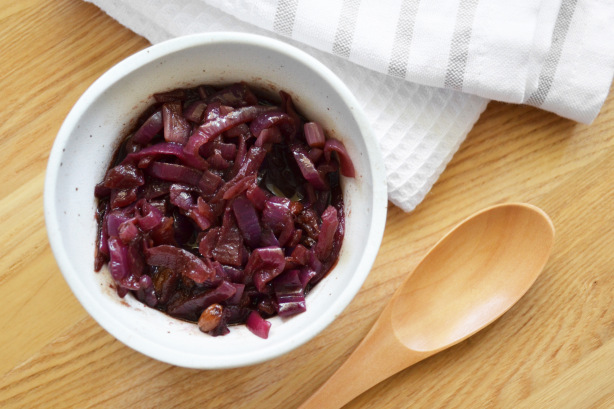
Agrodolce is a traditional sweet and sour sauce. Its name comes from “agro” meaning “sour” and “dolce”, meaning “sweet”. Agrodolce is made traditionally using vinegar and sugar. Sometimes, additional flavouring is added, such as wine, fruit, or even chocolate. It is served over rigatoni or wide noodles, such as pappardelleand can also be served with salmon or lamb meat.

INGREDIENTS
- 2 tablespoons olive oil
- 2/3 cup balsamic vinegar
- 1 teaspoon sugar
- 1 tablespoon unsalted butter
METHOD
- Heat 2 tbsp of oil in a large skillet over medium-high flame till it shimmers
- Sauté onions until they turn golden brown and crisp-tender. This takes 6 to 8 minutes.
- Stir in vinegar, sugar, and 1/2 tsp salt
- Cook until sauce is syrupy. This usually takes about 2 minutes.
- Remove from heat and stir in butter.
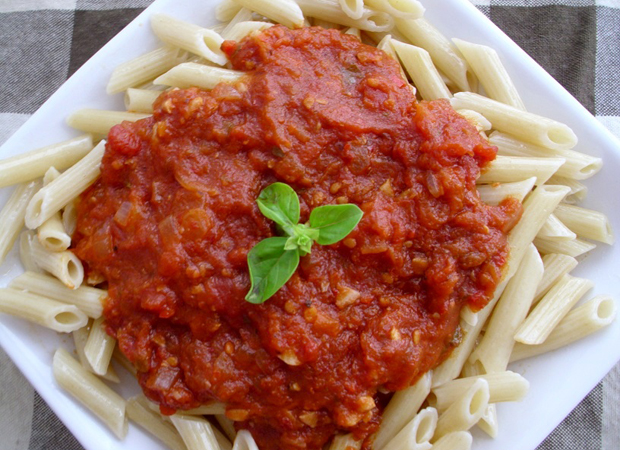
Arrabbiata sauce is a pasta sauce meaning “angry sauce” in Italian. It is so named because of its spicy nature.

Arrabbiata sauce with Penne pasta INGREDIENTS
- 1 tsp Olive Oil
- 1 cup chopped onion
- 4 cloves garlic, minced
- 3/8 cup red wine
- 1 tbsp white sugar
- 1 tbsp chopped fresh basil
- 1 tsp crushed red pepper flakes
- 2bsps tomato paste
- 1tbsp lemon juice
- ½ tsp Italian seasoning
- ¼ tsp ground black pepper
- 4 peeled and diced tomatoes
- 2 tbsps chopped fresh parsley
METHOD
- Heat oil in a large saucepan over medium heat. Sauté onion and garlic in oil for 5 minutes.
- Stir in wine, sugar, red pepper, basil, lemon juice, tomato paste, Italian seasoning, black pepper and tomatoes. Bring mixture to boil. Simmer uncovered for about 15 minutes.
- Stir in parsley.
- Serve with the hot cooked pasta of your choice.
It is a myth to think that Roman cuisine consists of pasta alone. Sure, they eat pasta all the time, but not as a main course. In Italy, pasta is actually more of a starter (primo). It is eaten in very little quantities, followed by the main course (secondo).
BREADS
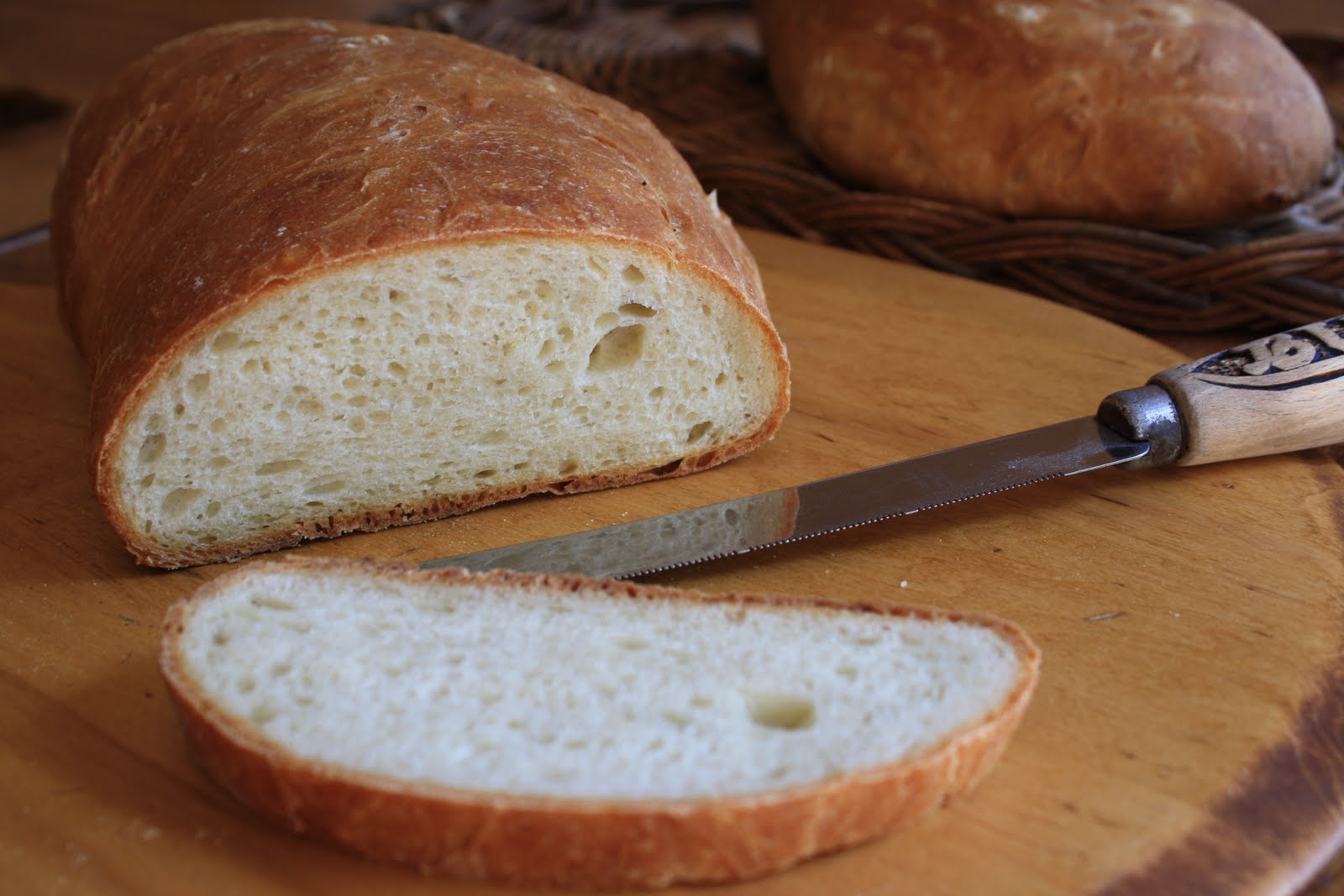
In Rome, bread varies in quality depending on the flour, which depends on the grain used, the setting of the millstones and the distinction of the sieves. The very best bread is made from wheat flour and the very worst is from bran alone. Traditionally, bread loaves were cylindrical yet somewhat flat, like a coffee cake, but shape is hardly a fixed parameter now.

The types of bread include
- Libae—small rolls
- Panis Primus—cheap, coarse grain bread
- Panis Secondus—Bread one step above Panis Primus
- Panis Plebeius—Common Bread
- Panis Castrensis— Army Bread
- Panis Sordidus—Dark Bread
- Panis Rusticus— Country Bread
- Siligineus— White Bread.
Legumes like beans, green peas, chick peas, lentils, etc. were also added to bread.
FRUITS AND VEGETABLES
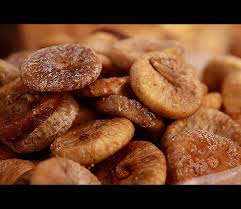
The common fruits eaten by Ancient Romans are almonds, plums, walnuts, apple, figs, pomegranates, filberts, quinces, grapes, chestnuts, pears. Fruits were generally eaten raw, dried, preserved, and cooked. They were generally dried and preserved for winter. However, this is not the case in modern Rome. Nowadays, all sorts of fruits are eaten all over the world and Rome is no exception. Vegetables were eaten in variety too—artichokes, garlic, beans, lentils, onions, parsnips, peas, pumpkins, radishes, melons, cabbages, cucumbers, lettuce etc.
BEVERAGES
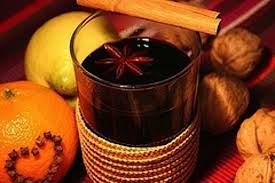
Wine was a major beverage, considered as a symbol of richness and prosperity. It was always watered down. Romans never drank wine straight. It was taken in small quantities with breakfast and in moderately large quantities during the main meal—Cena. Cena was taken between lunch and supper. Supper was generally a light affair, but wine was mostly taken during Cena.
Other beverages included:
- Calda, which was a mixture of warm water and wine laced with spices. It was typically a winter drink.
- Mulsum; honeyed wine.
- Posca; Vinegar diluted with enough water to make it potable. It was a soldier’s or a slave’s drink.
MEAT AND FISH
Roman meats included Beef & Veal, pork, lamb, sausage, snails, sucking pig, hare, goat kid, venison, mutton, boar, mackerel, mullet, crab, eel, flounder, hake, lobster, rays, octopus, oysters, perch, duck, swordfish, flamingo, fig-peckers, dove, partridge, peacock, pigeon, thrushes, crane, goose, ostrich, etc.
The poor Romans could seldom afford meat. Out of the listed, pork was considered a great delicacy. Peacocks were served to impress guests at dinner parties and you were considered a happy guest if you belched loudly. It was a “polite” gesture, stating that you enjoyed your meal.
Well, after having read the scrumptious list of foods the Romans savoured, all one can say is Buon Appetito!
-

Cakes and History
We all enjoy eating those delicious, yummy cakes. Don’t we? The mere sight of that scrumptious, chocolate-draped cake (with that vanilla icing and cherry on top 😉 ) on a friend’s birthday party makes us yearn for a better, a ‘fit-for-gods” kind of a cake for our own birthday party!! When I was five, I wished for a super delicious yummy cheesecake for my birthday when my mom took me to my little cousin’s party who had got a strawberry cake for him.
Oh yes, CAKES. Who doesn’t love them? Whether it is a birthday or a wedding or even for those small little surprise parties at home, there is a cake for every occasion and for everyone. For that ‘sweet tooth fanatic’, for that ‘size- zero loving’ woman, for that ‘diabetic and still a sweet tooth fanatic’, and for the one who just loves anything sweet. But do any of us know anything about how cakes came into being? No, right? So, here is a small insight into the history of our favourite food. “Cakes”.
The history of cake is rich with rituals and symbolisms from different cultures and countries, all coming together to shape the cakes we know today. According to food historians, the Egyptians were the first tribe who showed evidence of possessing the skills of baking. Maybe they were fed up with the usual meat and hence started to try their hands at baking something new. However the cakes were sweetened with honey instead of sugar and were bread-like. The great poet Ovid mentions enjoying a cake during his brother’s birthday party in Tristia. History also claims that cake became a thing in ancient Greece. Some say that cakes came up only after the Middle Ages, and people enjoyed cakes only while celebrating festivals or on a birthday celebration. The tradition of adding small figurines to the cake and blowing the candles and singing a birthday song before the cake cutting began in England.
And why are the cakes usually round? Ever wondered? Here’s the answer. Although these days, we have a variety of shapes from heart-shaped to cartoon characters, animals, castles, and even photo cakes (where you have the picture of the person you are giving the cake to). But cakes were traditionally round, symbolizing the cyclical nature of life, the sun and the moon, which is probably why we have cakes during important events in our lives, highlighting that we are embarking on a new journey. The angel and the demon cakes! Yes there are cakes with those names. Angel food cakes were named as such due to their white and fluffy exterior, which came from egg whites supposedly symbolizing angels. However, if angels were there, could demons be far? Devil cakes started becoming popular in the 20th century. They were named so because the rich chocolate taste was so blissfully delicious that they were considered sinful. Even today, some people still think of eating chocolate as sinful due to the effects it has on their waistline. Today, cakes are served during holidays, weddings, baptisms, etc. Basically cakes have always been a part of all the significant moments in our lives. Ancient rituals have the tradition of eating cake at during ceremonial occasions. Cakes were offered to the spirits and Gods who showcased their special powers at particular times of the year. In China, cakes were made in honor of the moon goddess, Heng O at the time of harvest. Pancakes are made in Russia to pay respect to the Goddess of Spring called Maslenitsa. At the time of their traditional festival, the Beltans rolled cakes downhill to depict some solar movement. They hoped that rolling the cake would ensure the continuous movement of Sun. Strange as it sounds, but the Celts believed that if the cake broke while moving downhill, it was indicative of the person’s death within a year. Across the globe, people made cake offerings to deities and Gods during the time of harvest and the cakes were prepared from fruits and grains that were born out of the soil.
Times passed, and technology took center stage. In the 19th century, lives of the bakers became easier. Baking powder was born from sodium bicarbonate and baking became a faster process. Soon, ovens were invented and accurate temperatures could be used to bake the cake for just the optimum amount of time. With technological advancements, new techniques for levelling and sweetening developed. What was initially regarded as a form of sweet bread now has a category of its own and comes in various varieties and colors. Today you have them all. The cakes, the pancakes, the cupcakes, pop cakes and what not!
So there you have it. Historical and insightful things to know about the cakes we eat to treat our taste buds. Like everything else, cakes have had their moments in history too. So the next time you savor your taste buds with that tasty cake think of all the human inventions needed over time, to allow you to this little luxury.