Tag: health

  • Paneer Tikka

    Paneer Tikka

    Paneer Tikka
    Paneer Tikka

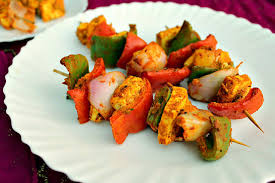
    Paneer Tikka is a popular tandoori snack which is a simple recipe. Paneer Tikka is a marinated paneer cubes which are arranged on skewerss,which are used for holding food and then baked in an oven.It is considered as one of the best paneer recipes.There are many varieties in paneer tikka to prepare.Mostly,paneer tikka is prepared on a tandoor and hence it can be named as tandoori paneer tikka but it can also be made simply through an oven.

    Paneer Tikka Masala is used to make Paneer Tikka which is  a spicy dish of onions and garlic.The garlic flavor richens the dish.This dish is originated in India and considered as an popular dish in Middle-east and Europe.This dish is popular for both vegetarians and non-vegetarians as many varieties lies in this recipe as it can always be substituted with chicken and also Chicken Tikka Masala can also be added inspite of normal masala powder  while preparing.
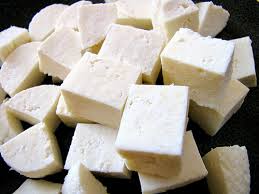
    Paneer
    Paneer

    Paneer is a dairy product now-a-days become majorly famous due to its elegance in taste.It is a type of cheese of milk curdled from sheep,goats, cows.It has a good quantity of calcium which helps in building strong body and it strengthens the bones,teeth.It also develops insulin resistance syndrome and helps in  back pain and joint pains.As it is rich in proteins,it reduces the risk of cancer and also prevents stomach disorders and is mostly useful for elder women.

    Recipe of Paneer Tikka:

    Paneer Tikka can also be made in a tawa instead of oven.We also can make paneer at home easily which tends to be healthier than which are available in markets.

    Method to prepare Paneer

    muslin cloth
    muslin cloth
    1. Boil 2 litres of fresh milk and add vinegar or curd or lemon juice to the milk and stir well and keep it aside.
    2. After the milk has been curdled,wrap it in a muslin cloth(a thin delicate sheet) and rinse it with fresh water and squeeze the water.
    3. Now,form it like a ball and place it under a saucepan for nearly 20 minutes.
    4. Then,paneer of 200 gms is ready and we can use it in all foods.

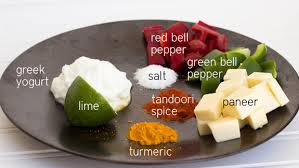
    Ingredients needed for Paneer Tikka-
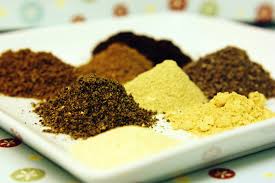
    ingredients needed
    ingredients needed
    requirements
    requirements
    • 2 green and red cubed capsicums cut into cubes
    • 1 onion cut into cubes
    • 1/2 cubed tomato
    • 1 1/2 cup of paneer cubes
    • 1/2 tsp of tandoori masala powder
    • 1/2 tsp of lemon juice
    • 1 cup of hung curd or yogurt
    • 1 1/2 tsp of ginger-garlic paste
    • 1 tsp of red chilli powder
    • 1/2  tsp of garam masala powder
    • 1 tsp of coriander powder
    • 1 1/2 tsp of oil
    • 1/2 tsp of kasturi methi leaves
    • 1 onion sliced for garnishing
    • toothpicks
    • salt to taste

    Preparing Paneer Tikka

    1. Take hung curd or yogurt in a bowl and beat it until it turns into a smooth paste.
    2. Add all spice powders such as red chilli powder,garam masala,coriander powder,tandoori masala powder and also add ginger-garlic paste,kasturi methi leaves and salt.
    3. Mix well and prepare a  marinade(a mixture where the food is soaked to give flavor).
    4. Now,add paneer and add the capsicum pieces,onions and stir them so that all ingredients are mixed up and leave it for an hour to marinate them.It can also be covered and placed in a  refrigerator.
    5. Now ,take a toothpick and arrange capsicums red and green,onion,paneer in an order.
    6. Switch on the stove and heat tawa and put 1 1/2 tablespoons of oil.After mil heating,lightly fry paneer and vegetables over the heat. and cook them until those items turn light brownish in color for 3-4 minutes.
    7. Now,Paneer Tikka is transferred to a plate and slowly remove the toothpicks by pushing the vegetables into the plate.
    8. Add 1 -2 tsp of lemon juice over the food and garnish them with sliced onions and serve them.

    Paneer Tikka
    Paneer Tikka
    • Paneer Tikka can also be served as a roll wrapped.The vegetables we arranged in toothpicks can be taken or also kept like it while serving.
    • Paneer Tikka can also be grilled in an oven.The marination process  should be more than 2 hours.The more it marinates,the flavors gets fused much more that they get even more tasty after preparation.
    • You can also use mushrooms,babycorn,cauliflower,tomatoes in this dish.
    • For low fat,we can add 1/4 cup of milk.
    • We can add gram flour to the marinade such that it prevents from sticking paneer in the pan.
    • Also,we need to ensure that the paneer are not overcooked and it is cooked on all sides.

    Paneer Tikka is a freshly made spicy Indian dish which can be accompanied with naans,chapati,bread.It is a tasty dish with several variations.It is also served with a gravy known as Paneer Tikka Masala.It has been popular such that even International fast food chains have added this recipe in their menu.Now-a-days,instant making packages are available in markets by different companies.It can be made within less amount of time.But the home made taste can’t compare with any taste which needs to be tasted once in a life time.


  • Mangoes: Shout out to all the Mango Maniacs

    Mangoes: Shout out to all the Mango Maniacs

    Summer is at full stretch and the scorching heat and frequent power cuts don’t make it easy to fancy this season. There are still stuffs that we do root for throughout the year. Yes! I’m talking about long vacations, hometown visits or vacationing in the hill stations! But for all the “Foodaholics”, out there awaits the king of all fruits. Yes! MANGOES!! Though age is no category for a mango maniac, still I believe that kids are best examples of the same as to them apart from joining exciting summer camps or watching TV for endless hours, mangoes do hold a special place. Have to admit watching kids eat mangoes with pulp all over hands is an off-putting yet adorable sight. They are ones who won’t count calories but would feast upon them and contest with their siblings of who had the most like a true Mango maniac! As a kid when we used to head for our hometown, the sight of mango laden trees and lots of them used to get us frantic! Even in the cities at that time the quality of mangoes available in the market used to be fine and more feasible for the “Feast contests”.             Nowadays, we find it difficult to make a difference between which one is naturally and which are artificially ripened mangoes as both of them look almost alike. Well, to be honest artificially ripened looks more alluring. There are many features that set them apart like artificially ripened ones will have distinct patches of green color and their taste gives slight burning sensation in the mouth.  It is said that to get the taste of natural mango one should wait for the season to set in like after April. Now to list up all the mouth watering delicacies made from mangoes, though note that this wouldn’t include any sophisticated recipes but more like a list of the best homemade “Beat the heat” and other refreshments  from mango. Just to be sure Do Google the recipes for them!

    1. AAM PANNA!

    Refreshing drink made from raw mangoes, Aam panna is made by taking the pulp out of boiled raw mangoes and then mixing the pulp with water adding sugar or jaggery. Of course not forget, Ice! Having a chilled glass of Aam panna after an exhausting day in office or playing all day in the scorching heat surely refreshes the senses. Aam_Panna

    1. AAMRAS!

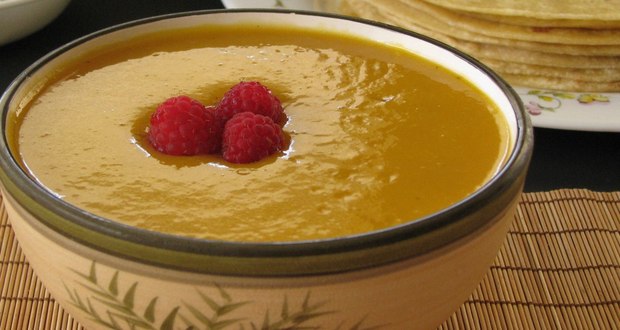
    Aamras is nothing but mango puree flavored with cardamom and saffron. This refreshment goes well with Puris, Paranthas or can relished solo. Sweetened naturally doesn’t have added sugars and one can enjoy this with limited calorie intake. aamras

    1. MANGO SMOOTHIE!

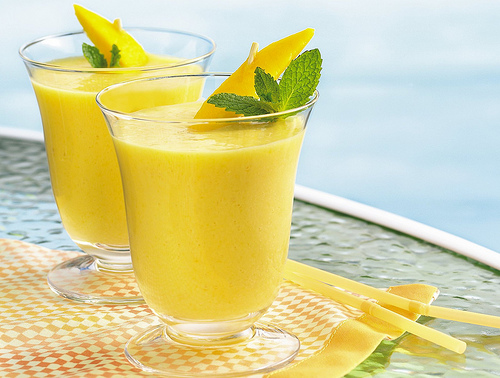
    Delicious summer drink prepared by blending mango pulp with almost equal amount of water and lime juice (as per preference). Sugar or sugarcane juice can be added to sweeten it more.Smoothie should be served chilled. Mango-Smoothies

    1. KHATTI MEETHI CHUTNEY!

    As it is not so much popular than the above refreshments, so I don’t know what its market name is. Regardless in our household it has been given that name.So, it’s basically prepared by frying raw mango pieces with mustard and cumin seeds. The fried mango pieces are the poured into hot sugar or jaggery syrup and cooked for few minutes.This mouth watering chutney tastes tangy-sweet and goes well with the meals or can be enjoyed as it is. Khatti meethi chutney

    1. MANGO MOUSSE!

    One of the favorite deserts ever! Mango mousse is a light and creamy sweet dish prepared by both using egg or egg less. Prepared by blending the mango pulp with honey and cream and refrigerated for 30 minutes or so. This can be served with your favorite toppings like blueberry, tooti fruity e.t.c.  In the egg version while blending, egg whites pre- cooked in caramel is added. Mango mousse

    1. MANGO UPSIDE-DOWN CAKE!

    Fan of baking? If not too, this flavorsome cake is worth every bite.  Prepared like any other cake with a twisted layer of mangoes at the bottom. Top the cake with whipped cream and there you have a perfect piece of delight. Mango upside down cake   Okay, so the point made Mangoes are “Kings of Fruit”. Apart of being awesomely delicious let’s see if they carry more value.

     SKIN

    Having acne problems? Boil a raw mango, take the juice and apply as an acne remover. Mangoes are believe it or not great cleansers and exfoliate your skin too. Add wheat flour to mango pulp and apply this mixture to clean pores in the skin from deep within. For exfoliation purpose blend peeled mango with milk and crushed cashews or oat. People with sensitive skin can use mango-milk pack for refreshing their skin without worrying about reactions. Mangoes are also known to remove blemishes and enhance the skin color because of the presence of vitamin A, C and Beta carotene.

    Mango health benefits

    HEALTH

    4000 Years and older this fruit contains abundant levels of anti-oxidants  which is said to beneficial for preventing diseases like cancer, leukemia e.t.c.  It helps improving the eyesight due to presence of vitamin A. Additionally, the presence of fiber and Vitamin C helps in bringing down cholesterol and it increases metabolism.Mangoes are said to be rich in folic acid which helps in improving fertility.    So, a Mango maniac yet? There is around a month more for the mango season to get over, make sure you grab a bite of delectable must haves from safe to say now an “All rounder” fruit!

  • Eat a food Rainbow and Colour yourself Healthy!

    Eat a food Rainbow and Colour yourself Healthy!

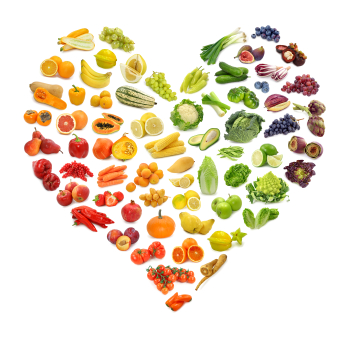
    Edible Rainbow

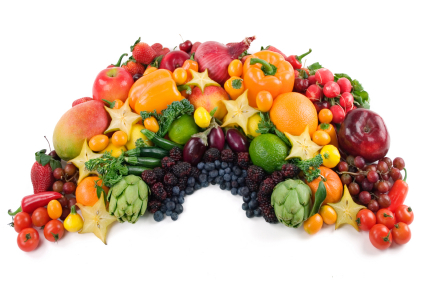
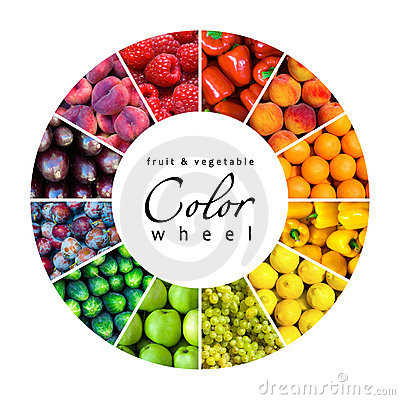
    Aren’t this is Exciting? What is it with food Rainbow. Something that is Truly colorfully healthy! Eat a food rainbow refers that you should make sure that you have red, greens, yellows and all the bright colours on your plate. Nature is full of colours and colours are such a positivity in itself. Same as your wardrobe has so many colorful clothes and so much versatility to make you look good on your outer side, similarly your plate must have variety of eatables, fruits and vegetables of all colours to keep you good from inside. This is a very healthy choice and everyone should opt it. We choose and eat food based on their taste, their cost, and their easy availability. The manufacturers have done a great job in creating foods that are inexpensive, easy to eat, and rich in sugar, fats and oils just to make them taste good and tickle you’re your tastebuds. But, wise decision is not to fall prey to the alluring tastes rather be cautious about your choice and choose the colourful.

    photo-2-12
    “Eating brightly coloured fruits and vegetables can keep you fit and healthy and protect against certain cancers, arthritis, heart disease, cataract and even premature ageing” , says Juliette Kellow
    When parents choose to use rainbow as a nutritional guide, you are fortifying that your kids are benefiting a wide spectrum of vitamins and minerals and other nutrients provided by each colour group. Making a choice to eat all five colour groups and sticking to them every day is superb way to maintain the good health of your kids and yourself.
    Why to eat Food Rainbow?

    fruit-rainbow-21442178
    Now the question may arise that what is the point in having a colour in diet anyway or why to include food rainbow in your diet? There’s one word to that: PhytoChemicals, also known as Phytonutrients. These are natural chemical compounds found in all plants. They safeguard against diseases and provide health benefits in humans and plants. Phytochemicals in veggies and fruits give them their colour. Each colour has its own vitamins, minerals and phytonutrients that helps in maintaining health of your family and keep it happy and prosperous. Eating a versatile fruits and veggies gives energy to the bodies of kids which help them in learning, growing playing and thriving. Different colours of fruits and vegetables signify different phytonutrients that each have, therefore using rainbow colours as a guide. It is great way of ensuring a wide range of phytochemicals in your children’s diet. A colourful rainbow diet is most appropriate way to keep a healthy body. It is one of the best defenses against cancer, chronic disease, heart disease or diabetes! So, here’s the rainbow guide to choose from the variety of colour foods in your plate from each colour group. There are so many more than you realize. Know about them and eat them everyday.

    green-fruit-and-vegetables-2
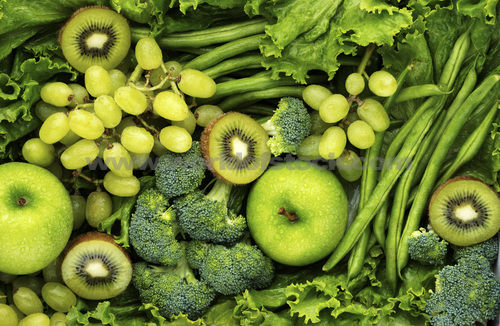
    Green: The fruits and vegetables coloured green by a pigment called cholorophyll. They contain phytochemicals such as indoles and glucosinolates and nutrients such as beta-carotene, folate, iron and calcium. A good intake of these antioxidants can act as natural sunglasses and prevent age-related macular degeneration which is a leading cause of blindness and also help in protecting against cancer. You can choose from variety of green vegetables and fruits like apples, grapes, kiwi fruit, avocado, peas, spring onions, beans, spinach, Brussels sprouts, lettuce, asparagus, broccoli, leafy cabbage, cucumber, watercress, peppers, spring greens etc.

    Blue-purple-Fruits-Vegetables
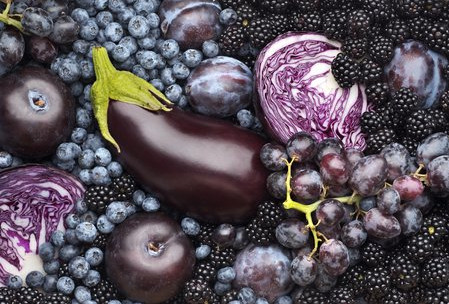
    Blue/Purple: The fruits and veggies coloured purple or blue contains phytochemicals called Anthocyanins. Many of these also contain ellagic acid and proanthocyanidins. Anthocyanins helps to keep heart healthy and reduces the risk of strokes. Good intakes of anthocyanin also helps to improve co-ordination and short term memory in old age as well as better vision. Researches have also shown that proanthocyanidins may help to protect against urinary tract infections. Many fruits and veggies like grapes, blackcurrants, blackberries, grapes, blueberries, prunes, plums, raisins, red onions, red cabbage are purple or blue in colour, from which one choose according to their taste.

    1333127831_Picture1
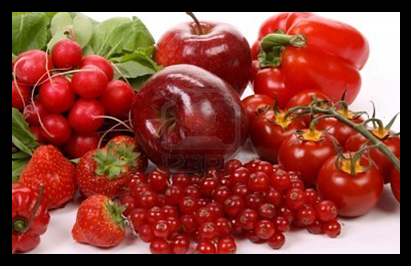
    Red: There are two main pigments that give fruits and vegetables their red colour which are Lycopene(a carotenoid) and Anthocyanins (a flavonoid). Many of these are also rich in vitamin C. Anthocyanins present in red fruits keep the heart healthy, help in fighting cancer, improve vision and memory and avoid urinary tract infections. Tomatoes, guava, watermelon are a very good source of Lycopene, which help in protecting against cancer, especially prostate cancer. We absorb lycopene more easily when foods have been heated, so processed tomatoes are better than raw. One can choose Red fruits and veggies from among raspberries, strawberries, cranberries, pomengranates, apples, rhubarb, watermelon, guava, tomatoes, pepper, radishes and potatoes.

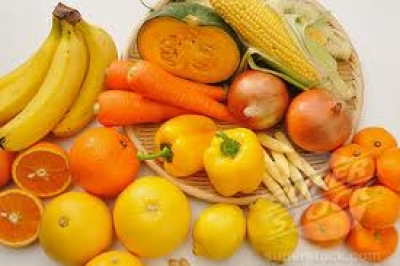
    yellow and orange fruitss and vegetables
    Orange/ Yellow: Yellow and orange fruits contain carotenoids such as beta-carotene and beta-Cryptoxanthin. They are also a good source of Vitamin C. Most yellow and orange foods are packed with beta-carotene, which the body converts to vitamin A , so is good for vision in dim light and maintaining the skin. These fruits and veggies can be apricots, mangoes, peaches, papayas, cantaloupe, oranges, pineapple, grapefruit, galia melons, sweet potatoes, swede, butternut squash, yellow and orange peppers, pumpkin, sweetcorn etc.
    All those different colours in your plate, add to plenty of textures and flavours, making meals, simply not just healthy but also more satisfying and enjoyable. Recognise, What colour is your diet?
    Happy Eating is Healthy eating. Be colourful. Eat colourful.

    iStock_000017664170XSmall1

  • The Goodness of Bitter Gourd

    The Goodness of Bitter Gourd

    The bitter gourd or karela is a summer vegetable mainly found in the tropical areas.  It first originated in India and then by the 14th century began to be widely cultivated in Asian countries, Africa and the Caribbean islands.  The edible fruit of this vine is extremely bitter but is a storehouse of iron.  There are different varieties of the bitter gourd, and they vary in size and colour. The medicinal value and antiseptic qualities of this humble vegetable cannot be underestimated. Its juice is often recommended for controlling diabetes, healing stomach ailments and as a natural way to good health.

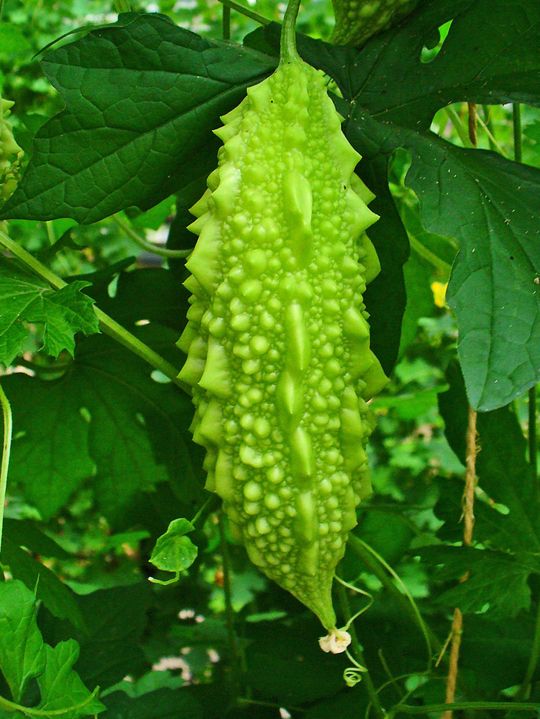
    The bitter gourd vine is herbaceous and has tendrils which help it to hold on to supports.  The leaves have rugged edges and grow alternatively on the tender stem.  The bright yellow flowers, both male and female are seen on the same plant.  After flowering in June the fruits usually start forming within a few months.  The fruit is oblong in shape, with a spiky outer surface which is bright green in colour.  Flat seeds are found inside the fleshy outer cover.  This vegetable has a watery texture, and is very bitter.  The skin is tender and edible and is eaten green.  When the fruit ripens, the skin becomes tough and bitter to taste and cannot be eaten raw.  On the other hand the pith which becomes dark red in colour is used raw in some salads.

    karela

    The different varieties of bitter gourd carry the same properties although they vary in colour, size and appearance.  The white or light green variety is longer in size with less tapering ends and a moderately less spiky exterior.  The smaller, dark green variety with sharp spiky exterior is used as a stuffed vegetable and is popular in Pakistan, Nepal, India and the Asian sub-continent.  This green vegetable is generally eaten in a cooked state, while the young shoots and leaves can be eaten as greens.  The bitter flavour of the bitter gourd makes it an important ingredient in stir fries, soups and in the making of herbal teas and beers.

    In India bitter gourd is cooked differently in the south and north.  The people in north India sometimes cook it as a stuffed vegetable in oil, or cook it separately with tomatoes and potatoes as a subzi and eat it along with roti and curd.  In south India it is cooked using coconut oil, with lots of grated coconut as a thoran, or with fried coconut as a theeyal or pachhadi and is consumed with steaming brown rice.  In Tamil Nadu, the bitter gourd is made as a special dish using onions, lentil and coconut along with tamarind juice.  This is a very popular preparation and is called ‘kattu pagarkkai’. In most of the dishes, a lot of onions are used along with rich spices and tomatoes, which help to lessen the bitterness of the vegetable. The green vegetable is cooked in different forms. In many households, bitter gourd is cooked with meat, eggs, beef, pork or shrimps and use coconut milk for added flavour.  Pickles, soups, curries, stews, chutneys and stir-fries made using this wonderful vegetable are popular delicacies all around the world.

    bitter-gourd-benefits

    Bitter gourd is well known for its medicinal values also.  Since time immemorial it has been used in herbal medicine systems.  It is largely used as sure cure for various ailments, especially complaints of the gut stomach and intestines.  Research has proved that the concentrated extracts of the bitter gourd has hypoglycemic and hypolipidemic effects which make it popular as a widely used remedy for diabetes. The extract of the bitter gourd is also used as a dietary supplement for breast cancer patients because it exerts a significant effect against the growth of breast cancer cells.

    If we have leisure time and interest in cooking we can experiment and bring forth innumerable attractive and mouth watering delicacies. For example:

    Fried karela Boat

    OLYMPUS DIGITAL CAMERA

    Directions:

    • Slit open  8 long, slender karelas and clean out the inside
    • Half cook the karelas in salted water with a pinch of turmeric
    • Grind 5 green chillies and 100gms of roasted channa
    • Mix well with salt, garam masala and coriander powder
    • Add chopped coriander and stuff into the slit karela
    • Tie each karela ( boat) with a thin thread
    • Use a shallow pan and heat the oil well
    • Fry the karela on a slow flame and carefully keep turning them over till they turn into a golden brown colour.

    The dish can be served hot with tomato sauce or pudina chutney. This appetizing and spicy dish can be enjoyed with rice, parathas or rotis.

    Hot Karela Achar 

    karela achar   

    The bitter gourd can also be used to make a very tangy, sour pickle with many spices and condiments.  This “Hot Karela Achar” goes very well with rice or rotis and can be carefully preserved for some time.

    Directions:

    • Wash and dry karelas well
    • Cut the karelas and De-seed.
    • Chop karelas and few green chillies into very thin slices
    • Rub salt well, squeeze out water and sun dry for one day
    •  Heat one cup of oil, splutter mustard and lightly fry a few methi seeds.
    • Add the dried karela and green chillies, curry leaves and fry till crispy
    • Mix thoroughly with a pinch of asafetida powder and salt to taste
    • Store in dry glass jars when cool and fill oil till top
    • Keep for two days, mix oil well and then serve.
  • Coffee Mania!

    Coffee Mania!

    You get up in the morning and you have it. You come home tired after a day of grueling work and you have it. You want to take a break to rejuvenate and satiate yourself and you have it. Well, you may be wondering by now what this ‘it’ is. It is a very simple thing actually. A cup of steaming coffee!

    cupofcoffee
    Coffee is a brewed beverage prepared from the roasted or baked seeds of several species of an evergreen shrub of the genus Coffea. Coffee plants are nowadays cultivated in more than 70 countries which are primarily in the equatorial region namely the continents of Latin America, Southeast Asia, and Africa. In case of India, the best quality coffee plantations can be found in the regions of Kunnor Valley located in the Nilgiri Hills.

    CoffeeBeans
    Have it hot or have it cold, pour milk into or have it without, add a dash of cream or not, take sugar with it or simply don’t – there are ample choices when it comes to sipping on this refreshing beverage. Coffee-lovers can partake of coffee in various ways. Here are some of the more popular ones:

    (1) Espresso:

    espresso

    Espresso is a concentrated coffee beverage. It is brewed by forcing a very small amount of nearly boiling water which is about 86 to 95 °C (that is, 187 to 203 °F) under high pressure through finely ground coffee beans. Espresso often has a thicker consistency than the coffee brewed by other methods. The flavours and chemicals in a typical cup of espresso coffee are much more concentrated. Espresso often serves as the base for other coffee drinks such as a latte, cappuccino, macchiato, mocha, or americano. The usual serving size is much smaller in case of this particular beverage. But be very careful while you have this drink for a little bit too much and you will be sharing the lifestyle of certain night owls!


    (2) Cappuccino:

    Cappuccino

    This comes next in the line of popularity when it comes to coffee. Cappuccino is a coffee-based drink prepared with the help of espresso, hot milk, and steamed milk foam. A cappuccino usually exceeds the height of the cup it is served in. The foam is thus, visible above the side of the cup. A cappuccino is traditionally served in a Chinese porcelain cup which has far better heat retention characteristics than glass or paper. It also enhances the aesthetic beauty of this simple drink. The foam on top of the cappuccino acts as an insulator and helps retain the heat of the liquid which allows it to stay hot for a longer period of time.
     

    (3) Latte:

    Latte

    A latte is a type of coffee beverage which has portions of both espresso and hot steamed milk. They are generally mixed in the beverage in a ratio of 1:3 to 1:5 espresso to milk. A latte always has a little foam on the top which acts a good insulator as well as makes the drink look extremely inviting. This beverage is very much similar to the Portuguese galão. It is immensely popular among the mass in the regions adjoining Portugal, Turkey and Spain.


    (4) Mocha:

    Mocha

    A mocha is almost identical to a latte except in the way it is garnished and for one special ingredient namely, chocolate. Mocha is usually prepared in the ratio of one third of espresso along with two thirds of steamed milk. However, a special portion of chocolate is added as garnishing later in the form of hot chocolate syrup. Some top chefs even add chocolate shavings and chips as an innovation. Mochas can contain either dark or milk chocolate. But in the current age of industrialization, other coffee vending systems across the world are designed in such a manner that they use instant chocolate powder as a ready alternative instead of the traditional chocolate syrup to marginalize profits.


    (5) Indian Filter Coffee:

    Coffee remains an integral part of South Indian culture in Asia. Whether it is a wedding ceremony or an occasion to entertain your house guests, coffee is an essential item on the menu. South Indian Coffee also known as Mysore Filter Coffee or ‘Kaapi’ (the South Indian phonetic rendering of “coffee’’) is a sweet milky form of coffee which is made from dark roasted coffee beans (70%–80%) and chicory (20%–30%). It is especially popular in the five southern states of India -Andhra Pradesh, Telengena, Karnataka, Kerala and Tamil Nadu. It is traditionally served in broad-based and goblet-shaped stainless steel glasses.

    (6) Instant Coffee:

    Instantcoffee

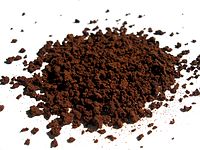
    Instant coffee is the most popular choice of coffee drink in today’s fast-paced life. Instant coffee is a beverage which is prepared from brewed coffee beans. Through various manufacturing processes, the coffee is dehydrated into the form of powder or fine granules. These can be rehydrated when steaming hot water is added to the mixture in order to provide a drink which is almost similar (though not identical) to the conventional cup of coffee. Some popular brands of instant coffee include Nescafe, Bru, Mr. Brown Coffee, Folgers, etc. This is the most popular type of coffee in terms of preparation and efficiency for the globetrotters or even people on the move 24×7. Thus, it truly lives up to its name.
     

    However, too much of a good thing is never beneficial. Thus, before signing off, let me caution you about the few health hazards excessive coffee consumption may give rise to. It might cause insomnia or heart ailments among some. But that is no major reason for you to get alarmed or panic. So, what are you waiting for? You now have all the necessary information which you require to make your decision regarding the type of coffee you would like to enjoy. Sit back, relax and simply enjoy your choice of hot (or cold) cup of coffee!


  • Fun facts about honey – the wonders it can do!

    Fun facts about honey – the wonders it can do!

    The negative impacts of redefined sugar have been too many to count but this does not imply that anything that is ‘sweet’ is harmful. There are numerous natural alternatives of redefined sugar which can be obtained from fruits, vegetables and the cute little honeybee! These do not have any sort of poor effect on one’s health and rather provide nourishing nutrients to the body.

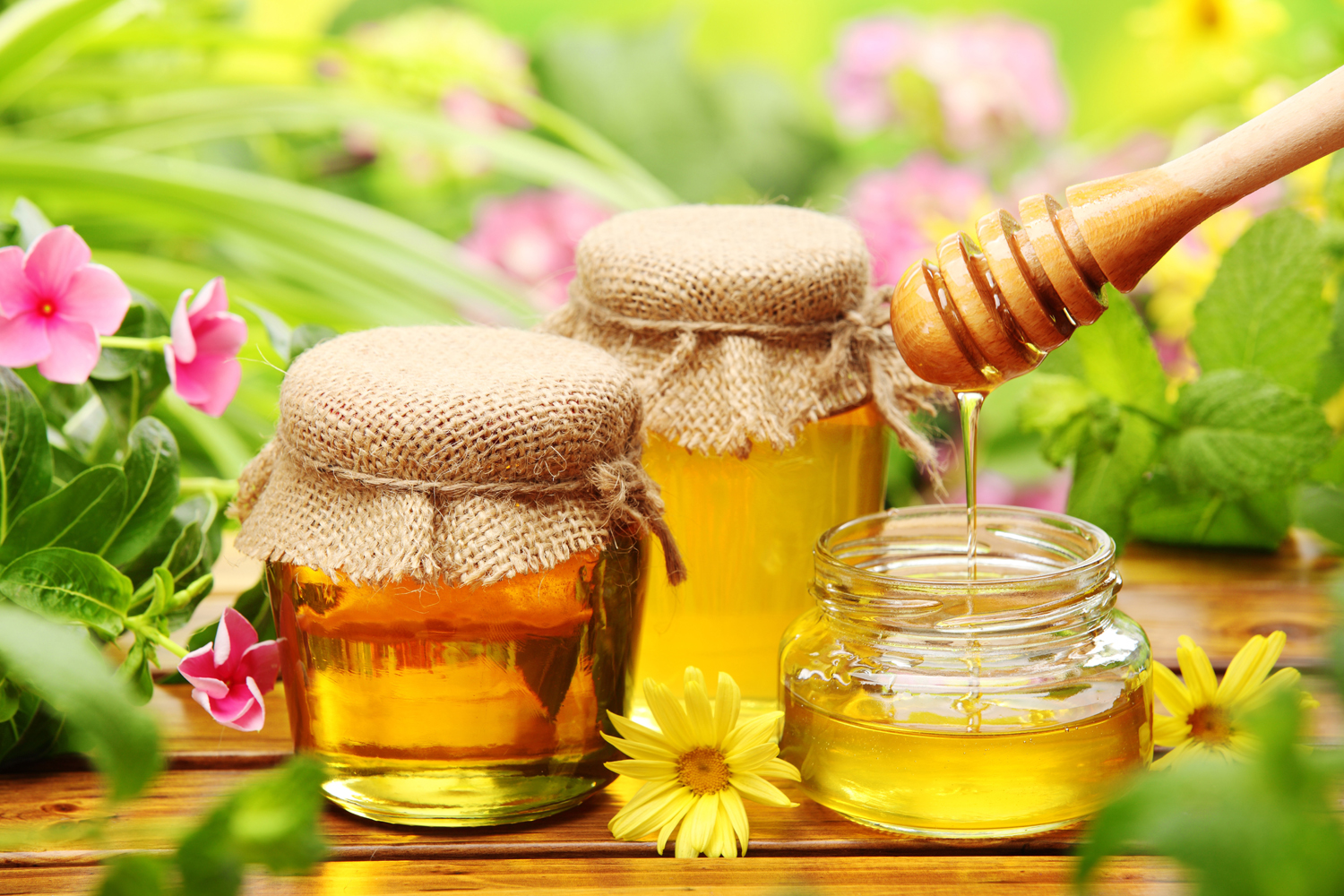
    Honey has been in use since more than four thousand years. Produced from the nectar of the flowers by the bees, this golden elixir has served the mankind since ancient days. In the olden Egyptian times, it was used to heal the wounds. Honey boasts of a superpower, it can be kept for an indefinitely long period of time without it getting spoiled. The Romans and the Greeks used to honey to treat eye and skin related problems.

    Following are some wonders that honey does for our health:

    1. Gives the immune system a boost

    Raw and organic honey is full of nutrients, vitamins, minerals and enzymes. These components of honey help your body fight away the harmful bacteria.
    When you are suffering from cold, or have a cough or a sore throat, how often have you heard your mother say, “Take a tea spoon of honey, you’ll be good!” I have heard it a lot of times and trust me, it totally works. Honey is useful in clearing out your throat.
    Regularly having honey mixed in warm water boosts up the immune system.

    2. Decreases the risk of a heart-disease

    Honey in combination with cinnamon revitalizes the veins and arteries of the heart. It also reduces the cholesterol level by 10%. This combo of honey and cinnamon is a boon for the heart patients as it reduces the risk of a heart attack, when taken on a regular basis.

    3. Ups the energy levels

    Honey provides the right amount of calories and energy to keep your body going. It gives an instant energy boost to the body. Athletes constantly have sports drinks for increasing their energy levels. They might provide instant energy but obviously have negative effects on the body in the long run. It has been proven that adding honey to the drinking water and consuming it during important events is as good as any energy drink you find in the market. How often do you find yourself suddenly craving for something sweet? Next time when you are in such a dilemma to choose between coffee and chocolate, instead go for the natural dose of sweetness, honey.

    4. Treats indigestion

    Are you the type of person to suffer from indigestion frequently? Well, honey is the best medicine for you. It is helpful in preventing acid reflux. It has certain antiseptic properties which help in relieving acidity in the stomach. It also neutralizes gases.
    If you have had too much to eat, drink up a warm glass of water with added lemon juice and honey.

    5. Helps you lose weight

    The first thing to do when you wake up in the morning should surely be drinking a combo of warm water, lemon juice and honey in an empty stomach. It is a proven technique which helps in weight loss. It is the best possible detox solution. It cleanses the liver and removes fat and toxins from the body. The same combination can be consumed just before sleeping as well.

    Warm-Water-with-Lemon-and-Honey

    6. Clears up the skin

    Looking for a new skincare product? Why don’t you try out some organic honey? It has anti-microbial and anti-fungal properties which moisturize the skin. Apply a dab of honey on your pimples and blemishes and leave it overnight. Wake up with a glowing and radiating skin! It prevents wrinkles and dryness. It gives your skin the kind of natural glow that no skin care brand can provide.

    Honey Pack

    7. Reduces dandruff and scalp related problems

    Honey can be diluted in warm water and applied to the problem areas and left on for three hours. It can later be rinsed with warm water. This relieves the constant itching in the scalp reduces scaling as well. It also helps in reducing hair loss to a great extent. I don’t need a new shampoo saying, ‘100% guarantee of no dandruff’ because I have the remedy at home!

    8. Metabolizes alcohol

    Have you had a little too many to drink? Vodka and whiskey all around you? It has been medically proven that an oral intake of honey would reduce alcohol blood levels, increase the body’s ability to metabolize alcohol, and thus would limit intoxication. Raise your hands for honey shots now!

    9. Helps treat wounds and burns

    Since ancient Greek, Egyptian and Roman times, honey has been effectively and extensively used in the treatment of wounds and burns. Thousands of years later, honey is still being used for the same. Many studies have been carried out that conform these abilities of honey. Application of honey makes the wound sterile. It can either be directly applied on to the wound or burn or can be applied in the form of a dressing which should be changed on a regular basis.

    Honey helps in treating seasonal infections. It boosts up the memory. And to add to its endless uses, possesses an extremely enchanting taste! Its soft and lustrous texture plays inside your mouth. Remember its uses, apply them in your day-to-day life and notice the difference.

  • APPLES

    APPLES

    apple


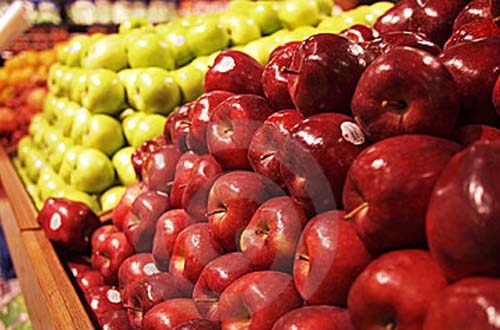
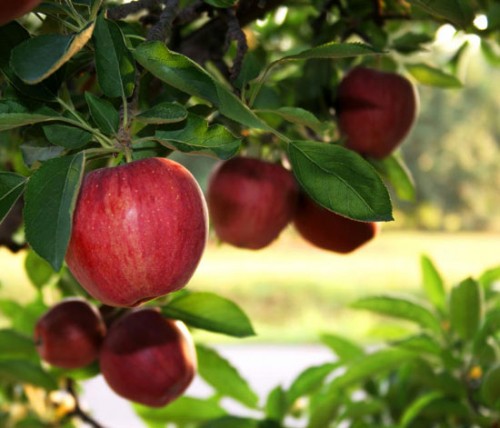
    The apple belongs to the rose family (Rosaceae) and is a derivative of its wild variety, Malus sieverslli, still grown and consumed in Central Asia. It is a Pome fruit, which means it is a fleshy fruit with a thin skin and the seeds are contained within the fruit. The apple blossoms are pink and gradually turn white as they mature. It comes in various colours and sizes and has a variation even in taste, ranging from sour to sweet. This quality of the fruit makes it a culinary specialty as it can be served in various ways – cooked and uncooked. The apple has ruled the health business for years owing to its immense qualities and benefits. Right from being on the teacher’s table to the platter of the healthy eater, the apple has continued its journey for thousands of years without compromising or losing out on its popularity as being the king of all fruits.

    Historically, apples have known to be an integral part of ancient mythologies. Extending to countries and continents all across the globe, the fruit has found favour and acceptance by both old and young, rich and poor, the famous and infamous and has even been associated with gods and goddesses. According to the famous English scholar, H.R. Ellis Davidson, apples have been linked to religious practices in Germanic paganism. Offerings of apples to gods and goddesses have known to be made in exchange for eternal youthfulness and fertility. The Germans have long believed that apples are no less than a life giving fruit that has found favour even with celestial beings.

    apple 1

    Among the Greeks, the fruit is a part of many religious traditions and is often looked upon as the ‘mystical’ or ‘forbidden’ fruit. The apple is considered to be sacred to the Greek goddess of love, Aphrodite. To throw an apple at someone was symbolic to professing one’s love and to catch the apple was an expression of acceptance of that love.

    Popular Christian belief has held that it was an apple with which Eve (the first woman) coaxed Adam (the first man) to commit the first sin of disobedience against God. As a result, the apple became symbolic of knowledge and immortality as well as of temptation and sin. Also, following the story, the larynx in the human throat came to be called as the Adam’s apple because of the notion that Adam never really swallowed the forbidden fruit and it remained in his throat.

    Apples have been grown and consumed for thousands of years now. Study reveals that there are about 7500 cultivators around the world contributing to different varieties of apple on the basis of colour taste and use. The reason for breeding apples may vary from cooking to eating or for cider production.  Domestic apples can be produced either naturally through seeds or through grafting. Apple trees are prone to a lot of fungi, bacteria and pests and so special care is taken by cultivators. In the year 2010 itself, 69 million tones of apples were produced around the world with China and the United States being the major contributors producing about 10% and 6% of the produce respectively. The third position was gained by Turkey followed by Italy and India.

    Apple-Nutrition

    ‘An apple a day keeps the doctor away’. This is not just a statement but also an advice given by the doctors to individuals across all age groups. The statement, however, may not really be as precise as it claims, but with a host of nutritional benefits, apples are a smart choice to munch your way to health. It’s believed that the apple is one unique fruit richly endowed with nutrients and activated enzymes which if consumed, helps in building up the body and improves its immunity, thus, making it possible that we remain healthy and free from diseases. The antioxidants in the fruit help in neutralization of potentially harmful free radicals that are known to cause cellular damage.

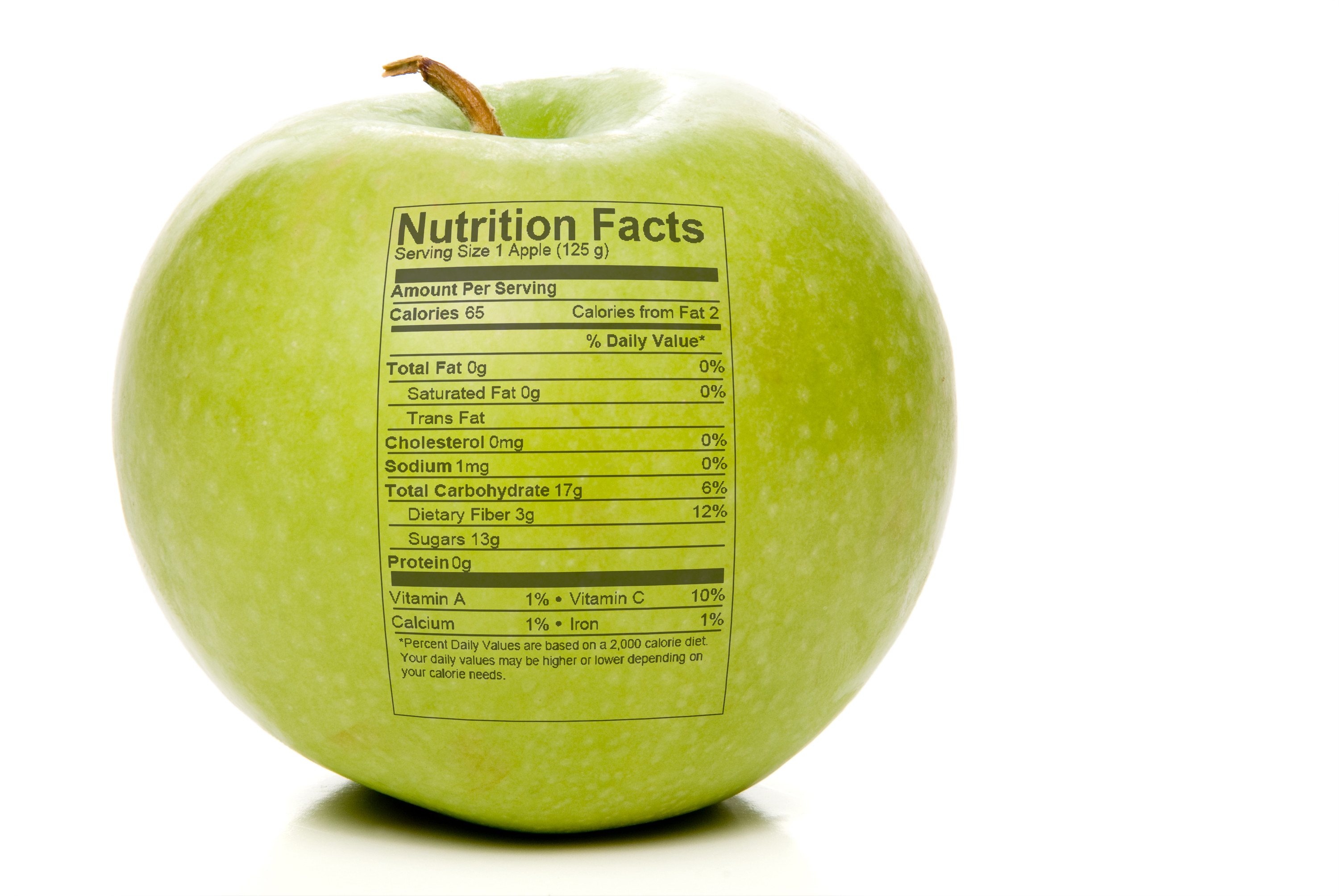
    Not just that, apples are a popular choice among the health and diet conscious being extremely low on calories. A whole medium unskinned apple has calories equivalent to 100 units which is about 5% of an average daily calorie intake. The smaller varieties have a lower calorific value. This means, one could enjoy an apple based dessert without disturbing one’s calorie budget; one would just need to scale down or scale up the size of the fruit as per need. It’s both a healthy as well as a wise choice. The fruit is a rich source of fiber as well. A medium unskinned apple provides with approximately 4gms of fiber. Fiber, as we all know, helps maintain a healthy weight and is crucial for waste elimination from the body. Daily consumption of an apple may also reduce LDL or bad cholesterol levels, thanks to the apple fiber.

    apples

    There are, however, a few negative attributes associated with the famous fruit. Apples are a rich source of the naturally occurring sugar, fructose. A medium sized apple would contain sugar equivalent to 16-20 grams. The sugar content may, however, vary depending on the size, type and quality of the fruit consumed. In such cases, individuals suffering from lifestyle diseases like diabetes must ensure that consumption of the fruit is done only after consulting a doctor. Apart from this, individuals who have problems digesting fiber, or have a weak digestive system following gastrointestinal issues, may find it difficult to digest the high fiber content in the apple resulting in loose stools. Another matter of concern is toxification of the fruit by harmful pesticides, which can be eliminated by washing the fruit well before consumption. One could also resort to organic varieties which would further reduce the problem.

    All this must not stop you from including an apple in your daily diet. Not only is it a healthy option, but, having an apple daily is also a wise decision. It will not only keep diseases at bay, but would also ensure you healthy nutrients as you go through the day

  • Food Cravings: Reclaim your control

    Food Cravings: Reclaim your control

    fitfreeze-fights-cravings_a-2200x800

    These cravings… oh! They really ruin the diet schedule. Sometimes, we are bored or other times we are emotional, and these food cravings manifest into consciousness. Seriously, we cant ignoreit , so hard to resist and if that yum, delicious food is readily available, it just goes out of control. Unfair, no? But, if controlled , its better for health in some way. If we understand why these occur and what can be the alternatives and how can it be under control through very little efforts, we will obviously put our sleeves up and go through the silly cravings.
    Picture this. It’s five o’clock and you are at your desk , sitting on your couch or out running tasks and suddenly you get this pang– an overwhelming need to eat. You have the dreaded feeling of craving and you just cant feel right until you grab that bag of chips, or a chocolate bar or lot of icecream, soda. Unfortunately, one thing is for sure, whatever we reach for is almost never a healthy choice. The question is why are these late night cravings or afternoon cravings are so intense and how they can be prevented by best of our healthy intentions.
    It is justified that our body requires a certain suitable amount of daily nourishment, but it is important to be able to distinguish between eating for physical nourishment or eating for emotional nourishment. Really evaluate whether you are hungry or not. If you are truly and completely hungry, fabulous, then eat, I will tell you how to do it right.
    Get out of the cravings mindset : Think and figure out if you want something crunchy or smooth, hot or cold or sweet. There are healthy options that will actually calm your cravings. If you want something salty and crunchy , your mind will automatically go to potato chips, but think about it, when has bag of potato chips satisfied your hunger? Processed potato, oil and salt have no nutritional value. Its better to go for organic peanut butter, celery or peas with soy sauce which will prove to be best options instead. If you want something creamy , opt for yoghurt or an avocado rather than icecream. For something sweet, try fruits or smoothie or weet vegetables like sweet potato or squash instead of cookies and candy. When we are hungry and crave for certain food, it means our bodies are actually deficient of that nutrients. If you are craving something sweet, it indicates that your body needs glucose to perform its daily functions and tasks. Salt cravings occur when you lack in minerals found in natural unrefined salt. Potassium, magnesium and calcium are actually removed from table salt in the refining process. When you are craving something salty, you are not likely to satisfy that craving by finishing off a bag of Lays. Instead season your food with some sea salt and munch on some raw vegetables or go for sprouted beans or eat flax seeds (alsi) in little amount. You can also sprinkle it on your plate of raw veggies, making it an awesome and healthy choice. If you are craving for meat, you probably need some iron in your diet. If you are craving icecream, you probably need some more fat. Essentially, if you crave it (and you are hungry), eat it but opt for the natural healthy version of what you are dying for.
    Does your mood fluctuate with what you eat? Learn how to strike a balance: If you have a craving, but aren’t hungry, you are probably looking to fulfill an emotional need. We frequently reach for food because it is easy and cheap instant fix. Remember, it is only temporary, and all your feelings are going to rush right back. If you’re sitting at your desk, suddenly feel a craving, you might just need a break and maybe some excitement. Try going for a walk around the office or striking up some conversation with co-worker . After 10 minutes, your craving will be a distant memory as you distract off your mind. If you have spent all evening alone and you have started to dream about that gallon of chocolate, vanilla icecream, leave the icecream in freezer and pick up the phone and call a friend and keep talking. Usually, when we want something sweet, it is because we need some pleasure in our lives. Go, get a ten minute massage or a manicure, pick up a romantic novel, take a long bath or start chatting. Anything makes you like goddess.
    Get a dose of sunshine with Vitamin D: So next time you get a craving, don’t feel like your body is wrecking you, or that you have to use your will power to overcome it. Try to understand the messages your body is sending you. When you can learn to deconstruct your cravings and listen to your body, cravings can actually prove to be very healthy, helpful tool.
    Wow! Isn’t this great to know what exactly your body is craving for and not interpreting the actual needs. This will really help to sort out and maintain our healthy regime simultaneously. When it sounds so good, it feels too.
    So, next time you feel craving for this junk food, try to figure out and use an alternative. After all, we have so many!
    Happy Craving, happy eating. Happy Life!

    Hunger-Cravings-Stop