Tag: festival

  • What makes Delhi, Dilli…

    What makes Delhi, Dilli…

    A very long time ago when the heart of our nation was not famous for its countless rapes, an absent Government and Mufflerman; there was actually a city and a world inside that city that everybody loved. What made Delhi earn the jealousy of other metropolitan cities in the country, what is it that made Delhi stand shoulder to shoulder with Mumbai, the economic capital of India. Why is it that, people who have ever stayed in Delhi leave it with a heavy heart and tell everyone else that they can’t understand the emotions attached with the city if they have never ever lived in the city. Let’s find out!

    The Beginning of the Real Delhi:
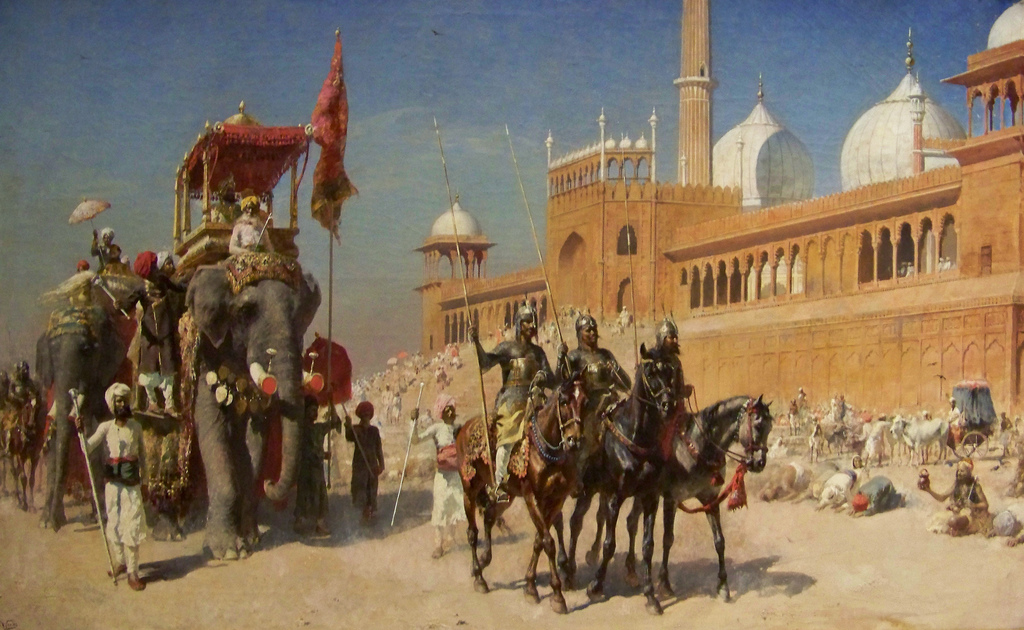
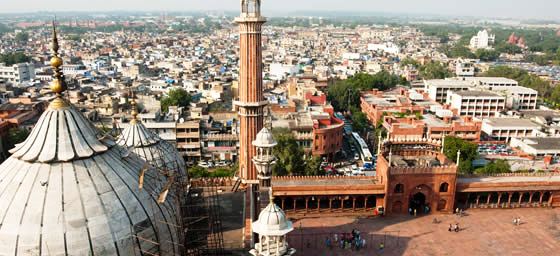
    Great_Mogul_And_His_Court_Returning_From_The_Great_Mosque_At_Delhi_India_-_Oil_Painting_by_American_Artist_Edwin_Lord_Weeks Now, the love for Delhi started long back when the Mughals transferred the Capital of India from Agra to Delhi. This is when the real on-ground transformations started taking place in Delhi. Before this move, people were as oblivious of Delhi as they were of any village in India. Firstly, with the onset of Mughals came along great Architectural Feats. For example Delhi boasts of the largest Brick Minaret in the world the Qutub Minar (well, it was built by Qutubbudin Aibek), it flaunts one of the largest mausoleums in India – The Jama Masjid, It carries reticence with its Old Fort. Also the Red Fort that instills in us a feeling of patriotism whenever we see it on our TV sets. All these Architectural marvels brought a Mughal charm to this city of ours and elevated it above its neighboring cities.

    Dilli and the finger licking tales:
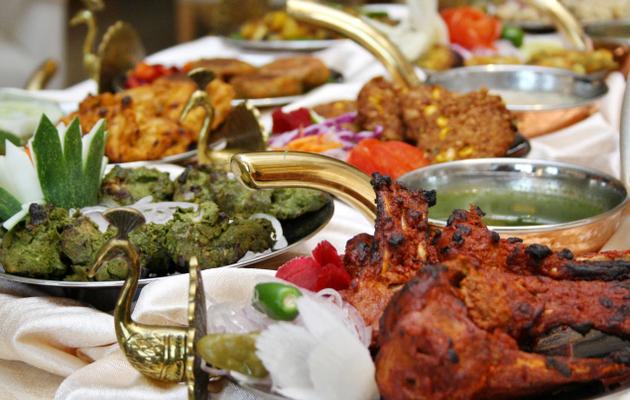
    AWADHI_FOOD_FESTIVA_898557g Along with the great architectural skill set of the Mughals arrived in Delhi their eternally pristine culinary taste. Their food was not just food, but Art on Stove. The Tandoori murg, The kadhai paneer, the Nihari,the  Paya, the Kachri Qeema, the Delhi-mein-world-famous-Mughlai Chicken, their biryani style and countless others set the tongues of the native Delhiites wagging. Not only did their cuisine establish itself in Delhi, it even grew there. More and more dishes were invented as an amalgamation of Delhi and Mughlai cuisines. This was a great culinary juxtaposition just waiting to happen. Seemed like this match was made in heaven. So, the Mughlai cuisine added one more feather to Delhi’s hat.

    Asli Delhi, Purani Dilli:
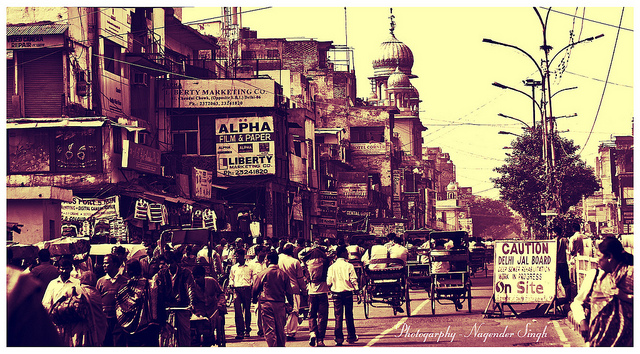
    7717061676_0ba4ab21a8_z Now, the heart of the Heart of the Nation. The Chandni Chowk and Chawri Bazaar area. For those new to the maps of  Delhi, these areas lie in the center of Delhi and still boast of historic architecture. These areas are famous for their super cramped streets, the always bustling crowd and nagging shopkeepers always trying to sell you substandard products. By the names in the list, all these seem to be pretty depressing by the levels of the national capital. But once you visit the place it seems just like your extended neighbourhood. It won’t seem as a market place to you, but a big great family  living in harmony yet tearing each other’s hair out. But there is a lot to watch out for in the Purani Dilli area. Since it is a crowded marketplace, pickpockets are always on the prowl. Also some shopkeepers tend to get too close for comfort levels in order to get their products sold. But every coin has two sides and prefer to see the loved one here please. Purani Dilli broken up and explained in pieces in the next points, because it ain’t so small that it can be contained in one measly point.

    The Paranthewaali gali:
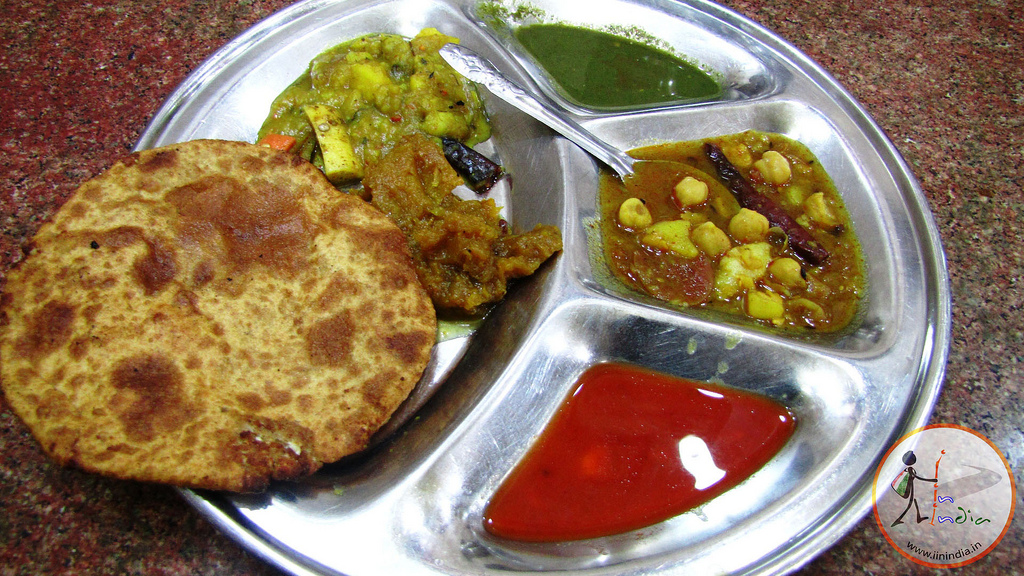
    4950341851_7711ec9fd9_b Now, now, now. Every once in a while a moment comes in every person’s life that can’t be expressed even if you keep squealing with delight for a fortnight. For a foodie that moment would come when he enters the paraanthe waale gali. The lane where our Bollywood Star Akshay Kumar slaved and toiled for many years. The paraanthe waali gali is an even narrower lane than what already was a cramped main road of Chandni Chowk. There are a multitudes of shops there only selling paranthas. But mind you, these are not ordinary paranthas, these are paranthas made of Rabri, Paranthas made of bitter gourd and paranthas made of lady finger and all the odd vegetables and sweets you can ever garner. And these are not made on a pan or a stove, these aranthas are deep fried just like samosas and tikkis are. Your whole perception of paranthas changes after entering this foodie paradise. This narrow lane adds another dimension to your notion of parantha, by doing something with it that was unimaginable before this.

    The Japanese Samosa:
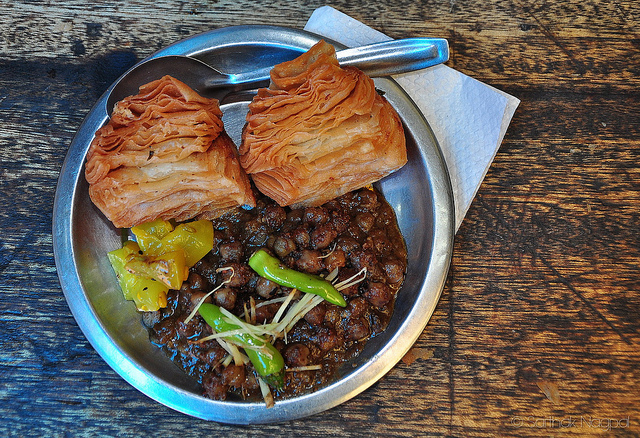
    7745361346_3ba6e884b2_z Well, to be honest, this is just sold in one shop in the entire Chandni chowk. But I swear to God, that you won’t have eaten anything like this before this. This samosa’s shape is more or less like regular samosas but the corn flour covering on the outside is striped. Thus the Japanese samosa is not wholly covered but partially revealing. The inner filling forms the crux of the whole dish. It is not spicy or filled with mashed potatoes for that matter. It is filled with a sweet mixture like that of a halwa. Thus changing the whole thought process around the samosa. By just keeping the name and shape intact, this exquisite dish retain the name value and the ingenuous sweet filling inside and the striped contours give it a modern twist. And thus, the Japanese Sammosa, The tour of the real Delhi has just begun. However, even the most brilliant of writers and esteemed authors would fail in describing the exact charisma and fascination of the city. Such complexly woven is the feel of it. I am just a young scribe who is trying to portray to you an image that tells what exactly Delhi is, if you have have never been there or miss the hell out of that angelic city of yours. To be continued…
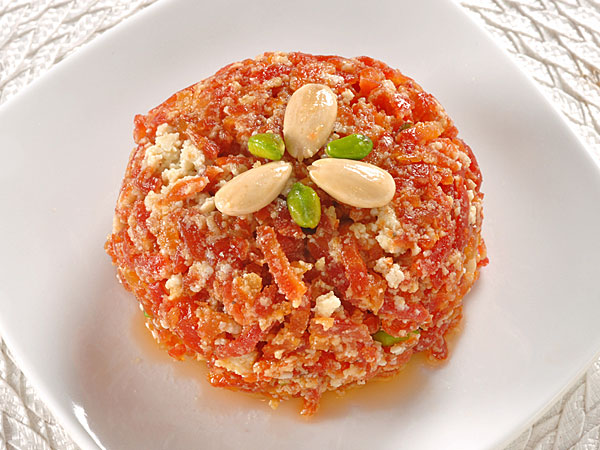
  • Winter Delights: Gajar Ka Halwa and Gujarati Meethi Kadhi

    Winter Delights: Gajar Ka Halwa and Gujarati Meethi Kadhi

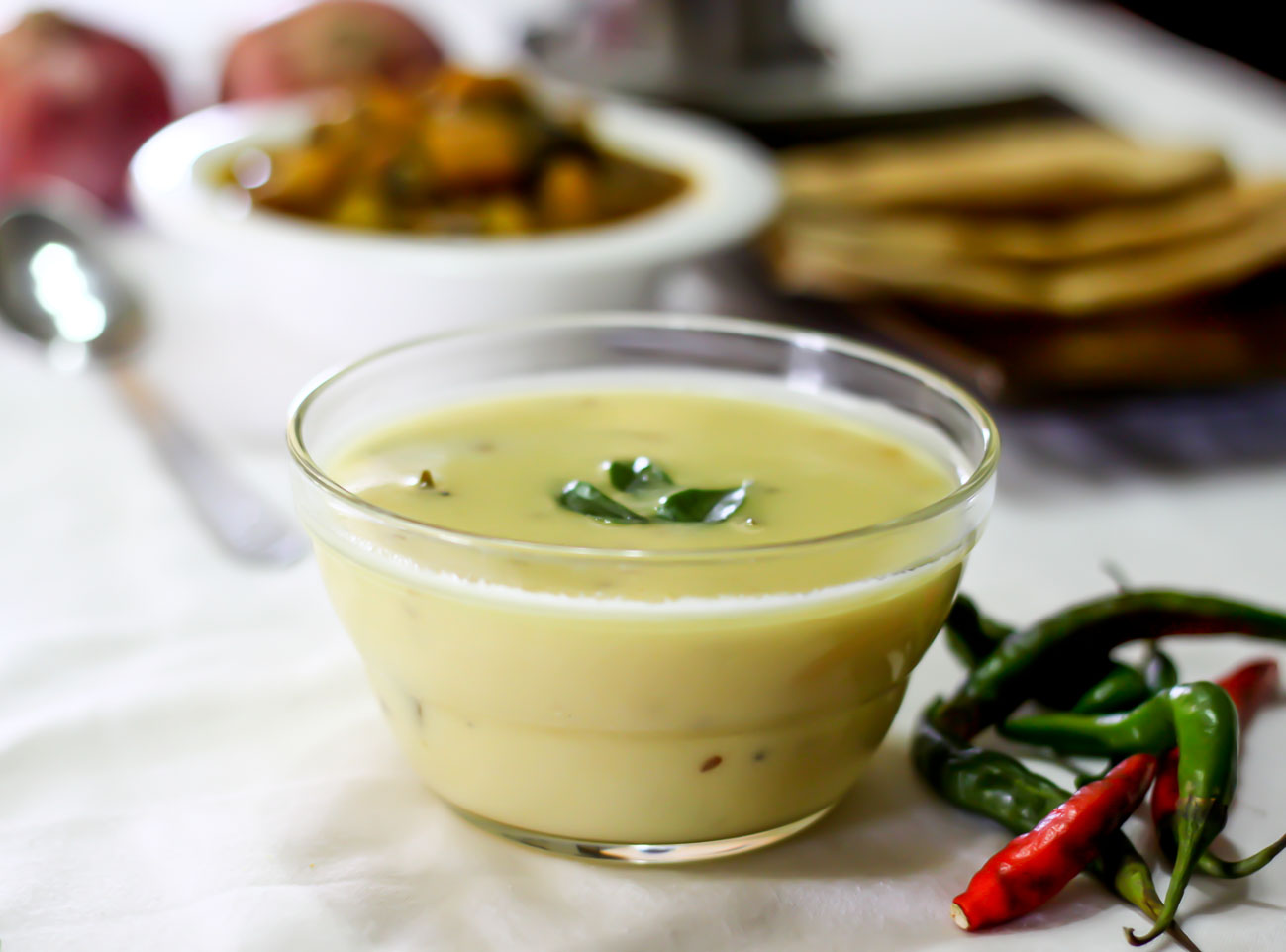
    The frigid winter months of December and January are bearing down upon us, and all anyone wants to do right now is to curl up cosily in their heavy blankets and eat tons of hot, rich food. The harsh weather right now makes the human body crave even more for nutrition, and it is not surprising that some of the best dishes that we know of taste the best in these freezing days. Compared to the year long summer heat in most parts of India, we have a greater appetite for food in the winters. It is in these few weeks that we look with great curiosity towards our kitchens, and wait impatiently for our mothers to emerge out of the area with some aromatic and delicious gastronomic work. Be it sarson ka saag and makke di roti, gulab jamuns, hot coffee, or ginger tea, all of these dishes and more never fail to tickle our tastebuds during the cold season. Here are two easy to cook recipes, one for gajar ka halwa, and the other for Gujarati meethi kadhi, in case you ever need a hot fix for your winter woes.


    Gajar ka Halwa

    Also known as gajrela, gajar ka gajrela, and carrot halwa, gajar ka halwa is a South Asian dessert pudding and a winter delicacy in north Indian states. Made by cooking grated carrots, milk, ghee (clarified butter), and nuts together, this dessert is eaten on many festive occasions in both India and Pakistan apart from being available round the year in most sweetmeat shops of the subcontinent. A completely vegetarian preparation, gajar ka halwa is a dish enjoyed by all people, and has been subject to a number of culinary innovations, some of which are a vegan version, red velvet gajar ka halwa, similarly flavoured doughnuts topped with the same, a cream cheese and halwa combination which is the desi counterpart to the carrot cheesecake.

    The dish dates back to the ancient Mughal times, and the word “halwa”, meaning sweet, is itself derived from the Arabic language. Gajar translates to carrot from the Hindi language. While gajar ka halwa may seem like a particularly difficult preparation to pull off in the kitchen, it is actually not. Although the ingredients do take a considerable amount of time to cook fully, gajar ka halwa is a very easy recipe to make provided you have all the cooking materials you need ready at your disposal.

    Recipe (serves three-four)

    Ingredients required:

    • 1 kg of grated carrots, cleaned and peeled beforehand
    • 100 ml of condensed milk
    • Cleaned, preferably roasted, dried fruits and nuts (cashews, almonds, raisins, pistachios)
    • ½ kg of khoya
    • 4 big tablespoons of desi ghee (clarified butter)
    • 1 cup of castor sugar
    • 4 cups of milk
    • Cardamom seeds. Alternatively, you can use one-third of a teaspoon of cardamom powder.

    The steps needed:

    • Put the shredded carrots and milk in a heavy-bottomed pan or a wok on medium flame.
    • Let the carrots soak in the milk to a considerable amount. Let the mixture turn a rich golden-orange colour.
    • Add condensed milk and cardamom and stir for some time.
    • When it is cooked halfway, add khoya, after putting aside some for garnishing. Also add ghee.
    • Once everything is properly mixed, add sugar on a low flame. Take note of the flame and ensure that the sugar does not caramelize in the halwa.
    • Add dried fruits from above, garnish with a little khoya, and serve in bowls. You can also add varakh (the silver food foil) for an aesthetic look.


    Gujarati Meethi Kadhi

    Kadhi is an Indian main course dish of desert origins, and was first made in Rajasthan. However, it quickly grew popular with people from other regions of India, and now has different variants according to different states, belonging to Punjab, the Sindh area of Pakistan, Gujarat, Uttar Pradesh, and Maharashtra. While it is a dish best served hot, kadhi itself is derived from curd and yoghurt, which ironically taste best when cold.

    Gujarati cuisine is known for its sweetness, and its kadhi carries the same quality. In our household, Gujarati meethi (Hindi for “sweet”) kadhi is a winter favourite, and its recipe has passed on from one generation to the next, with a few modifications by each. This dish can be had as a drink, and since we already have the salty kadhi of Uttar Pradesh, complimented with besan pakodas (fillets), Gujarati meethi kadhi is served as a hot and sweet beverage mostly in the evenings. It hardly takes much time and effort to prepare, and is the perfect heavy snack that will fill your stomach in between meals. All you need is a bowl, a saucepan, and some easily accessible cooking materials, and a time period of fifteen minutes to spare.

    Recipe (serves two)

    Ingredients required:

    • 2 big tablespoons of besan (gram flour)
    • 1½ glasses of curd
    • Half a cup of water
    • Turmeric
    • Curry leaves
    • Asafoetida
    • A teaspoon of rai (mustard seeds)
    • Two teaspoons of sugar
    • Salt
    • Whole, dried red chillies
    • 2 teaspoons of oil

    The steps needed:

    • Add the besan and curd slowly in a big bowl, stirring slowly so that no lumps are formed.
    • Put a pinch of turmeric in this mixture. Also, add salt according to taste.
    • In a separate pan, put oil and let it heat on a slow flame.
    • To the hot oil, add rai, a little hint of asafoetida, and some curry leaves. Be careful to not let the curry leaves blacken completely because of excessive heat.
    • On a low flame, add red chillies to the pan.
    • Take the besan and curd paste, and pour it in the pan.
    • Stir continuously so that no lumps are formed while keeping the pan on a medium flame.
    • Let the mixture boil, and then pour it in glasses.
    • Top with a few curry leaves and serve hot.
  • Various New Year Day Celebrations in Different Regions of India

    Various New Year Day Celebrations in Different Regions of India

    New Year Celebrations
    New Year Celebrations

    Christians celebrate January 1st as New Year.India celebrates New Year by both solar and lunar calendar system.Most of these New Year festivals are celebrated based on Hindu calendar that follow by the movement of the moon.In India, different places celebrate New Year in different times of the year.As India is having multiple cultures, celebration of New Year may also vary distinctly.Most of the states in India celebrate this festival at the time of harvesting of crops.These days are celebrated with different names as Ugadi, Gudi Padwa, Baisakhi, Puthandu, Bohag Bihu, Pohela Boishakh, Bestu Varas, Vishu, Losoong, Navreh, Hijri and Cheti Chand.

    Ugadi:

    UGADI-Festival-celebrations
    UGADI-Festival-celebrations

    In Andhra Pradesh, this day is dedicated to Lord Brahma,the creator of this world, as he has started creating the world on this day itself gaining significance for this day.It is also a belief in Hindus that Lord Vishnu has appeared in Matsya avatar on this day.This celebration includes cleaning of the houses and surroundings, decorating entrances with green mango leaves and wearing new clothes.On this day, people wake up early in the morning and have some oil massage to the body followed by head bath and visit temples to offer prayers.

    Ugadi festival celebration in Karnataka
    Ugadi festival celebration in Karnataka

    In Karnataka, this festival is considered as New Year to the people and believe that this day bring new hopes and happiness in life.On this day, people wake up early in the morning, have bath and visit temple to offer prayers to god with sincerity while the priests chant mantras.On this occasion, people wash their houses, paint them and decorate the entrances with mango leaves. Ugadi pachadi, lemon rice and many varieties of dishes are prepared on this special day.

    Gudi Padwa:

    Gudi Padwa celebrations
    Gudi Padwa celebrations

    Gudi Padwa is celebrated on the first day of the Chaitra month of the Hindu calendar.This is celebrated as New Year by Maharashtrians and Hindu Konkanis’.According to Brahma purana, Gudi Padwa is the time when  Lord Brahma has started creating the world.On this day, people hang Gudi on the right side of the main entrance of the houses.Gudi is a cloth tied to the end of the bamboo and a copper pot is placed inverted on the stick along with a garland.Festive cards and wallpapers are shared among friends and dear ones on this occasion.People offer prayers to god and prepare delicious mouth watering dishes on this occasion.

    Baisakhi:

    Baisakhi-celebration
    Baisakhi-celebration

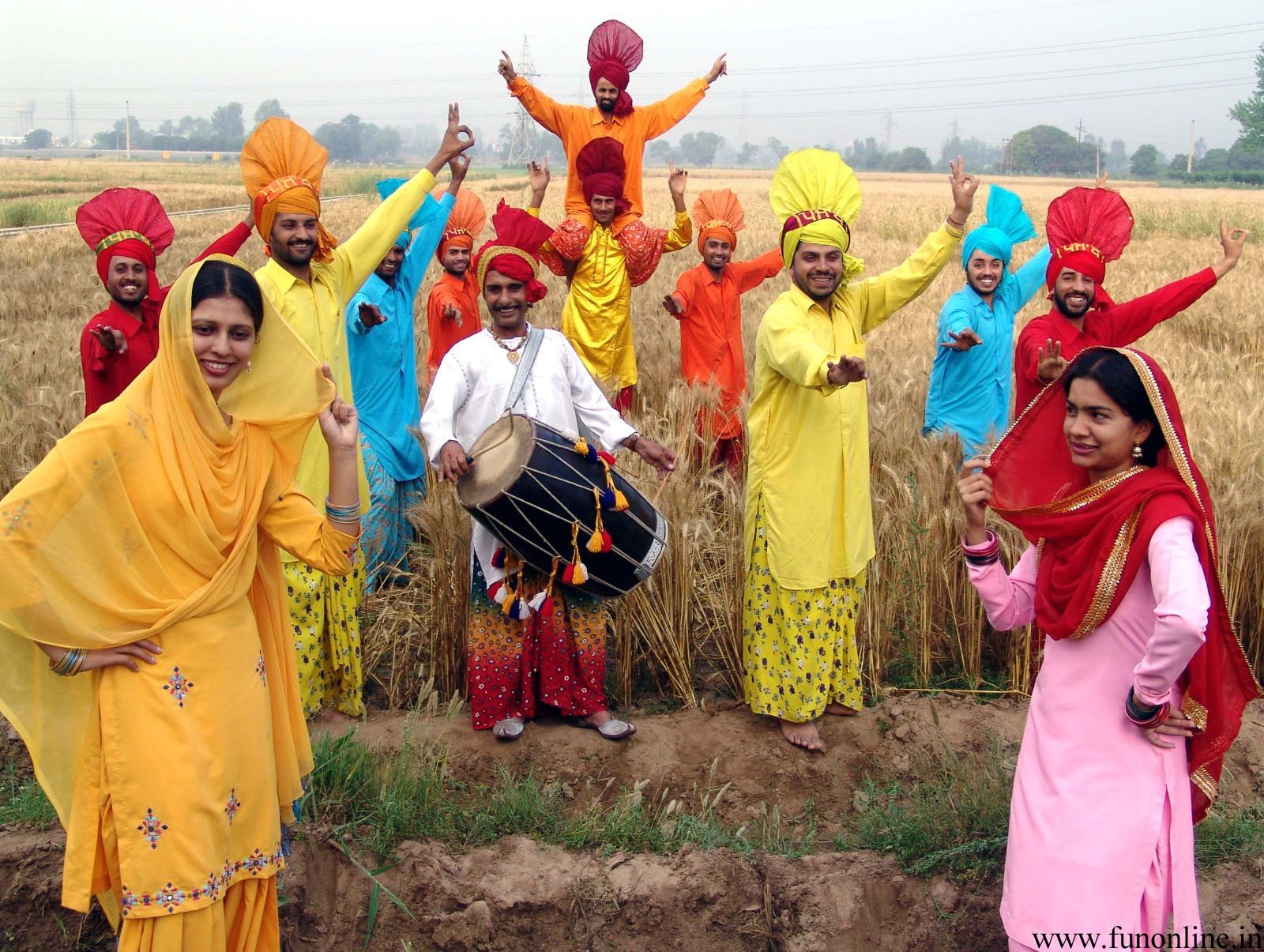
    Baisakhi is a New Year day celebrated in Punjab and Haryana. This  festival is generally celebrated on 13 April.Baisakhi is the major festival of Sikhs and is celebrated to denote the arrival of the harvest season.On this occasion, people wear new clothes, prepare halwa and other delicious dishes at home.

    Puthandu:

    Puthandu-Tamil Nadu
    Puthandu-Tamil Nadu

    Puthandu is the New Year day of Tamil Nadu celebrated on the first day of Chithirai, the first month in Tamil calendar.Puthnadu is also known as Varusha Pirappu  and usually falls on 13th or 14th of April.On this occasion, women decorate the house with colorful kolam  patterns and the center of the kolam is decorated with lamp.On this occasion, people wear new clothes and eat maanga pachadi which is a symbol of this festival.

    Bohag Bihu:

    BIHU_Assam
    BIHU_Assam

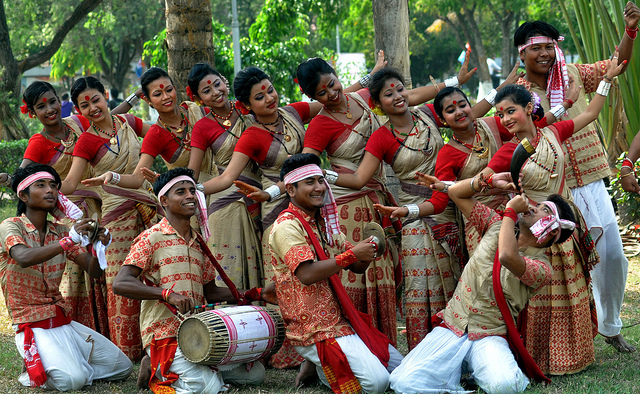
    Bohag Bihu is a major agricultural festival celebrated in Assam.Songs and dances play a vital role in  Bihu celebrations.The festival revolves around agriculture and the changes in the seasons.Bihu is celebrated three times in an year namely, Bohag Bihu( also called as Rongali Bihu ),Kati Bihu ( also called as Kangali Bihu ) and the Magh Bihu ( also called as Bhogali Bihu ).The first one Bohag Bihu is the most important one among the three.This is a spring festival that usually falls in the mid of April.

    Pohela Boishakh:

    Pohela Boishakh festival
    Pohela Boishakh festival

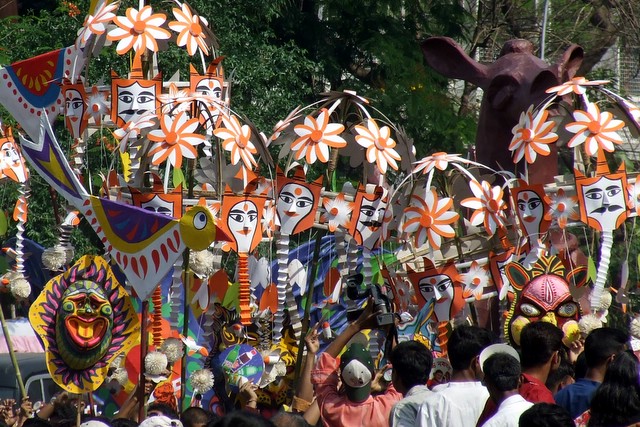
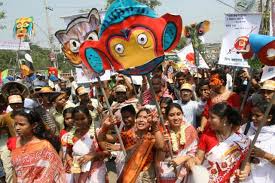
    Pohela Boisharkh is the festival celebrated on the first day of Bengali calendar.This festival is celebrated in both West Bengal and Bangladesh.On this occasion, people clean their houses,wear new clothes and offer prayers to god with sincerity.People spend with friends and relatives on this day and prepare various kinds of food items.This festival generally falls on the mid of April.

    Bestu Varas:

    Bestu Varas festival
    Bestu Varas festival

    Bestu Varas is the festival celebrated on the first day of Gujarati calendar.This festival usually falls after Diwali.People greet each other on this day saying “Nutan Varsha Abhinandan” or “Saal Mubarak”.This festive day starts early in the morning by firing plenty of crackers.On this day, people decorate their houses with marigold torans and  draw colorful rangolis at their doorstep.People wear new clothes,visit temples and greet their friends and relatives a happy and a prosperous new year.

    Vishu:

    Vishu Festival
    Vishu Festival

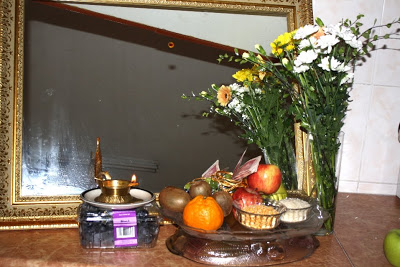
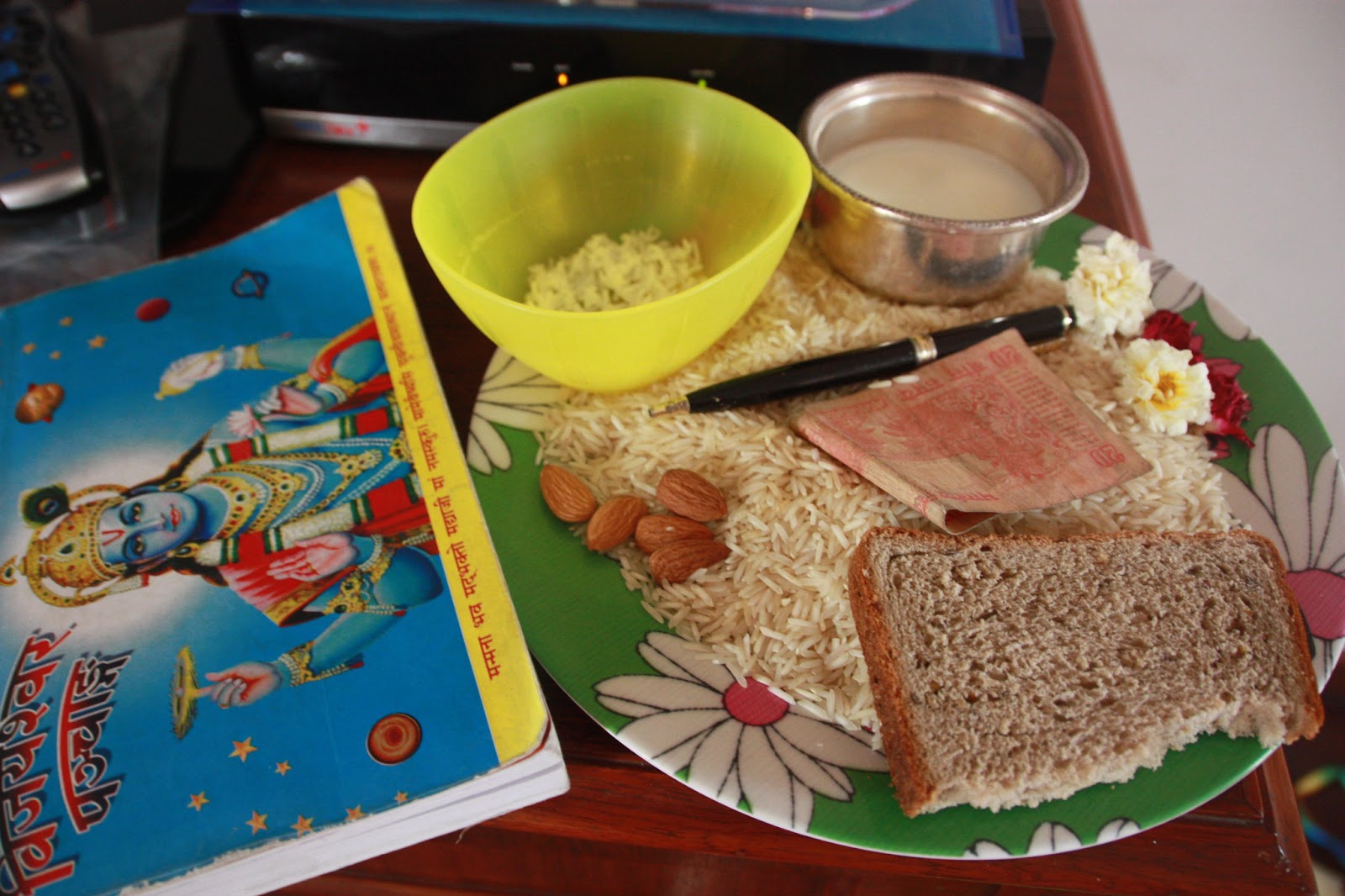
    Vishu is a  festival celebrated on the first day of Malayalam month of Medam.This festival is usually celebrated on 14 April of Gregorian calendar.The festival is defined by the offerings to the god called Vishukanni. This consists of the auspicious articles like rice, linen,cucumber, betel leaves, matal mirror and uruli.All these arrangements are completed by the women the night before Vishu celebrations.On the  day of Vishu, people must wake up with eyes closed and go to the pooja room, so that the first thing a person can see is the Vishukanni.

    Losoong:

    Losoong festival
    Losoong festival

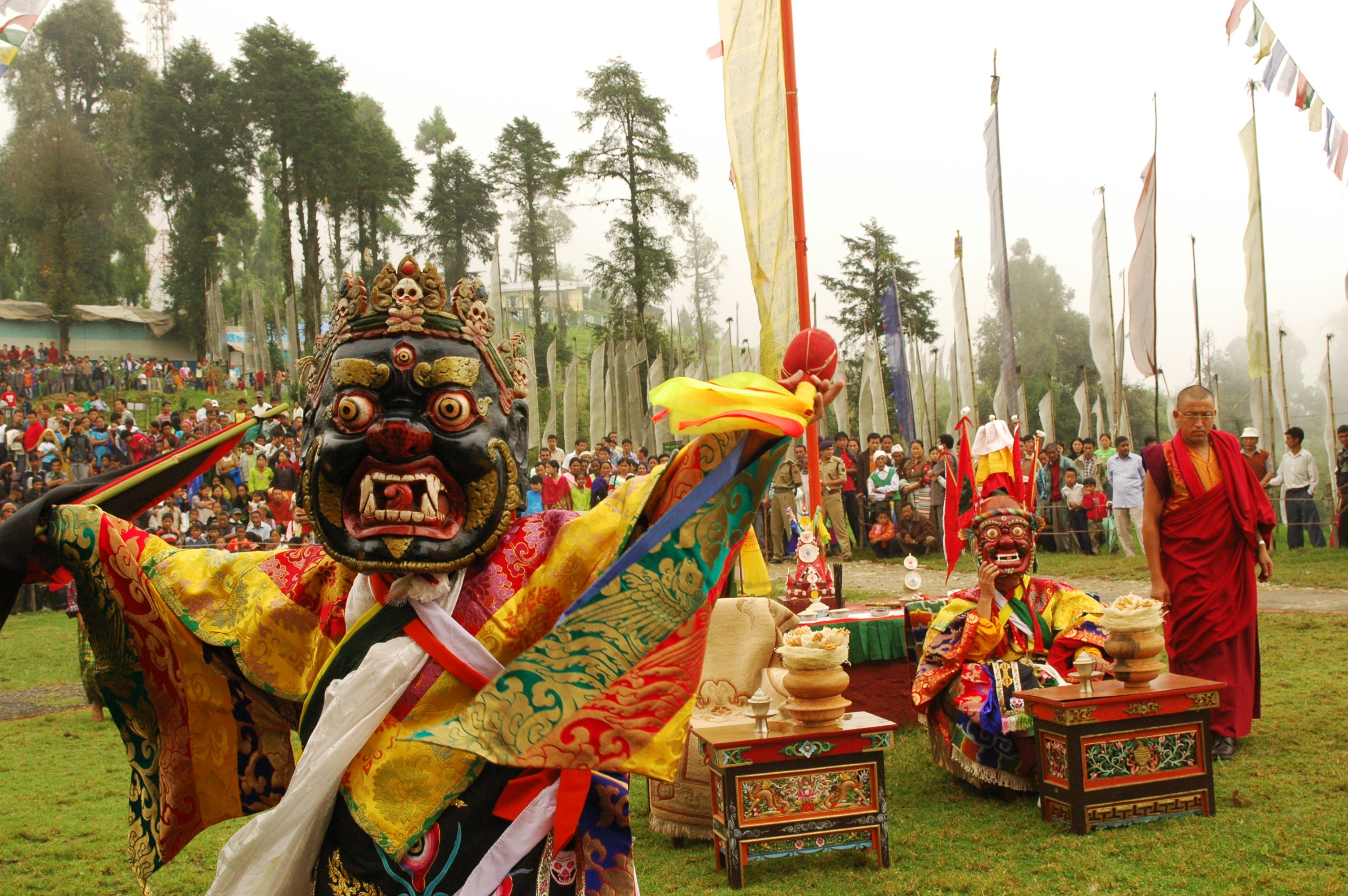
    Loosong is one  of the most famous and old festival of Sikkim celebrated in the month of December.This festival is usually celebrated at the end of harvesting season.This is also considered as the farmers’ New Year festival.On this occasion, Chham dance is  one of the major attraction.

    Navreh:

    Navreh festival
    Navreh festivals

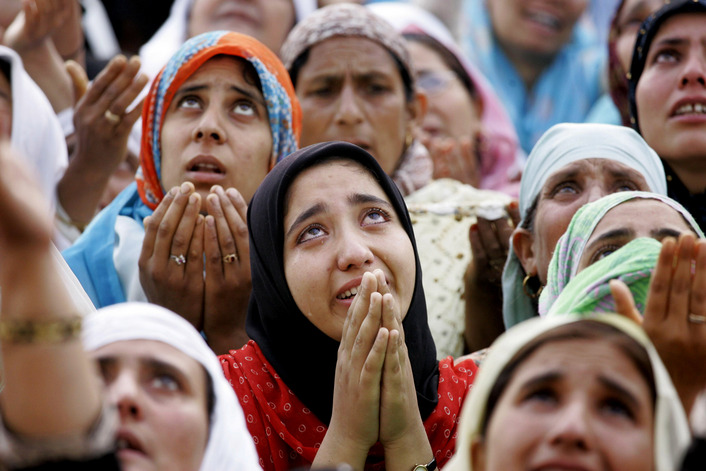
    Navreh festival is celebrated in Kashmir as New Year.This festival usually falls on the first day of Chaitra  Navratri and is generally referred as Shivratri.

    Hijri and Cheti Chand:

    Hijri festival
    Hijri festival

    Hijri is the Islamic New Year celebrated on the first day of Muharram.The Islamic calendar does not depend  on the Gregorian calendar so it may vary depending on the Lunar calender.This  festival is celebrated with unique customs and traditions.

    Cheti Chand festival
    Cheti Chand festival

    Cheti Chand is the festival celebrated on the second day of Chaitra masa by Sindhi community.The people of Sindhi community celebrate this festival as a honor to the birth of Jhulelal.

  • Diwali-A festival of lights

    Diwali-A festival of lights

    Diwali is celebrated by Indians all over the world with great happiness.This is the reason it is most popular and is also most likely festival in the country as well as abroad.Diwali is also known as festival of lights.Diwali is different from other festivals it doesn’t comes with one day celebrations, it brings a series of holidays along with it.On the day of Diwali goddess Lakshmi is worshiped with most devotion and peace of mind.During the Diwali season lights, crackers, sweets are shopped frequently everywhere in India and abroad.This festival generally falls in the month of September-November.The festival is generally celebrated as the victory of good over evil.It can also be said that the victory of  light over darkness and knowledge over ignorance.The festival gets its name from lamps ( known as deepa ) that are arranged in a row ( known as avali ).As Indians on the day of Diwali arrange lamps outside the house in a row, it is known as Deepavali.By doing so they feel that  that it is a symbol for the inner light that protects us from spiritual darkness.

    Diwali a festival of flowers
    Diwali a festival of flowers

    Five day festival:

    First day ( Dhanteras ) :

    According to Hindu month diwali starts with Dhanwantari Trayodashi, it is the thirteenth lunar day of Krishna Paksha.This Trayodashi is popularly known as Dhanteras.According to few beliefs, on this day lord Dhanwantari came out of ocean with ayurvedic to look after the welfare of mankind.On this special occasion people worship god of death Yama by lightening a yama diya.There is a tradition from many years that buying a utensil on this day will bring good luck.

    First day of Diwali celebrations
    First day of Diwali celebrations

    Second day( Choti Diwali ):

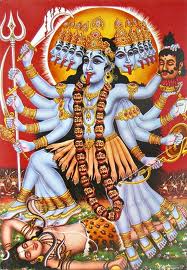
    The second day of Diwali is Narak Chaturdashi.Ancestors say that lord Krishna has killed the demon Narakasura on this day to make people free from fear.On this special people have oil massage to body and they take bath on this day.There is also a belief that people who don’t take bath on this day will go to Narak.

    Narak chaturdi celebration
    Narak chaturdi celebration

    Third day ( Lakshmi Puja ):

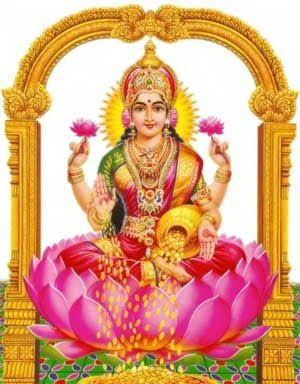
    The third day of Diwali is the main day of Diwali and is known as Badi Diwali.On this day people worship Goddess Lakshmi with divine and peace of mind to bless them with wealth and prosperity.Many of the business people do this puja every year to seek blessings from goddess lakshmi.All the women at home do this puja asking goddess Lakshmi to look after their family.On this day people clean their homes and decorate it with various colorful lights and fire crackers to express their joy.

    Lakshmi puja on third day
    Lakshmi puja on third day

    Fourth day ( Govardhan Puja ):

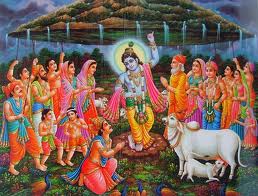
    The fourth day of Diwali is celebrated as Gowardhan puja.The name itself specifies that on this day we must worship gowardhan parvat.Legends say that on this day lord Krishna offered pooja to gowardhan parvat to protect people from heavy rains.Since then it became a tradition for Hindus to worship Govardhan Parvat.

    Govardhan puja on fourth day
    Govardhan puja on fourth day

    Fifth day ( Bhai Duj ):

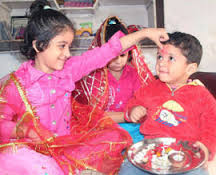
    The fifth day of Diwali is celebrated as Bhai Doj.The name itself says that it is the time to honor brother and sister relationship.Legends say that on this day when brothers visit their sisters they will get rid of all their sins.Thus on this day brothers visit sisters and and sisters sweeten their mouth with sweets.This day ends the festival Diwali.

    Brothers visit sisters on fifth day
    Brothers visit sisters on fifth day

    Lights and fireworks:

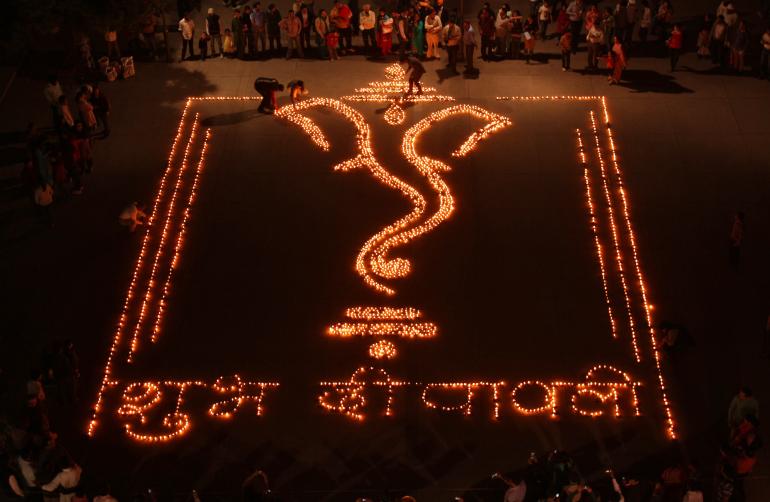
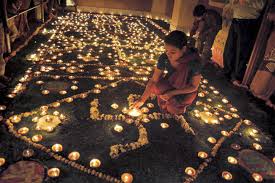
    As the name specifies that it is a festival of lights arranges in a row.On this special occasion houses, shops, public places are decorated with oil lamps in a attractive manner.Few people replace oil lamps with candles.The lamps are lightened using mustard oil and mostly placed in a row in windows, doors and outside buildings.These lamps are lightened to welcome goddess Lakshmi into home’s.The main reason for the celebration of the festival is that the return of Lord Rama and Sita to Rama’s kingdom after fourteen years of exile.On this day oil lamps are often seen floating on the rivers especially Ganges.

    Diwali lights
    Diwali lights

    Fireworks:

     The illumination of fire crackers is mainly for the better maintenance of health, wealth, knowledge, peace and prosperity.People living on earth enjoy firing crackers.There is a reason that during the month of the festival as winter falls, few types of bacteria will rice up due to the atmospheric changes.To kill those bacteria and insects people fire crackers and the fumes produced by the crackers kill a lot of insects and mosquitoes, found in plenty after the rains.Fireworks are a big part of the Diwali celebrations.But since many years there are some movements against it as it is causing air pollution and as it also leads to some dreadful accidents.Diwali is officially considered as holiday in many countries like India, Nepal, Srilanka, Singapore, Myanmar, Mauritius, Guyana, Suriname, Malaysia, Fiji.

    Diwali fireworks
    Diwali fireworks

    This festival is considered as festival of peace.On this occasion Hindu, Jain and Sikh communities also mark charitable causes, kindness, and for peace.As it is festival of peace on the this day the at thee International border, Indian forces approach Pakistani forces and offer traditional Indian sweets.In response to this the Pakistani forces offer Pakistani sweets.

  • Bathukamma – A festival of flowers in Telangana

    Bathukamma – A festival of flowers in Telangana

    Bathukamma is a festival of flowers that is celebrated by Hindu women in Telangana region.This festival is celebrated every year during the month of September and October.According to lunar calender this festival is celebrated during the Bhadrapada Amavasya ( also known as Mahalaya Amavasya ).This is a festival that is celebrated for complete nine days during Navarathri.On the festive day of Durgashtami the main festival Pedda Bathukamma or Saddula Bathukamma is celebrated just before two days of Dussehra.Bathukamma the festival of flowers is followed by Boddemma  Bathukamma which is a seven day festival.Actually the festival Boddemma indicated the ending of varsha ruthu and the festival Bathukamma indicated the starting of sharath ruthu.

    Bathukamma - a festival of flowers
    Bathukamma – a festival of flowers

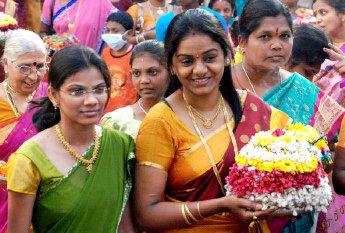
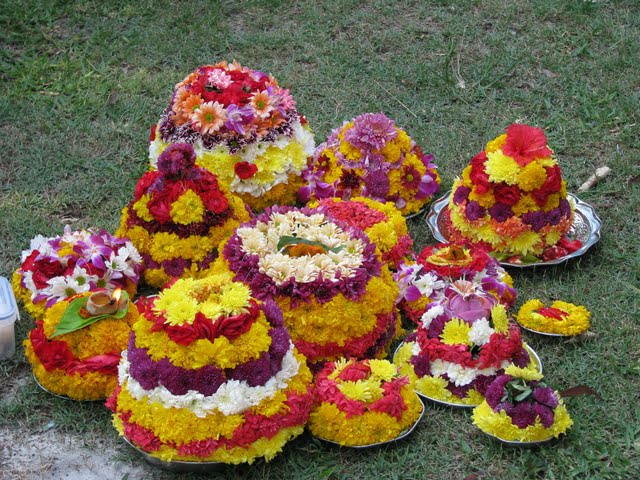
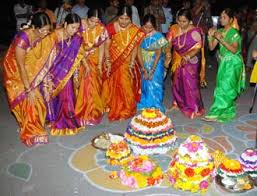
                    The culture of Telengana can be seen clearly in this festival.In this festival the flowers are arranged in a stack manner which are very rare and unique seasonal flowers.These flowers which are rich in medicinal value are arranged in the form of layers like a clay pot.The word Bathukamma itself says that it means the mother goddess to come alive and in this festival goddess Maha gouri who is a life giver is worshiped in the form of Bathukamma.Women wear traditional dress on this special occasion,mostly women like to wear saree and few teenage girls wear half sarees with the matching jewelry and accessories.It intensifies the importance of womanhood.

    Traditional sarees and half sarees on this special occasion
    Traditional sarees and half sarees on this special occasion

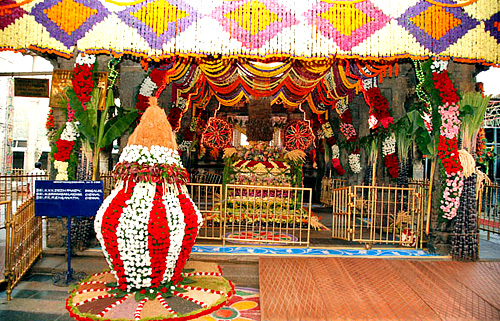
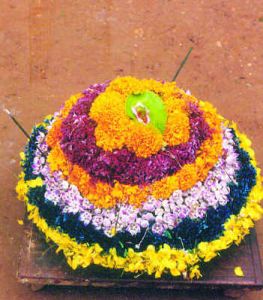
    This is the second largest festival after Vijaya Dashami in the Telangana region.Goddess Gauri who give life giver is worshiped in the form of Bathukamma.In that festival women try to seek blessings of goddess gauri to give them prosperity and do good for their family for the whole year.Very bright and colorful flowers are arranged step by step in the form of a cone and at the top of it turmeric are placed which signify both life and eternity in their colors.The goddess is created every year and is worshiped for the whole 9 days completely with divine and pure heart, later on the tenth day the goddess is immersed duly in local water bodies.This is the largest festival in Telangana and was started long ago about centuries back and is still celebrated as grand cultural event in this region with great enjoyment.

    Bathukama-colorful-flowers-arranged-in-the-form-of-cone
    Bathukama-colorful-flowers-arranged-in-the-form-of-cone

    This festival involves mainly flowers the goddess Gauri devi is arranged in as a beautiful flower stack in seven different layers as a conical mound.As the flowers arrangement resembles goddess they are generally unique and having medicinal value.Men from the houses go around and search for the flowers like Gunuka, Tangedi, Lotus, Alli, Katla, Teku flowers and gather them which bloom during this festive season in most vibrant colors in the uncultivated and barren lands of the Telangana region.By using these gathered flowers women prepare their goddess Bathukamma by using a wooden plank or wide plate and arrange these flowers which are fragrant in the form of layers.After the plank is taken the flowers are taken and they also use pumpkin to decorate the flower top and also keep tumeric on the top of this flower mound.

    On the occasion of Bathukamma the arrangement of flowers and decorating Bathukamma
    On the occasion of Bathukamma the arrangement of flowers and decorating Bathukamma

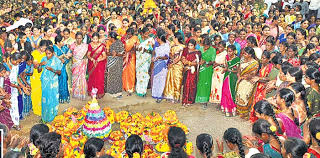
    After the completion of 9 days on the tenth day the visarjanam or immersion of Bathukamma is done in the nearest water bodies.This festival is celebrated with complete devotion and interest throughout the Telangana region.The Women of Telangana region participate in this festival with most enthusiasm and great fervour by dressing up in the complete traditional dresses like wearing traditional silk sarees and wearing matching jewellery for it, whereas the young girls wear langa voni or half saree with complete accessories.The women of Telangana gather in large numbers and place Bathukamma in the middle and dance around them by singing songs related that are of stirring Bathukamma folk songs.Along with the songs women move round the bathukamma by clapping their hands which give a wonderful look for the festival.

    Maleeda
    Maleeda

    Bathukamma festival which is also known as Bodemma looks amazing when the lakes are filled with flowers.On this day, Maleeda is made which is offered to the god as a prasadam made of jaggery and at the end of the day,it is distributed to the people.The festival ground is filled with women as male companions aren’t allowed here and young girls participate in large numbers.

    There are many myths regarding this festival.One of the myths  according to legends is that Bathukamma or Parvati is a lover of flowers.Flowers are arranged om a square wooden plank with that size of frames forming on top of it which resembles the shape of a temple known as Gopura.On the top of the flowers,a lump of turmeric is kept and this little floral mountain is worshipped as Goddess Bathukamma.

    Bathukamma festival
    Bathukamma festival

    This festival is celebrated with utmost joy and gaiety.There are many dance performances,traditional music,dramas for many tourists who visit to watch this splendid festival.This festival is attracting thousands of tourists and many  are coming here just to watch this festival.During this month long celebrations, Jataras ( fairs or melas ) are also held.If you are a traditional lover,then this festival sure will attract yor attention towards it and it fills your mind and heart with joy.

  • The holy month of Ramadan – all you need to know!

    The holy month of Ramadan – all you need to know!

    With the advent of the pious month of Ramazan or Ramadan, hustle and bustle can be seen throughout all the Muslim households. The preparations begin a lot in advance. Excitement can be seen everywhere. From shopping for clothes and accessories to stocking up the eateries in order to avoid the last minute confusions, people do it all. This is the ninth month of the Islamic lunar calendar. This is said to be the most sacred month. The word Ramadan is of Arabic origin. Its literal translation is ‘intense scorching heat or dryness’. It is a rigorous month of intense fasting wherein all the members of the family fast every day for the entire period. The fasting is mandatory for Muslims who reach puberty unless they are physically unable to do so. Certain exceptions are made in the case of children, ill people, pregnant women, diabetes patients, menstruating women etc. The fasting or the rozas commence from dawn and end at dusk. They do not consume any food or drink neither do they smoke. Swearing is something that is also avoided. As I have heard from some friends, they do not even gulp in their saliva. This might be a shocker, but it’s true.

    Fasting is undoubtedly good for health. It has its perks. It gives the digestive system a rest along with allowing the cleansing and de-toxification of the body. It relaxes the body and revitalizes it. A tranquil spiritual feeling descends. In popular belief in Islamic culture, fasting washes away the sins and bestows upon the people many rewards. The fasting diverts the attention from materialistic activities and gives time for spiritual reflection, cleanses the soul and purifies the heart. The person becomes more considerate, empathetic and self-disciplined. He begins to see the less fortunate in new light and within him generosity creeps in.

    Namaz

    The beginning of Ramadan is marked by a new moon. Fasting begins from the very next day when the moon is seen. The month lasts for approximately 30 days. It depends on when the crescent moon has been sighted.
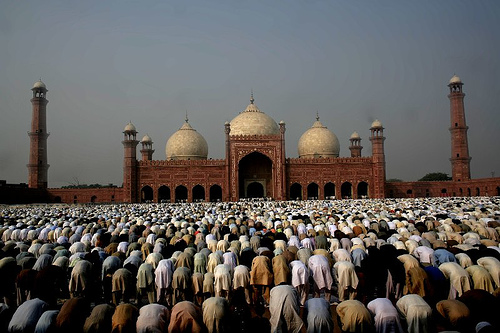
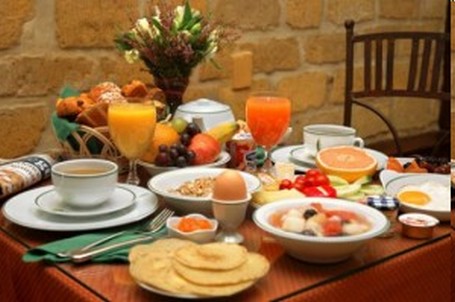
    The people who fast wake up early before the sun rises and consume the meal called ‘suhoor’ or the ‘seheri’ which keeps them going through the day. Thus the suhoor is a heavy meal which gives enough strength for the entire day to the people who are fasting. It is very necessary to consume ample amount of water or sharbat during suhoor in order to remain hydrated throughout the day. As soon as the sun rises, suhoor ends and the first prayer or the namaaz is offered. This first prayer is called the fajr or the morning prayer.

    sehri

    The entire day goes by without consuming anything. People put themselves through rigorous fasting. They offer five prayers or namaaz during the day. The devotion and dedication of these people is a thing to admire.
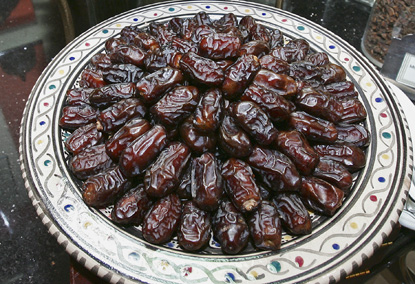
    At sunset the last prayer is offered which is called the maghrib. The meal which breaks the fast at sunset is called ‘iftaar’. Most people eat dates for breaking the day long fast and later go on to have a proper feast.

    dates

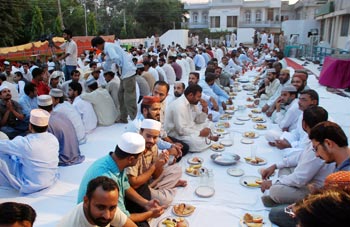
    At iftar, social gatherings are very common in which the meal is spread out in a buffet style. Friends and families gather for this small celebration together during the evening.

    iftar-dinner-080918_04

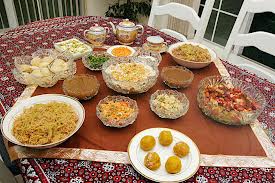
    Traditional dishes and desserts are served which are specific to the month of Ramadan. Families also share the dishes they prepare for iftaar with their neighbours. Nothing quenches the day long thirst like a glass of water does! Juices and milk are also a popular choice, though caffeinated beverages are not usually consumed. Sewain is the most sought after dessert.
    Iftar

    Common food items that are consumed during the two meals are fresh fruits and vegetables, dry fruits, kebabs, sharbat, salads, lamb stew, haleem, jalebi etc.
    Some people also indulge in the practice of giving away food to the poor and homeless during iftaar. This can be done on an individual basis wherein the meal is offered to a few people. This can also be seen in large public areas where the less fortunate gather and break their fast with the food these people offer to them. This charity is one of the most important parts of Ramadan. It is believed that helping a fasting person break their fast garners great rewards.
    Along with fasting and charity, reciting the Quran, the holy book, on a regular basis is also an integral part of the month of Ramadan. This recitation is voluntary rather than mandatory. Though it is pretty common to finish the entire Quran during the course of the 30 days.
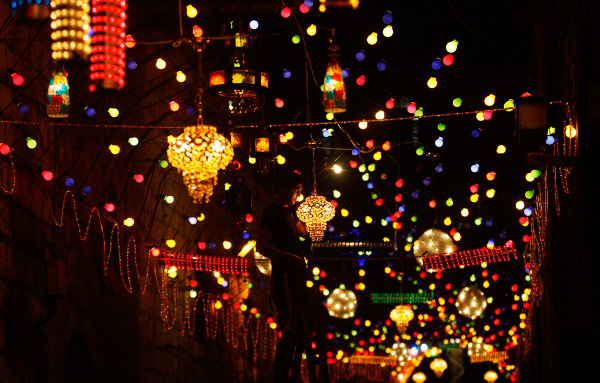
    Ramadan gets over on the next day after the sighting of the new moon. The day when it gets over is celebrated as Eid-ul-fitr. This festival is celebrated with huge pomp and show. The people flock the bazaars and shopping malls for new clothes and accessories. Henna or the mehendi, colourful bangles and beautiful suits are adorned by the women. This is a day of no fasting. People decorate their houses with pretty lights and set up a lavish feast. The gifts are given in the form of Eidi to children and relatives. ‘Eid Mubarak’ is the greeting that is said all around. Neighbours and family members visit each other to share sweets and dishes. Sewaiyaan is the most loved sweet dish which is prepared with vermicelli in milk along with dried fruits.
    Ramadan-prep
    Ramadan is a month where people believe that all their sins get forgiven. And they do a lot to achieve that, fasting straight for 30 days is no easy task. It is admirable to see them put themselves through so many restrictions in order to stand by their culture.
    Wishing all the people who are celebrating this holy month, Ramadan Mubaarak!!

  • The Best Carnival on Earth!

    The Best Carnival on Earth!

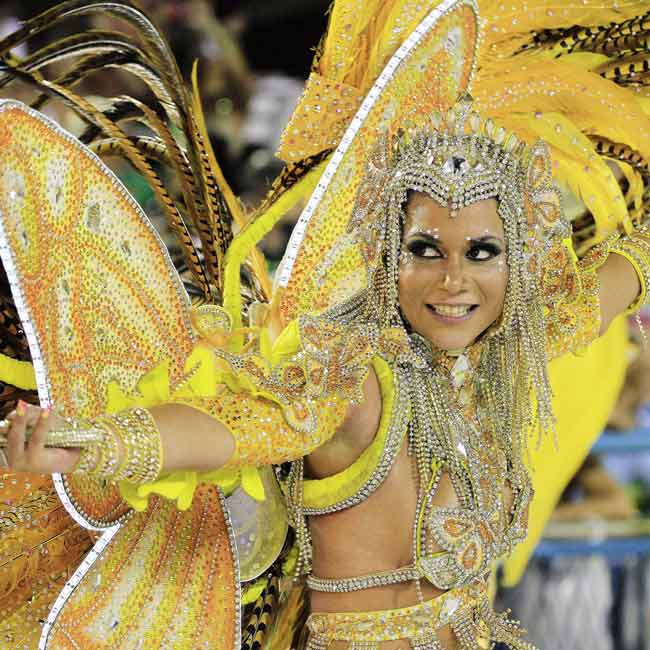
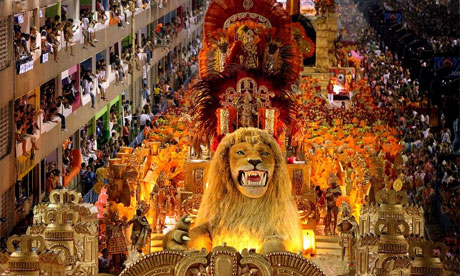
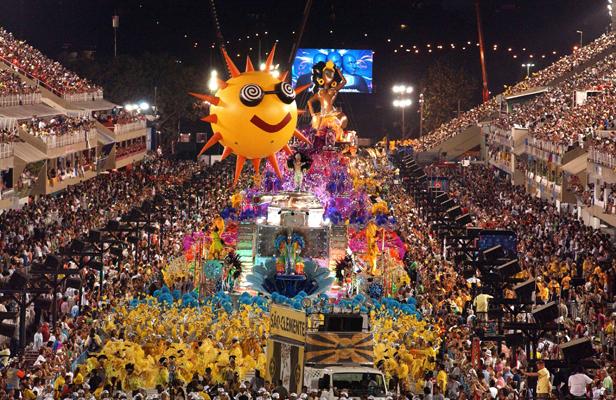
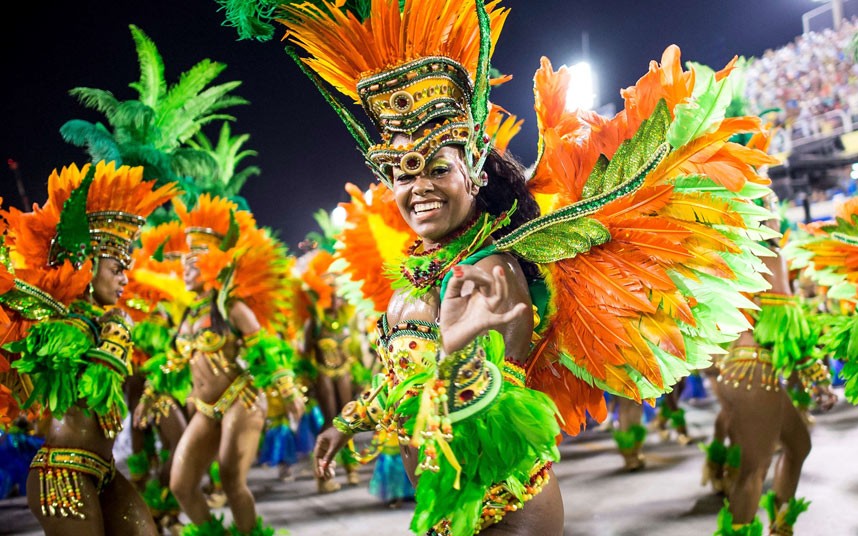
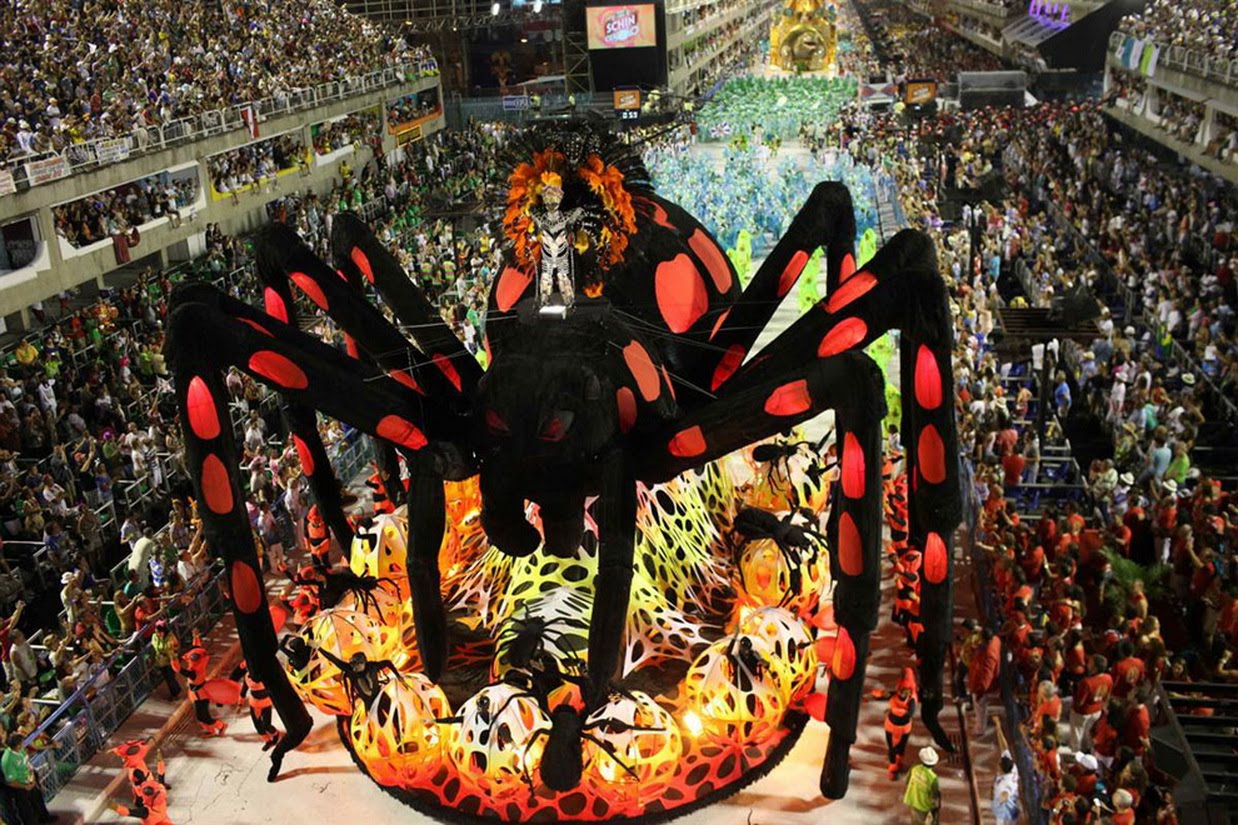
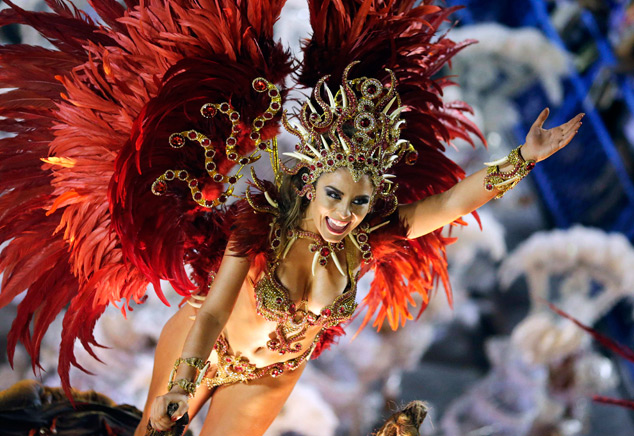
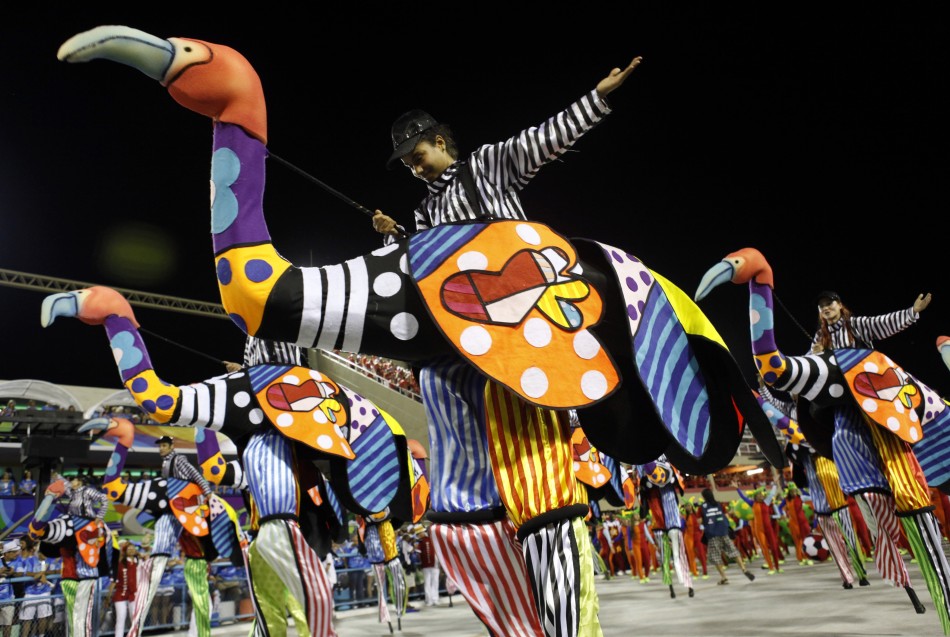
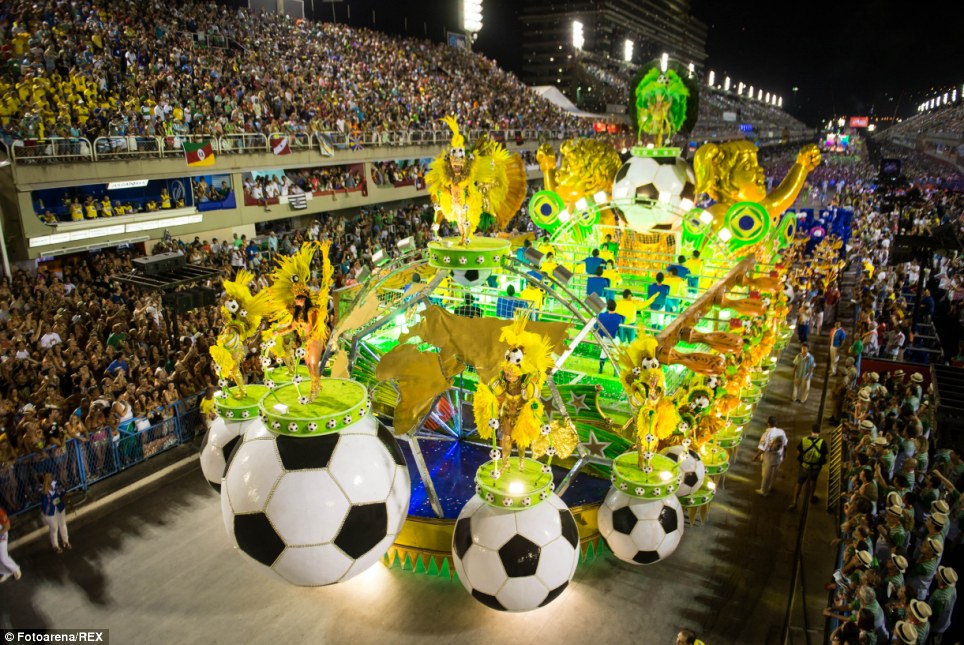
    SAMBA It’s one of the hottest, sexiest and the most amazing carnival on the face of this earth! And not just this, but the Carnival is something that gives one chance to witness the true culture of Brazil. It is a euphoric extravaganza, where people from all walks of life come together and have tons of fun. A lot of people consider the Carnival in Brazil as one the biggest festive celebrations. It has got wild parties, colours, vibrance, costumes and everything you can relate to the idea of ‘festivity’! It’s celebrated in Brazil every year before Easter. The word Carnival holds its roots in the word ‘carnelevare’ which literally means ‘removal of meat’. Traditionally, the festival is believed to be celebrated before those particular days when the Roman Catholics abstained from consuming alcohol or meat. This was done to drive away bad things from their life. The carnival originated in the Era dominated by the Europeans. The carnival was the day when people indulged in alcohol, sex, dancing and all the fun just before the beginning of Lent. That was the time when people exchanged clothes (and sometimes even slaves)! PARADE Carnivals are a thing across the globe. But the Brazilian Carnival tops the list when it comes to the popularity of carnivals. It’s a weeklong festival where people revel in dances and enjoy a lot! Almost all the Brazilian cities host a carnival before Lent, but the one we know of (and of course, the pictures that we usually get to see) are of the Carnival at the capital city of Brazil, Rio! Samba has been the traditional dance of Brazil and people wear beautiful costumes and masks and do the samba to the beats of drums. Now the pictures that you see of the festival are of the famous parade that happens during which gorgeous (and very sexy) samba dancers standing on a vehicle move across the stadium as more and more people join in the parade. rio-carnival--danc_2841261k Generally, shops are shut during the time of the Carnival and people come out to rejuvenate themselves. Many Samba schools who are also involved in various community services form the organising team of the Carnival. You don’t know how to dance? It is totally okay. A lot of people with two left feet come to enjoy this carnival and try their hand (ummm actually feet) at dancing!   Here are some really interesting facts about the amazing Rio Carnival:

    1. It’s held 40 day before Ester and is super-wild four day extravaganza.
    2. It ends on a day called ‘Fat Tuesday’, which comes before ‘Ash Wednesday’, that is the start of Lent.SPIDER
    3. The festival is celebrated in the month of February which is the hottest month of the year. We see the city’s temperature rising during this time, literally and metaphorically too!
    4. The Greeks and Romans celebrated the arrival of spring with a grand party. The festival’s history can be traced back to the age old tradition of the Greeks and Romans.
    5. The traditions were carried to the New World in the 1700s by the Portuguese.br
    6. A festival called “Entrudo” is when people throw water, lime and food at each other.
    7. The Carnival as we know it today has evolved with time. Huge street parades with people revelling and dancing are the best part of the Carnival.
    8. A lot of bands and orchestras entertain the people with Samba music.
    9. The Samba Parade is the most awaited and the most interesting part of the Carnival. It is actually a competition between the odd 200 Samba schools of Rio..br 1
    10. Sambodromo is the stadium where the Carnival is celebrated. The audience witness an enthralling competition between Rio’s Samba schools and they are judged based on their elaborate costumes, dances and music.
    11. £3 million and more are spent on the outfits and preparations of the Carnival.
    12. The dance schools are formed from a majority of people from the city’s slums.br3
    13. Around two million people attend the festival each year.
    14. The mayor of Rio inaugurates the festival each year where he hands over a huge gold and silver key to the Fat King, Rei Momo.
    15. The festivities begin much before the actual Carnival starts. Actually, Rio is a result of months of preparation and hard work.
    16. Small local parades that are called ‘blocos’ happen across the city and attract thousands of people.
    17. A ‘Pee Patrol’ is appointed to catch hold of the people who urinate on the streets. The funny thing is that this happens even after 17,000 portable toilets are installed around the city.
    18. 25,000 jobs are created because of the carnival and around £420 million of revenue is generated by the hotels and bars.
    19. Celebrations of the Carnival are held in Sao Paulo, Olinda, Manaus and Porto.footy
    20. Each year, this greatest and the most magnificent Carnival on Earth attracts celebrities like Jennifer Lopez and PSY.

    .

  • ONAM

    ONAM


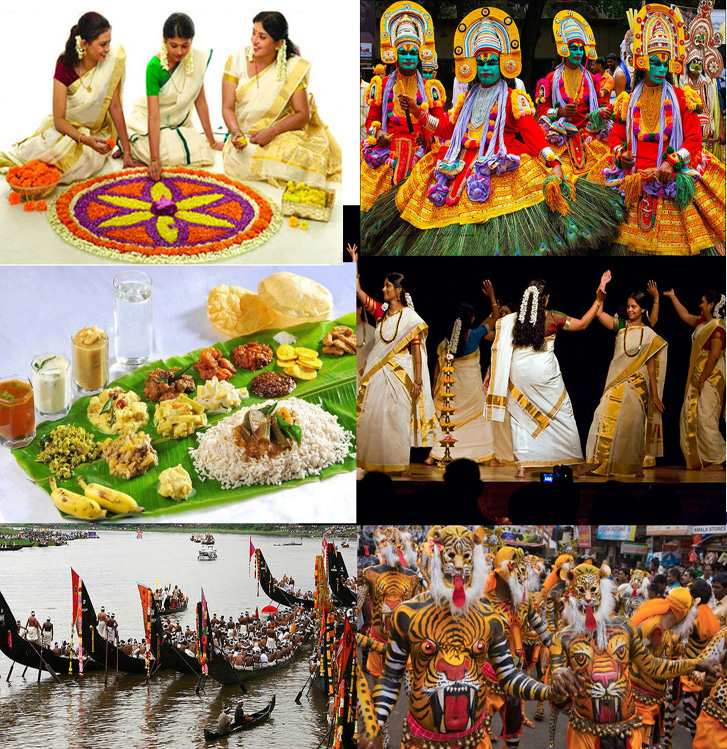
    onam 3

    Onam is one of the many festivals celebrated on a large scale in Kerala. This is basically a Hindu festival celebrated with a lot of enthusiasm for a period of 10 days. According to the calendar the festival falls between the months of August and September which also is the period of harvest in the state and therefore the festival is regarded as a harvest festival Of Kerala.

    Onam marks the welcoming of a famous king Mahabali who had ruled the state of Kerala in the old days. The story goes in this way that Mahabali was a wise and loving king who loved and cared his subjects. Anyone coming to him for help or arms was not sent back empty handed. The state was believed to be in its golden stage as there was no problem of poverty or drought and everybody had a good standard of living with not much difference between the rich and the poor. The fame and news of the generosity of the king spread not only in the state but also in nearby areas and slowly spread to the farthest lands as well. It is believed that the fame of the king spread to such an extent that it even made the gods feel challenged, who now began fearing his growing powers. They presumed that he might become over powerful and rule over both the heavens and the underworld, so Aditi, who was considered the mother of the gods pleaded with Lord Vishnu to curtail or control the powers of Mahabali. As a result Vishnu transformed himself into a dwarf and immediately went to test the king. He approached the king as a beggar and asked the king for arms. Seeing the plight of the dwarf the king granted him more than what he had asked with utmost happiness. It is believed that one of the king’s Wise men had advised the king not to favour the beggar so much as he did seem like a ordinary human, however the king denied all the wisdom the firmly declared that there was no greater sin than not fulfilling ones promise and so he kept his word and helped the beggar. Seeing the generosity of the king, Vishnu in the disguise of the beggar wished for the fulfillment of one more wish to which the king agreed. Three pieces of land that was covered under his feet was the demand made by the beggar. When the king agreed to the demand, Vishnu increased in size and with his first foot covered the heavens. With his second foot covered the underworld and when the king realized that the third foot would cover and destroy the earth, Mahabali offered his head and so was pushed down under the ground, however seeing the love which the subjects had for the king, Lord Vishnu gave the king a blessing that he could visit his people once every year and it is this day that marks the homecoming of the king and so the people of Kerala do not keep one stone unturned to ensure that a proper tribute is given to the king who sacrificed his life for his subjects.

    onam

    Onam is celebrated for a period of 10 days and throughout the festive days people wear new clothes, prepare new dishes and decorate their houses and also take special consideration on decorating the entrances of their houses with flowers to welcome the king. Special prayers are conducted in the temples during the wee hours of the day and according to tradition the younger members of the family receive gifts and blessings from their elders. Other than the prayers and worship, the festival also showcases events such as boat races, carnivals having decorated elephants, fireworks, music and the famous kathakalli dance which are traditionally associated with the festival. The government also ensures to make the best use of this festival by generating various events and advertisements to promote tourism and also showcasing the states beauty and culture.

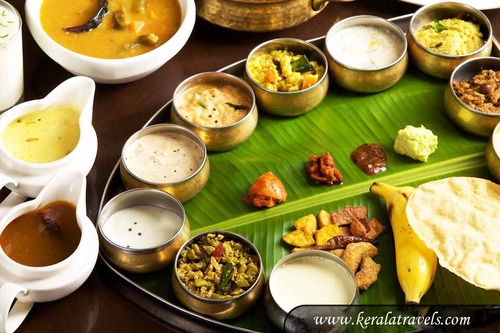
    onam 1

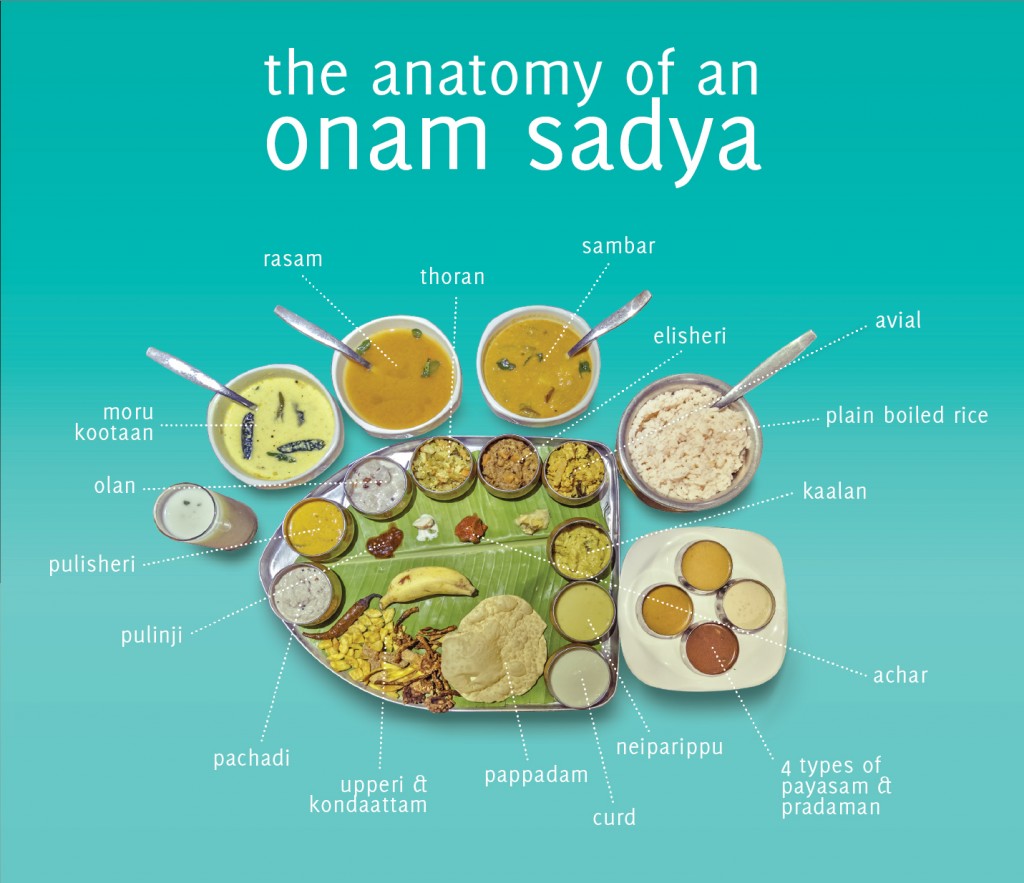
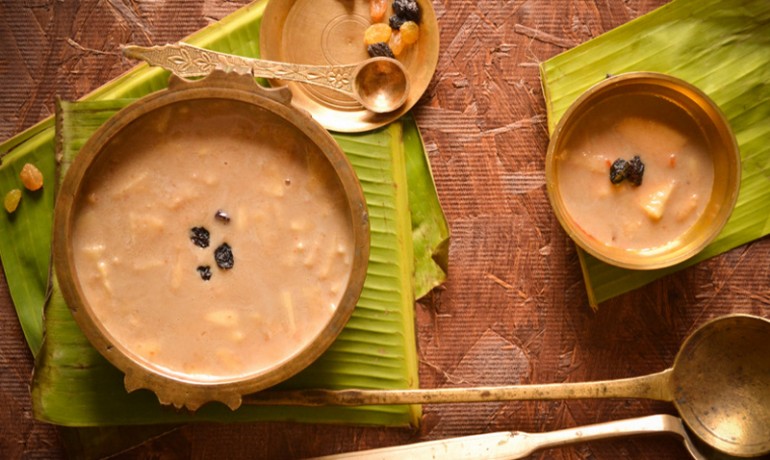
    The festival’s grandness is increased with the heavenly feast prepared during the celebration. The platter or the course of the serving is done in a particular way. The serving of food is done on banana leafs, the placement of which is also given major importance. There is a special order with which various dishes are served with the beginning done by serving of rice followed by curries which are mainly of three different types. We also have many fried items, most common one found is called ‘upperies’ which are basically banana chips fried in oil to bring in the extra salt and crispiness of the food. ‘Papadams’ or ‘Papad’ as we call them in the North India is also a part of the menu. Among the sweeteners we mostly have two dishes called ‘payasams’ and ‘prathamans’ and in many cases fruits are also served. The taste of every dish prepared increases as it is ensured that the whole family eats together, in many cases with we have 2-3 generations dining together with mostly the men of the family having first along with the children followed by the women of the household.

    onam 2

    The revenue raised during these ten days of fun and folly is huge, mostly arising from the sale of liquor and food items and a small contribution also given by decorative items and stuffs. Its I believe the only festival in the state which seeks so much of popularity and enthusiasm not only among the women and children but also among men who sport themselves with white lungis with golden borders specially made for this occasion. Similar dress code is also seen for women who adorn white sarees with golden borders.

    Onam is therefore a festival not only of joy and celebration but also carries in itself something for all age groups. Being in the northern part of India, many would have just seen the festival being celebrated in travel channels or read about them in magazines, however according to me an attempt should be made to enjoy the festival live because I believe it will be a time of your life which you would never wish to forget.

    \

  • Barbecue the Indian hangout

    Barbecue the Indian hangout

    The west has now twin meaning of Barbecue, it’s to barbecue and to be at one. The sheer tradition that this tiny (not literally!) thing packs in itself is awesome. From sports to backyard parties, Barbecue is a way of life there. The Wild West is set in its way and doesn’t seem to want to change, and rightly so. The untamed east has its versions of the game with the famous tandoor taking the spotlight. However why just confine ourselves to this and stay away from delicious wildness of the barbecue?

    The idea seems good enough but is it really so easy? Where would one by a barbecue and top of that how would we convince anyone in our family for this, it seems a strange thing to be asked on our birthdays! But no worries my friend for there is a simpler option where you can just rush into a custom made barbecue just for the armatures like us. This may go to mild for the pros and the nitpicking foodies out there but for the enthusiasts and admirer of the craft this is the place to be. Its Barbecue nation.

    th


    The story of this restaurant began in Mumbai and later on spread out to 36 joints in all. It is one of the must try places of Asia, ranks in top 100 in the list. This place is among the 20 must try restaurants of the country. What is it about the lace that in mere 8 years it has loyal fan following who swear by the food and service and are all rearing to barbecue? The idea of over 600 per plate (with taxes) is sure to put off majority of people yet everyone from students to families to corporates swears by it.


    To start with the place has unlimited option on the available food. The cooking is a fair mix of American, Mediterranean, Oriental and Indian style of cooking. This typically includes chicken, fish, prawns, crabs preparation for the meat lovers, cottage cheese, pineapple preparations, potatoes etc. prepared uniquely for the veggie lovers. One gets to keep ordering the starters till they wish to eat. The next step is buffet main course with equally diverse and delicious options. The last step is dessert with 5-6 desserts of unlimited count for you. First drink is one the house, this may be iced teas/ slushes or beer, choice is yours!

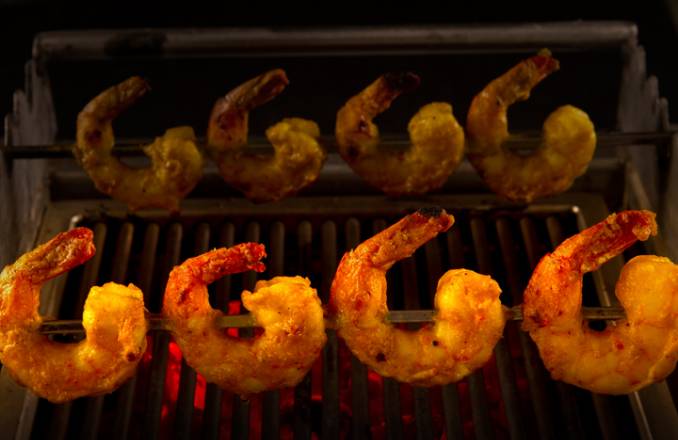
    One of the most obvious attractions here is the live barbecue available for the customers on each table that gives you the opportunity to do the task yourself. The dishes are cooked and given to you with add on flavor to barbecue it with. This adds to the fun and experience of the place and makes it all the more unique.

    mouth-watering-kabobs

    Festivals:

    If food and drinks weren’t enough to keep the crowd busy, Barbecue nation has all the more options to keep the customers loyal.

    Grand Trunk road: the dishes complement the iconic path, offering food from the milestone places and it is no doubt a unique palette to experience.

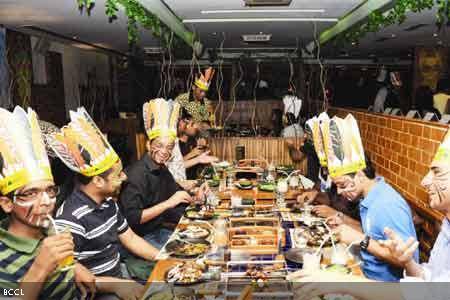
    Hakuna Matata: Here the African safari is celebrated with peri-peri chicken and coconut flan and lot more. With complementary hats being given to all. The African safari is a sure shot success.

    13267095

    Merry Madness: this is live troupe singing and dancing to classiest and funkiest music that will make you tap along for no good reason. Life at barbecue is never boring.

    Personal input:

    After a long day of shopping in heat of Mumbai in May (girls, you know!) we reached the worli Branch (Mumbai) for lunch with happy plans to leave in an hour and get back to the umm work! It was Hakuna Matata festival which meant some waiting. There was African jungle cardboard with pop-in-head for pictures which nicely occupied our time. After the entry and free drinks we were ready to dig in. And we did. I won’t go into all the mouthwatering details but 3 hours later we happily dropped the shopping plans and headed home to catch on some zzz.’s. The place convinced us against shopping and that is something else!

    Barbeque-Nation-food-galery

    The service is impeccable. The server enquired about the dishes and taste. When a friend commented on the need for more spicy food, the cook was literally called out. The second round of the starters was made spicy for us and it was hot! The servers gave personal attention to the needs, the kind of food preferred and advice on what to try and even how! There were no raised eye brows on the fourth helping of the gateau or the ceaseless picture taking sessions.

    Overall this place gives you space, is worth your penny and promises to give you a wonderful memory. The ambience and service separates it from other restaurants thus making it a place for friends or family to chill together with a live barbecue.

    Have at it atleast once! The best part is as the bills are fixed on per plate cost, there will be no nasty surprises in the end to spoil your taste.

    Cheers!